
Machu Picchu Circuits Guide 2026 and Which Ticket Is Best for You
Traveling to Machu Picchu in 2026 is no longer about entering the attraction and walking around as you wish. All aspects are now determined by machu picchu circuits, routes, and entrance timings. Picking the wrong one might cause you to miss some parts, even though you are within the site.
It is because of this that travelers are searching for answers to questions such as what is the best Machu Picchu trail or what is the best Machu Picchu trail for beginners. This guide is written to provide a clear and natural narrative of what you will see and experience on each trail through the Machu Picchu circuits 2026.
Overview of the New Machu Picchu Circuits Explained and Maps
The new Machu Picchu circuits system was created to protect the archaeological site and control visitor flow. There are no longer open trails for tourists to walk through the citadel, but instead, the site is sectioned into trails that are one-way and overseen.
However, when travelers study a Machu Picchu circuit map or a Machu Picchu circuits map, they are not just looking for routes to follow but for paths that need to be taken. Barriers and officials ensure that every tourist adheres to their particular circuit to the letter.
It is crucial to understand how circuits in Machu Picchu work. This means that once you gain entrance, you cannot change your routes, backtrack, or go to a place allocated to a different circuit. This means that purchasing your ticket is much more crucial now compared to previous years.
What Are the Different Circuits of Machu Picchu Available Now
For those wondering what are the different circuits of Machu Picchu, there are currently three main options.
There are different Machu Picchu circuits have been crafted based on different experiences of Machu Picchu. Circuit 1 Machine Picchu takes you on a tour of the top terraces. Circuit 2 is a traditional route that leads you deep into the Incan Citadel. Circuit 3 portrays the bottom ritual areas and leads you on a climb uphill.
When citizens inquire about what the Machu Picchu circuits are, the first thing to note is that they all portray a different Machu Picchu experience.
Understanding the Difference Between Panoramic, Classic and Royalty Circuits
Differences between Machu Picchu circuits can be explained using a perspective approach.
Panoramic routes are views of Machu Picchu landscape, keeping you above the Inca ruin. Classic routes define Machu Picchu as a city, leading you through its streets. Royalty routes are set in the quieter Inca ceremony spots and adventurous trails.
When Machu Picchu circuits are ranked, the classic treks are always rated the highest for beginners, making the Machu Picchu classic circuit one of the most popular routes.
Official Machu Picchu Circuits and Routes (Ministry of Culture of Peru)
| Circuit | Circuit Name | Available Routes | Seasonal Availability |
|---|---|---|---|
| Circuit 1 | Panoramic Circuit | 1-A Machu Picchu Mountain Route 1-B Upper Terrace Route 1-C Intipunku (Sun Gate) Route 1-D Inca Bridge Route |
1-A & 1-B: Open in high and low season 1-C & 1-D: Open only during high season |
| Circuit 2 | Classic Circuit | 2-A Designed Classic Route 2-B Lower Terrace Route |
All routes open in high and low season |
| Circuit 3 | Machu Picchu Royalty | 3-A Huayna Picchu Mountain Route 3-B Designed Royalty Route 3-C Great Cavern (Temple of the Moon) Route 3-D Huchuy Picchu Route |
3-A & 3-B: Open in high and low season 3-C & 3-D: Open only during high season |
Machu Picchu Tickets: High Season and Low Season
High Season
| Period | Dates |
|---|---|
| Easter Week | April 17 – April 20, 2026 |
| End-of-Year Holidays | December 30, 2026 – January 2, 2027 |
| Main High Season | June 19 – November 2, 2026 |
Low Season
| Period | Dates |
|---|---|
| Early Year | January 1 – April 16, 2026 |
| Pre-High Season | April 21 – June 18, 2026 |
| Post-High Season | November 3 – December 29, 2026 |
Circuit 1 Panoramic View and When to Choose the Mountain Hikes
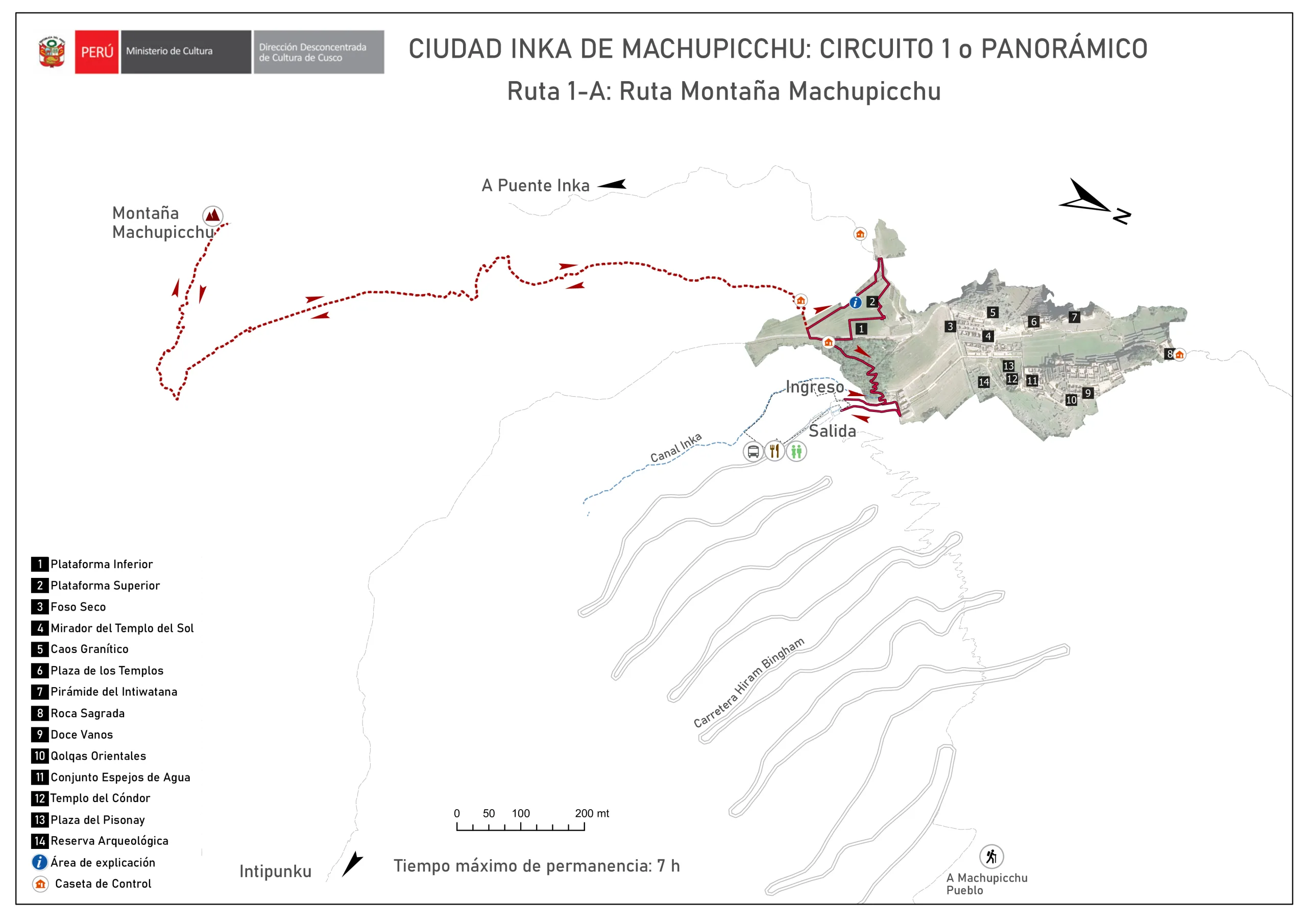
For those planning to do circuit 1A Machu Picchu, the highlight of their experience is climbing to Machu Picchu Mountain. The track diverges early for most walkers and proceeds up in an steady manner, having the city in view for most of the way.
The Machu Picchu circuit 1 map illustrates that this trek looks more towards the landscape aspects rather than the ruins. The worth of circuit 1 Machu Picchu trek is greatly dependent on one’s interest in trekking and scenic views.
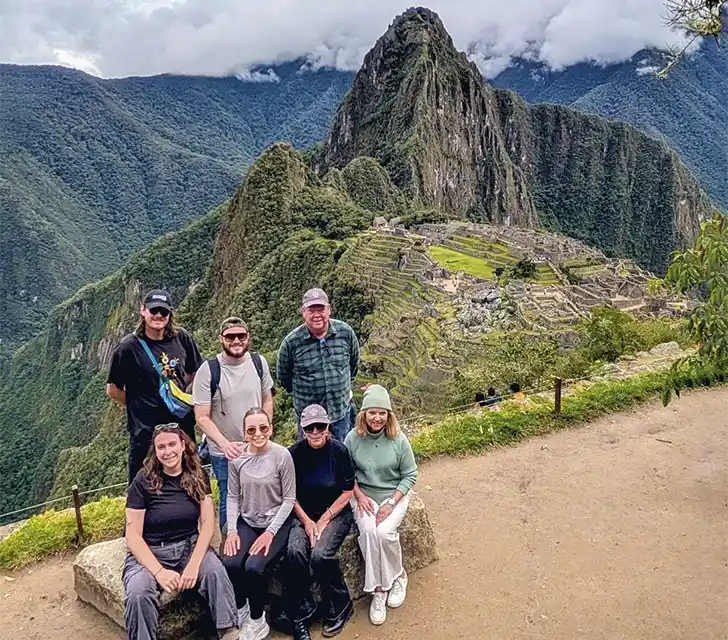
Circuit 1A – Machu Picchu Mountain Route
Route 1A Machu Picchu Mountain is the steepest of the Panoramic Route. Just short of the entrance of Machu Picchu, the path branches off from the main trail and climbs up towards the summit of the mountain.
This is mostly above the citadel with a concentration on natural scenery rather than archaeological sites. Here, tourists get to enjoy the highest panorama of Machu Picchu along with the Valley. This is mainly ideal for tourists with a sound physical condition in case they want to enjoy a hike along with a lot of scenic views rather than archaeological sites.
- Entry times: Early morning time slots, generally between 7:00 a.m. to 10:00 a.m
- Walking time: Estimated to be 3-4 hours if climbing.
- Seasonal access: Open year round but depending on weather conditions during both peak and low seasons.
Circuit 1B – Upper Terrace Route for the Best Photos Without Hiking
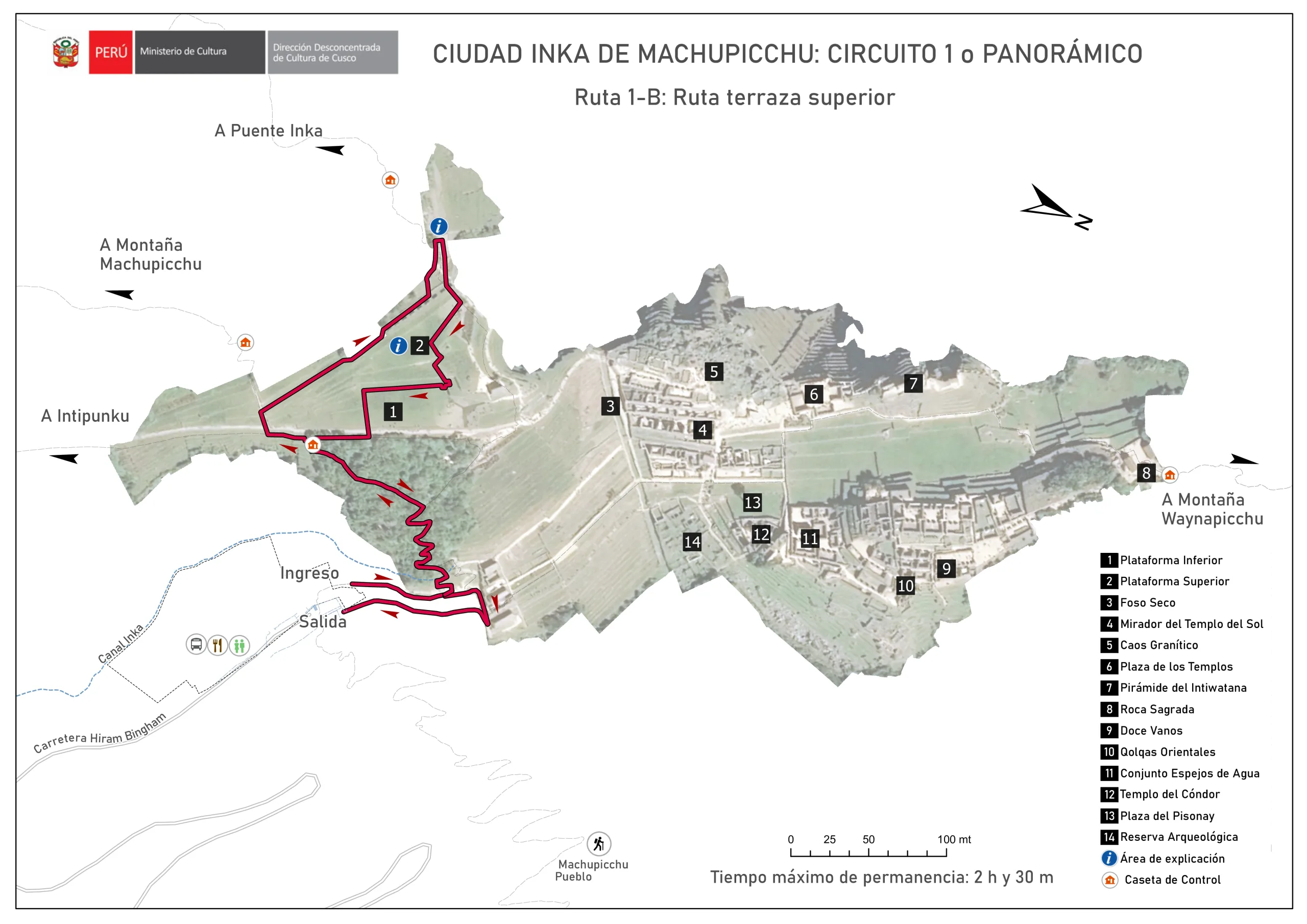
Route 1B Upper Terrace is probably the most straightforward option within the Panoramic Circuit. This short and easy path along the upper terraces grants wide, unobstructed views down upon Machu Picchu: a very nice overview.
This route focuses almost entirely on scenery and photography. Visitors stay outside the main urban sector, and it is ideal for those wanting the classic panoramic perspective without extra hiking or physical effort.
- Entry times: Standard Machu Picchu entry times, from 6:00 a.m. to early afternoon.
- Walking time: About 1.5-2 hours.
- Seasonal access: Open during high and low season.
Visiting the Sun Gate via Circuit 1C – Intipunku Gateway Route
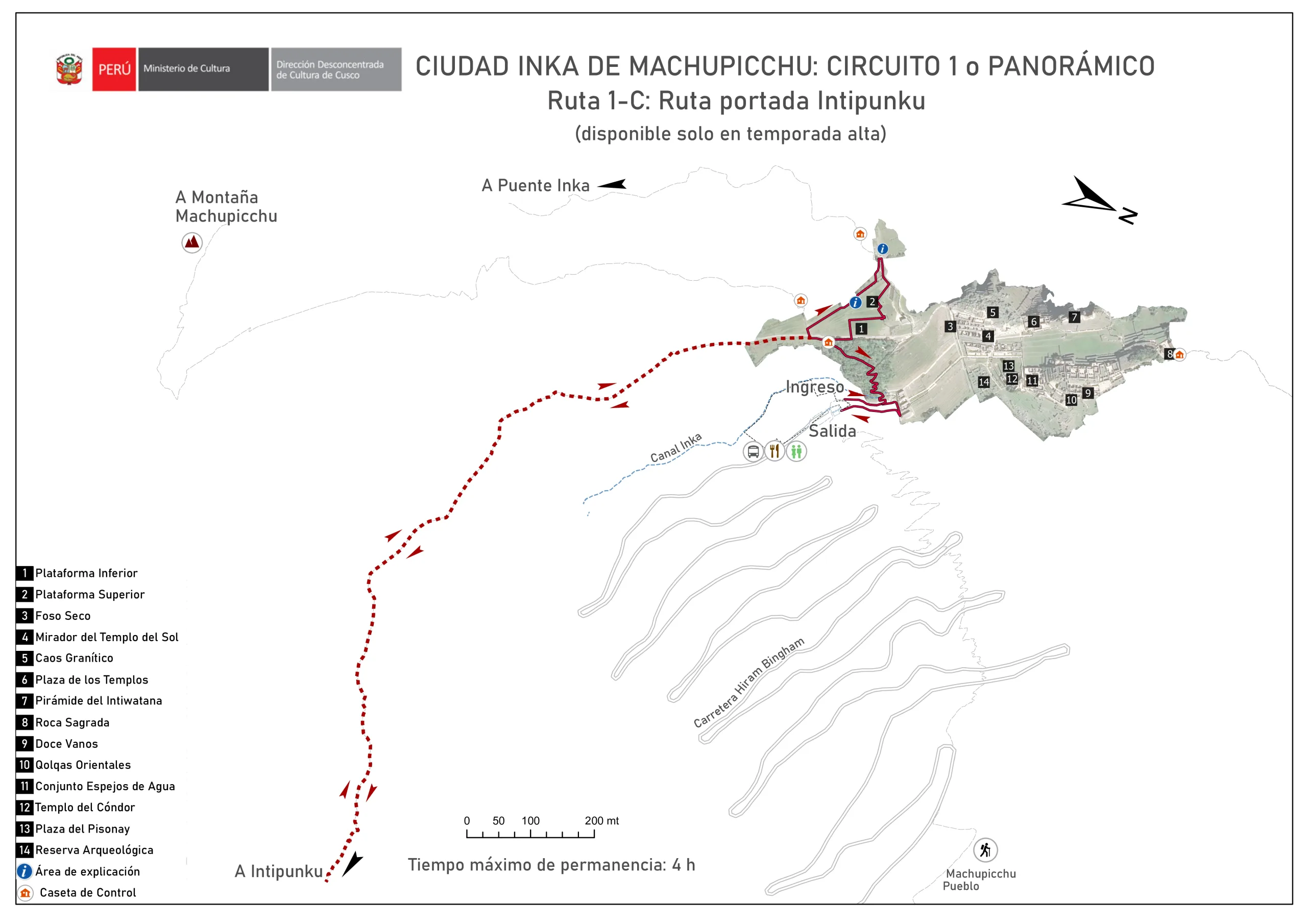
Route 1C Intipunku, commonly known as the route to the Sun Gate, passes by the Inca Trail entrance route. The walk is of moderate level and slopes away from the great citadel to Intipunku.
When viewed from the Sun Gate, Machu Picchu is seen in the distance, making such a great first impression. It is the best way to go if you want the historical background and not the specific details.
- Entry times: Morning entry slots, usually between 7:00 a.m. and 11:00 a.m.
- Walking time: Around 2.5-3 hours.
- Seasonal access: Only during high season.
Circuit 1D – Inca Bridge Route
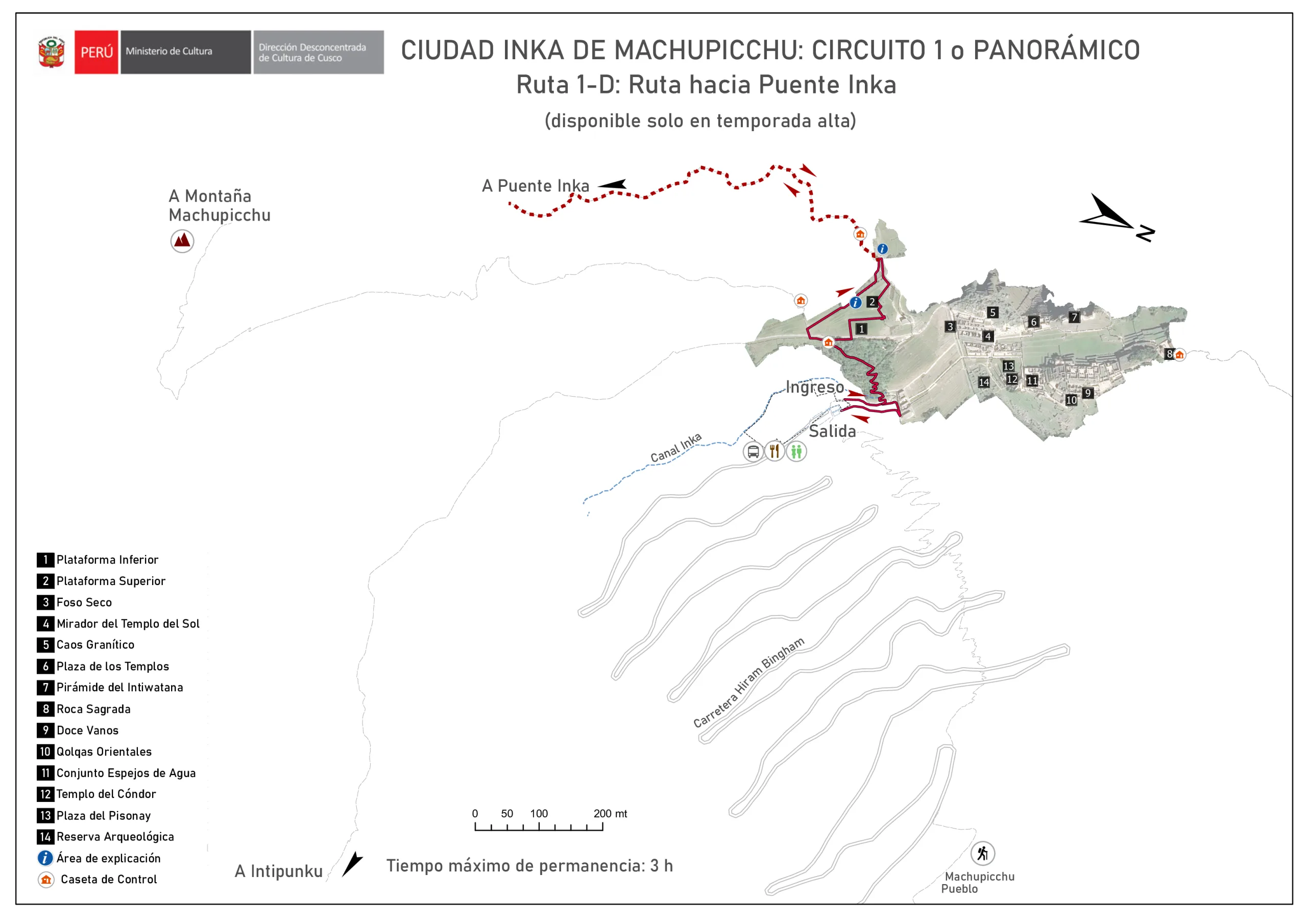
Route 1D Inca Bridge is a short hike gives an overview of the defensive layout of Machu Picchu. The path runs along a mountainside before reaching the Inca Bridge, where traffic to Machu Picchu was controlled.
It is relatively flat and simple, and one can enjoy the valley views along the way. It is also suitable for tourists wishing to have an added route that is of historical merit but do not want to engage in lengthy and arduous journeys.
- Entry times: Morning entry slots are generally from 8:00 a.m. to 12:00 p.m.
- Walking time: About 1-1.5 hours.
- Seasonal access: High season only.
Circuit 2 Classic Route Explained and Why It Is the Best Machu Picchu Circuit
Machu Picchu Circuit 2 is considered one of the top Machu Picchu circuits because it provides a balanced experience. When tourists are faced with alternatives such as circuit 2 Machu Picchu, among others, this circuit provides the best insight into the location.
The trail starts in the vicinity of agricultural terraces, where there is a complete view for the first time as one proceeds to the citadel. Taking a famous photograph marks a significant point for many tourists, but it is also a point that defines how the agricultural terraces, the temple, and mountains are integrated.
Having passed through all that, you naturally continue with the route to enter the urban center. The experience transitions from observing to engaging with the environment as you walk through plazas and by significant ritual and dwelling structures. It is only through this kind of transition that you can say you have experienced a Machu Picchu circuit 2.
Detailed Breakdown of Circuit 2A Designed Route vs Circuit 2B Lower Terrace
Visitors consider Machu Picchu circuit 2A vs 2B while weighing their purchase. Each route passes through similar major parts, but the trek is distinct for both routes.
In terms of difference, for Circuit 2A and 2B Machu Picchu, via Circuit 2B, there is emphasis on comfort as opposed to Circuit 2A, where there is an organized sequence. The easier route, Circuit 2B, requires an easier walk compared to Circuit 2A.
As far as content is concerned, there are no significant losses for either route.
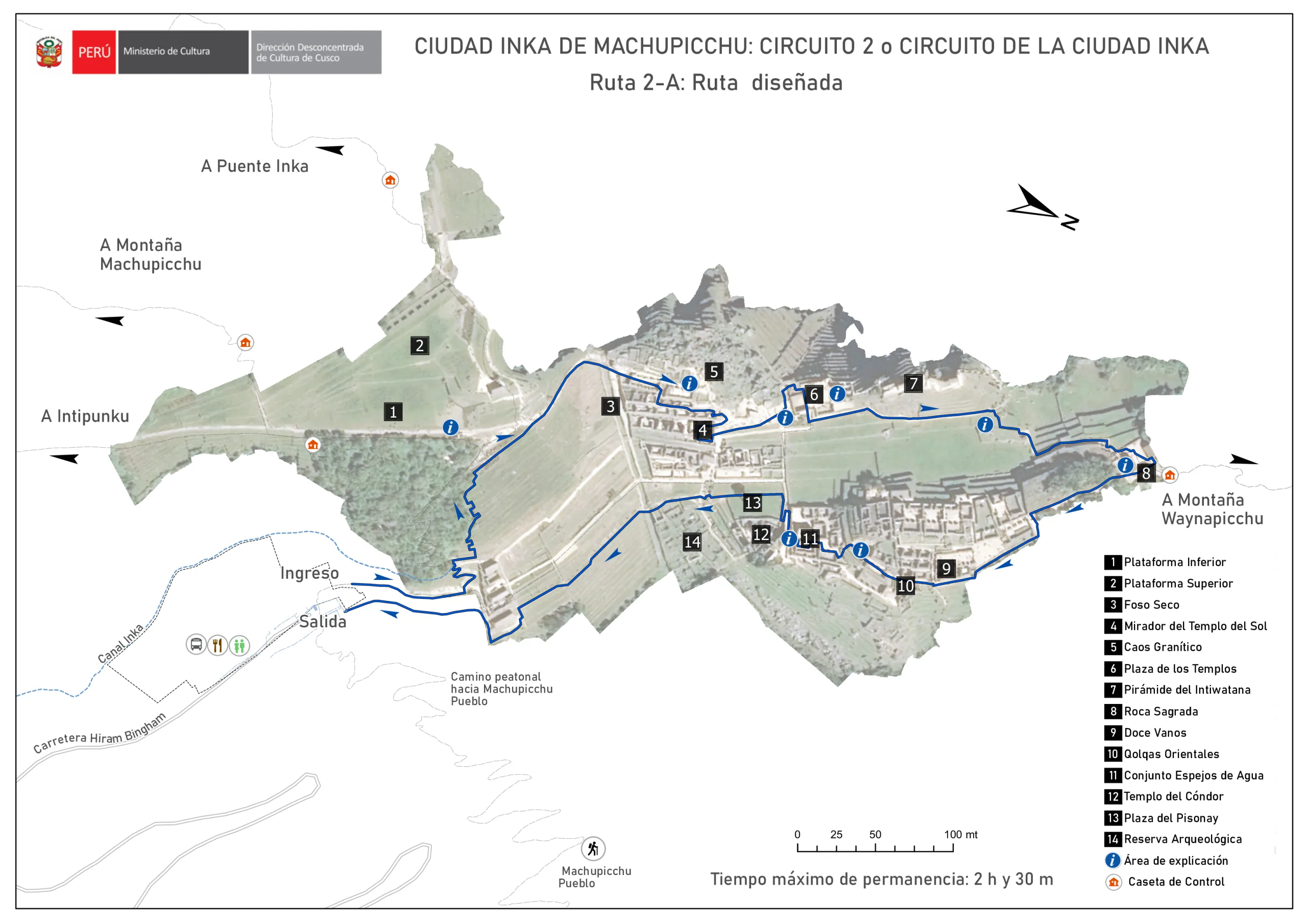
Circuit 2A – Designed Classic Route
Route 2A Designed Classic offers the most complete and systematic route for walking around Machu Picchu. The route begins near the top agricultural terraces, getting access to the classic view panorama that then leads down into the citadel.
Visitors pass through important urban, ceremonial, and residential areas in a logical order that also explains how Machu Picchu worked as a city. This trek is great for initial visits to Machu Picchu where a mix of scenic and in-depth exploration experiences is required.
- Entry times: Machu Picchu regular opening hours, 6:00 am to early afternoon.
- Walking time: Approximately 2.5-3.5 hours.
- Seasonal access: It is open throughout the year irrespective of high or low seasons.
Circuit 2B – Lower Terrace Route
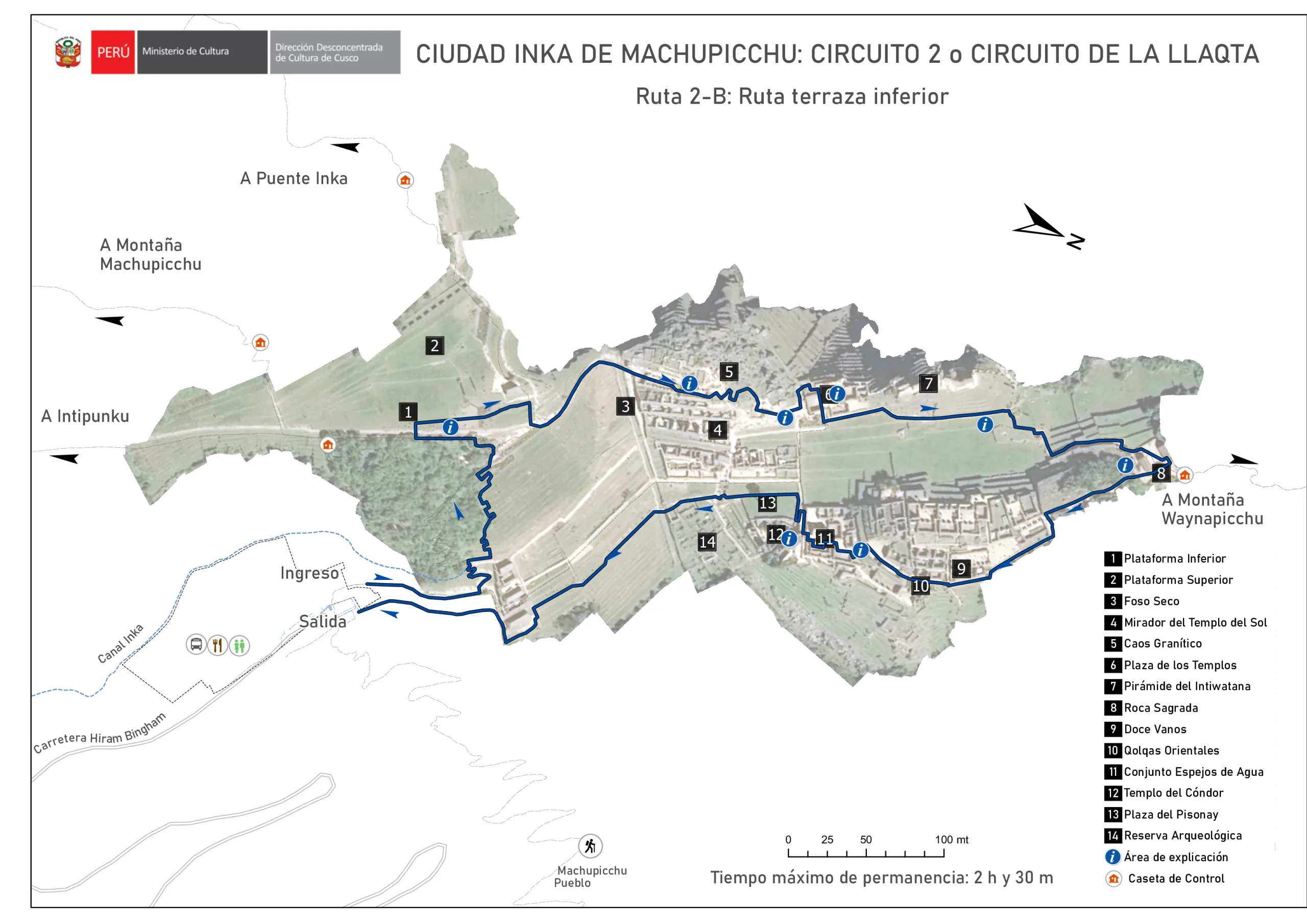
Route 2B Lower Terrace is slightly easier to access, with less changes in elevation, albeit passing through all necessary areas of Machu Picchu. This route leads to the citadel directly making it easier to walk.
This route includes the access to the major urban and ceremonial sectors of Machu Picchu Citadel but at a more relaxed rhythm. It is suitable for people who wish a not-so-demanding hike while still experiencing the major aspects of Machu Picchu.
- Entry times: Typical Machu Picchu entry times are from 6:00 a.m. until early afternoon.
- Walking time: Approximately 2-3 hours.
- Seasonal access: Open in both high and low season.
How to Buy Machu Picchu Circuit 2 Tickets Before They Sell Out
The demand for Machu Picchu circuit 2 tickets is always high. Circuit 2 tickets for Machu Picchu are usually sold out several weeks in advance, depending on the time of year.
If passengers are interested in purchasing Machu Picchu ticket circuit 2, they should start planning early, selecting a circuit first and then arranging train and bus times for entry as a result. Last minute planning typically means settling for a circuit, too.
Is the Classic Circuit 2 the Best Circuit for First Time Visitors
For those asking for a first-time choice between circuits in Machu Picchu, the usual answer is Circuit 2. This is primarily because it is believed to offer the best route in Machu Picchu, given that it provides both the iconic view point and substantial interaction with the ruins.
As the best route for Machu Picchu beginners, it does not demand heavy physical exercise while providing a complete appreciation of the location.
Circuit 3 Royalty Route and The Huayna Picchu Adventure
Machu Picchu circuit 3 focuses on lower terraces and quieter ceremonial areas. Travelers comparing circuit 3 Machu Picchu options often appreciate the calmer atmosphere and reduced crowd levels.
Access to Machu Picchu circuit 3 tickets is also limited, especially for routes that include mountain hikes.
Circuit 3A – Huayna Picchu Mountain Route
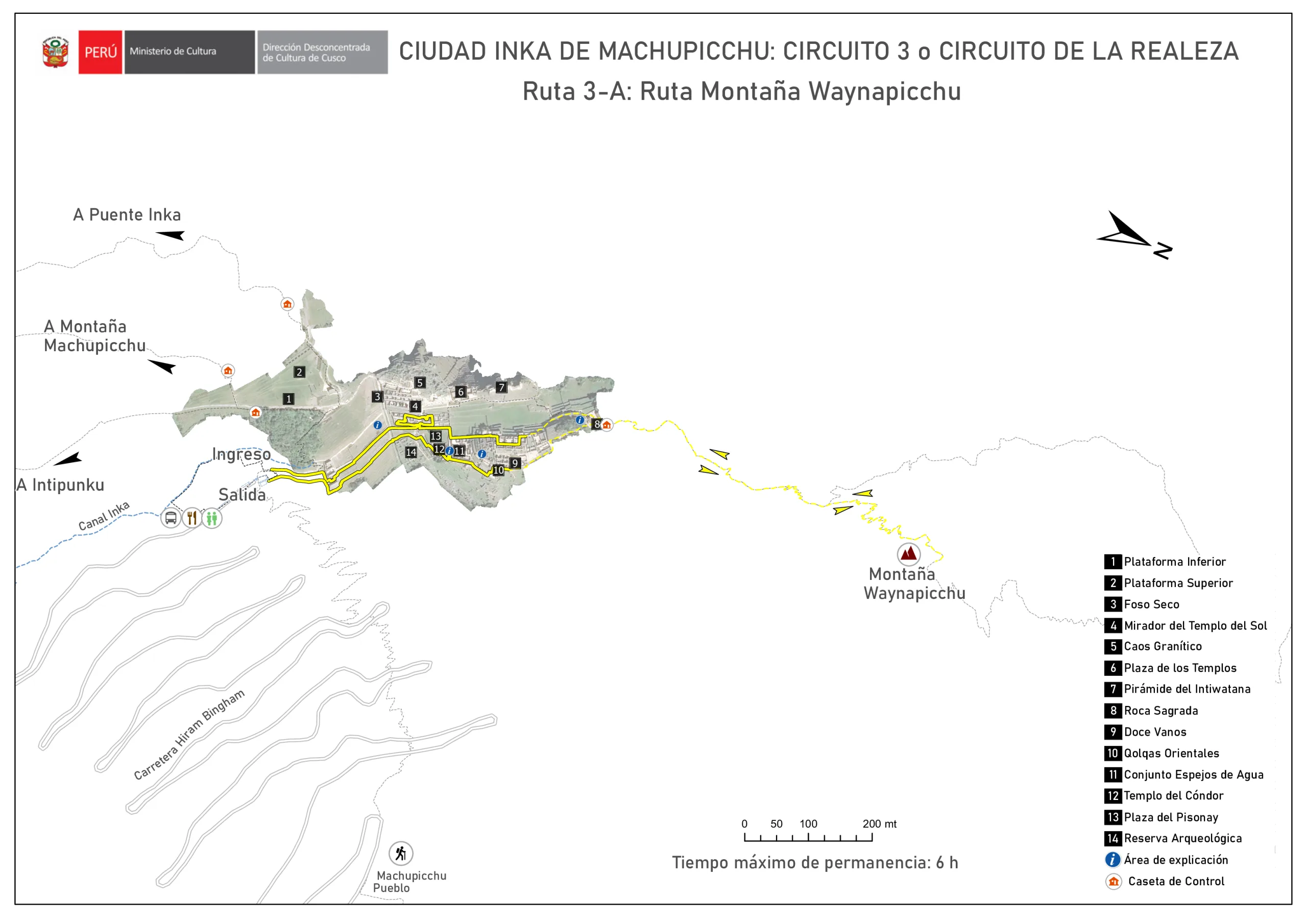
Route 3A Huayna Picchu is the most adventurous route available within the Royalty Circuit. After passing through the bottom areas of Machupicchu, this route starts its steep climb towards Huayna Picchu Mountain.
The climb requires some physical exertion, with exposed ridges to negotiate, but the perspective afforded in the final close-up look down at the citadel makes it worthwhile. We advise this route for those with strong constitutions and unphased heights.
- Entry times: Early morning time slots, normally between 7:00 a.m. and 10:00 a.m.
- Walking time: Approximately 3-4 hours.
- Seasonal access: Open in high and low season, weather permitting. May close temporarily due to rain or safety conditions.
Circuit 3B – Designed Royalty Route
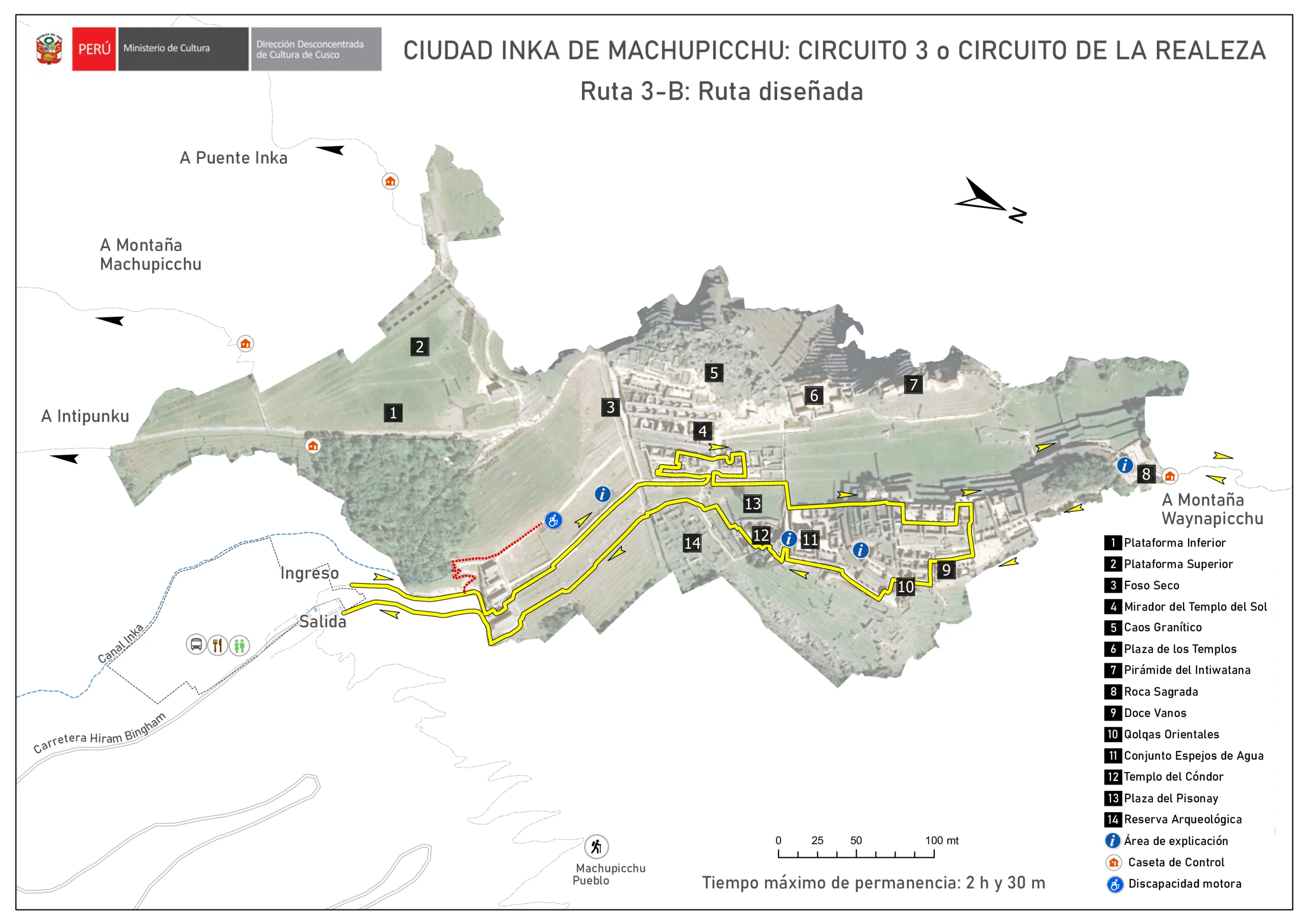
Route 3B Designed Royalty focuses on the lower ceremonial and residential areas of Machu Picchu. The walk stays closer to the core of the site, moving through quieter sectors that are traditionally associated with elite or ritual use.
This hike offers a much more relaxed journey with less crowding. It is perfect for those travelers that want to see another side of Machu Picchu without an advanced hike added on.
- Entry times: According to the standard Machu Picchu entry schedule, entry times go from 6:00 a.m. until early afternoon.
- Walking time: Approximately 2-2.5 hours.
- Seasonal access: Open in both high and low season.
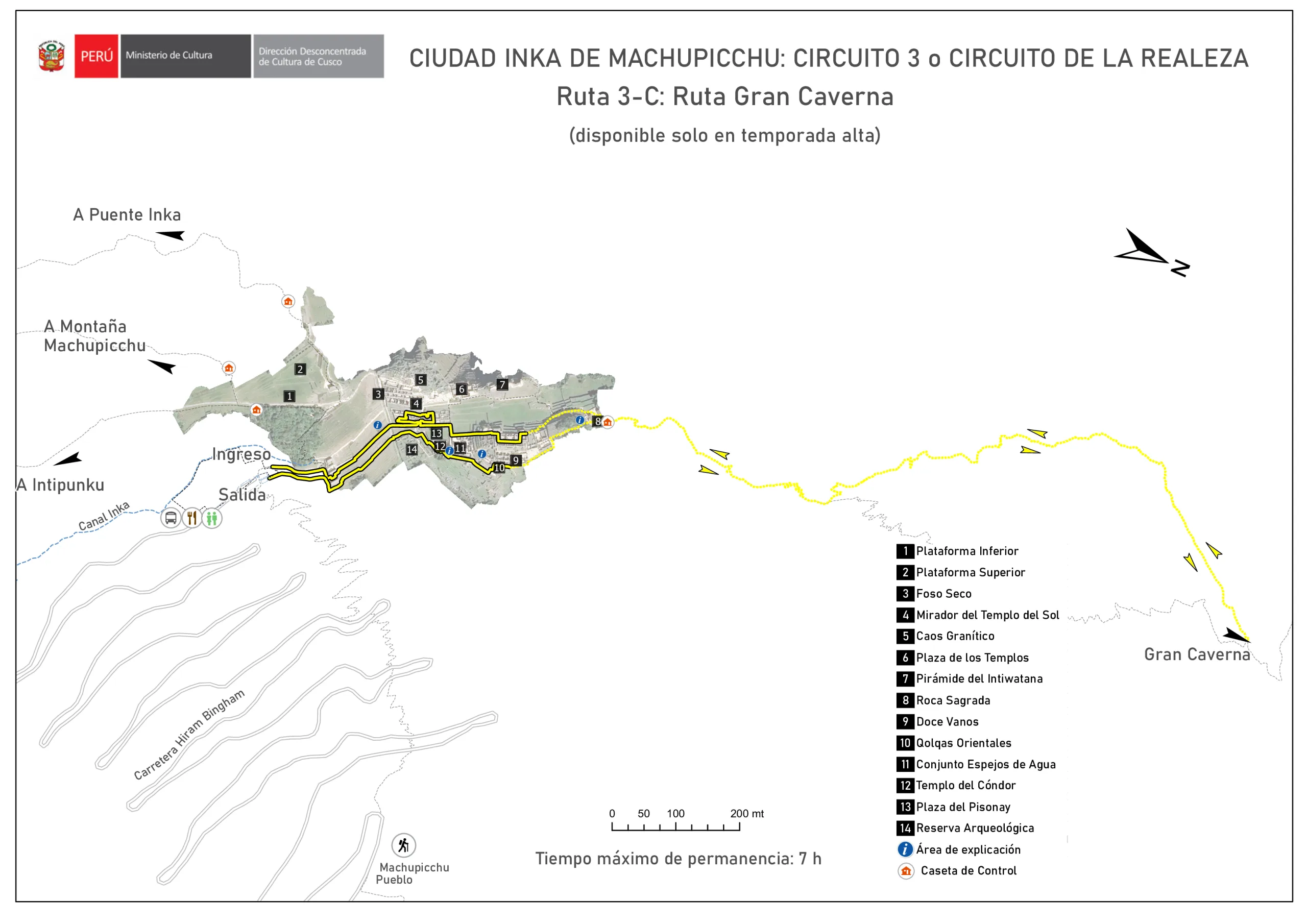
Circuit 3C – Great Cavern (Temple of the Moon) Route
Route 3C Great Cavern is an extended and quite private trek that leads out of the main citadel and into the surrounding forest area.
The experience feels very remote and introspective, with much more interest in the natural and ceremonial setting, and not very focused on the views. This trail is recommended for tourists who would like something different and is generally opened only during peak season.
- Entry times: Restricted to early mornings, usually between 7:00 and 9:00 a.m.
- Walking time: Approximately 4 hours.
- Seasonal access: High season only.
Circuit 3D – Huchuy Picchu Route
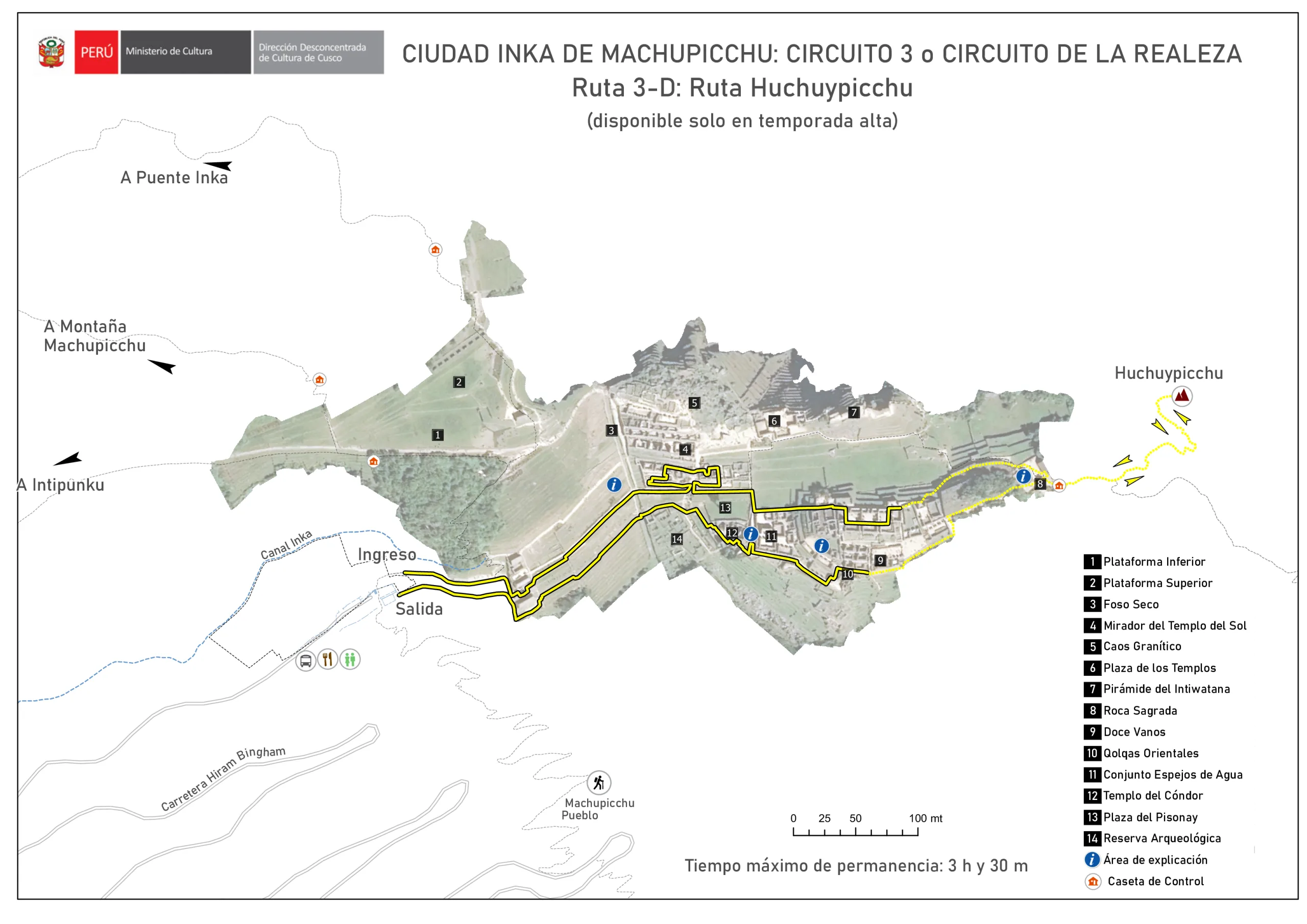
Route 3D Huchuy Picchu is the most accessible trek available in Circuit 3. The climb is short and easy to follow, with chiseled views of Machu Picchu, though not as grueling as Huayna Picchu.
This route is ideal for travelers who want a light hike and scenic views while maintaining a moderate level of physical effort.
- Entry times: Generally between 9:00 a.m. and 11:00 a.m.
- Walking time: About 2.5-3 hours.
- Seasonal access: High season only.
Comparison of Machu Picchu Circuits: Which One Should You Pick?
It is easy to compare routes to Machu Picchu so that tourists know which to follow based on precedence.
Machu Picchu Circuit 1 vs 2: Views vs Ruins
To make a comparison between machu picchu circuit 1 vs 2, it is evident that circuit 1 is for scenic views, while circuit 2 is for ruins and city plan.
For Machu Picchu, options 1 or 2 circuits depend on whether you are looking at landscape or architectural interest.
Machu Picchu Circuit 2 vs 3: Classic Tour vs Adventure Hikes
The question of Machu Picchu circuit route 2 vs circuit route 3 is one of balance versus adventure. Circuit route 2 provides informative explanations, while Circuit route 3 provides exercise as well as peaceful environments.
Learning about circuit 1 2 3 Machu Picchu together can help understand how these circuits can suit different travel personalities.
Which Circuit Is Best for Seniors and Families with Kids
For travelers looking for comfort, the most popular Machu Picchu circuit is usually Circuit 2B or Circuit 1B. These are widely regarded as the best Machu Picchu circuits for those traveling with families and seniors because the difficulty is lower and the paths.
Generally, concerns about Machu Picchu circuit 2 difficulty are small, especially for the lower-terrace option.
Essential Tips for Booking Your Machu Picchu Circuit Tour
When a reservation is made for Machu Picchu circuit tickets, planning needs to be made in advance. Entry times are stringent; no re-entry is allowed, and tickets, once purchased, cannot be modified.
Many travelers who book Machu Picchu Circuit 2 tours or a Machu Picchu Tour Circuit 2 find that matching up the train times and times with tickets is just as important as the actual selection of the circuit.
Can You Do Two Machu Picchu Circuits in One Day?
For those asking, can you do two Machu Picchu circuits in one day, this would be a yes, but only with two separate tickets and times that need to be carefully planned.
Combining routes like Circuit 1 and 2 Machu Picchu requires an appropriate level of physical fitness coupled with precise logistics. For most visitors, a single well-chosen circuit is sufficient.
How Long Does Circuit 2 Machu Picchu Take to Walk?
This question must be on many people’s minds: how long does Circuit 2 Machu Picchu take. The averages that are usually taken from visitors range between 2.5 to 3.5 hours to walk the route.
Knowing how long Machu Picchu Circuit 2 is makes tourists plan the time needed for transportation in advance without rushing the experience.
Machu Picchu Ticket Prices 2026
| Circuit | Route | Adult Price | Child (-18) | Student |
|---|---|---|---|---|
| Circuit 1 – Panoramic | 1A Machu Picchu Mountain Route | S/ 200 | S/ 118 | S/ 125 |
| 1B Upper Terrace Route | S/ 152 | S/ 70 | S/ 77 | |
| 1C Intipunku (Sun Gate) Route | S/ 152 | S/ 70 | S/ 77 | |
| 1D Inca Bridge Route | S/ 152 | S/ 70 | S/ 77 | |
| Circuit 2 – Classic Circuit | 2A Designed Classic Route | S/ 152 | S/ 70 | S/ 77 |
| 2B Lower Terrace Route | S/ 152 | S/ 70 | S/ 77 | |
| Circuit 3 – Machu Picchu Royalty | 3A Huayna Picchu Mountain Route | S/ 200 | S/ 118 | S/ 125 |
| 3B Designed Royalty Route | S/ 152 | S/ 70 | S/ 77 | |
| 3C Great Cavern (Temple of the Moon) | S/ 200 | S/ 118 | S/ 125 | |
| 3D Huchuy Picchu Route | S/ 152 | S/ 70 | S/ 77 |
Prices are indicative and subject to official updates.
Entry Times, Seasons, and Temporary Closures
Machu Picchu can be visited at any time of the year, but depending on the season.
The dry season, which runs from April to October, is the season when the weather is relatively consistent, and the circuits operate properly. It is also the peak period.
It is open during the rain seasons for a period of November to March. However, in case of heavy rain, the operation of the mountain roads may be suspended.
Every year, the site closes partially during the month of February. It is a period of maintenance and conservation. The main citadel is normally open during this time. However, some hikes may be closed.
Periodic closes may also be caused by landslides, weather, or renovation work.
Restrictions During Your Visit to Machu Picchu (Official Rules)
In order to conserve the site, there are regulations to be followed while visiting Machu Picchu, which should always be taken into account. Disregard for these rules can result in expulsion from the archaeological site, despite an ongoing visit.
- The use of drones is prohibited within the sanctuary.
- Bringing large tripods or sound-recording devices is not permitted unless prior approval has been obtained.
- Large backpacks, greater than 25 liters in size, are not allowed within the citadel.
- No food of any type is allowed inside; alcoholic beverages are not allowed.
- Visitors should not leave their itinerary; it is forbidden to step outside the circuit assigned.
- Any contact with the ruins-touching or climbing on structures of any kind is not allowed.
Essential Tips for Visiting Machu Picchu (Expert Advice)
Before entering on your tour, make a stop at the restroom facilities, as once you enter the site, there are no restroom facilities. Weather conditions can change suddenly, so it’s a good idea to bring a lightweight rain jacket or poncho with you.
- Wear comfortable, non-slip shoes, as many stone pathways can be uneven and slick.
- Bring water in a refillable bottle to stay hydrated during the walk.
- Seek protection from the sun by wearing sunscreen, sunglasses, and a hat, especially on days where the morning is clear.
- Please be attentive to the postings and the instructions provided by the site staff, as these two means are especially devised for visitor safety and site conservation.
The following tips will be very useful for traveling around Machu Picchu safely, respectfully, and well prepared.
Frequently asked questions about Machu Picchu Circuits Guide 2026 and Which Ticket Is Best for You
Yes, Circuit 3 is still worth it, even without adding a mountain hike. While it does not include the classic panoramic viewpoint, it allows visitors to explore different and less crowded sectors of Machu Picchu, including ceremonial and residential areas that are not part of Circuit 2.
For travelers interested in seeing a different side of the site, Circuit 3 offers a quieter and more intimate experience.
Circuit 1 focuses mainly on panoramic terraces and viewpoints, which is why access to the full urban sector is limited. It is designed primarily for photography and scenery rather than in-depth archaeological exploration.
Travelers who want to walk through plazas, temples, and living areas should consider Circuit 2 or Circuit 3 instead.
The famous postcard photo can be taken on Circuit 2 and on specific sections of Circuit 1B.
That said, each circuit offers its own unique perspectives. Circuit 3 provides closer views of temples, terraces, and sacred spaces that many visitors find just as memorable, even without the iconic wide-angle shot.
Restrooms are located outside the main entrance only. Once you begin any circuit, you must complete the route without leaving and re-entering.
For this reason, it’s recommended to use the facilities before starting, especially if you plan to walk longer routes like Circuit 2 or Circuit 3 with additional attractions.