Corpus Christi in Cusco History, Procession of the Saints and Traditions
Every year, the ancient city of Cusco transforms into one of the most spiritually charged stages in all of South America. Corpus Cristi the celebration that once replaced the great Inca ancestor processions fills the cobblestone streets with fifteen saints and virgins, thundering brass bands, sacred dances, and a dish that tells the story of an entire empire. Whether you’re planning to witness Corpus Cristi day in person or simply want to understand one of Peru’s most important traditions, this is your complete guide.
What Is Corpus Cristi?
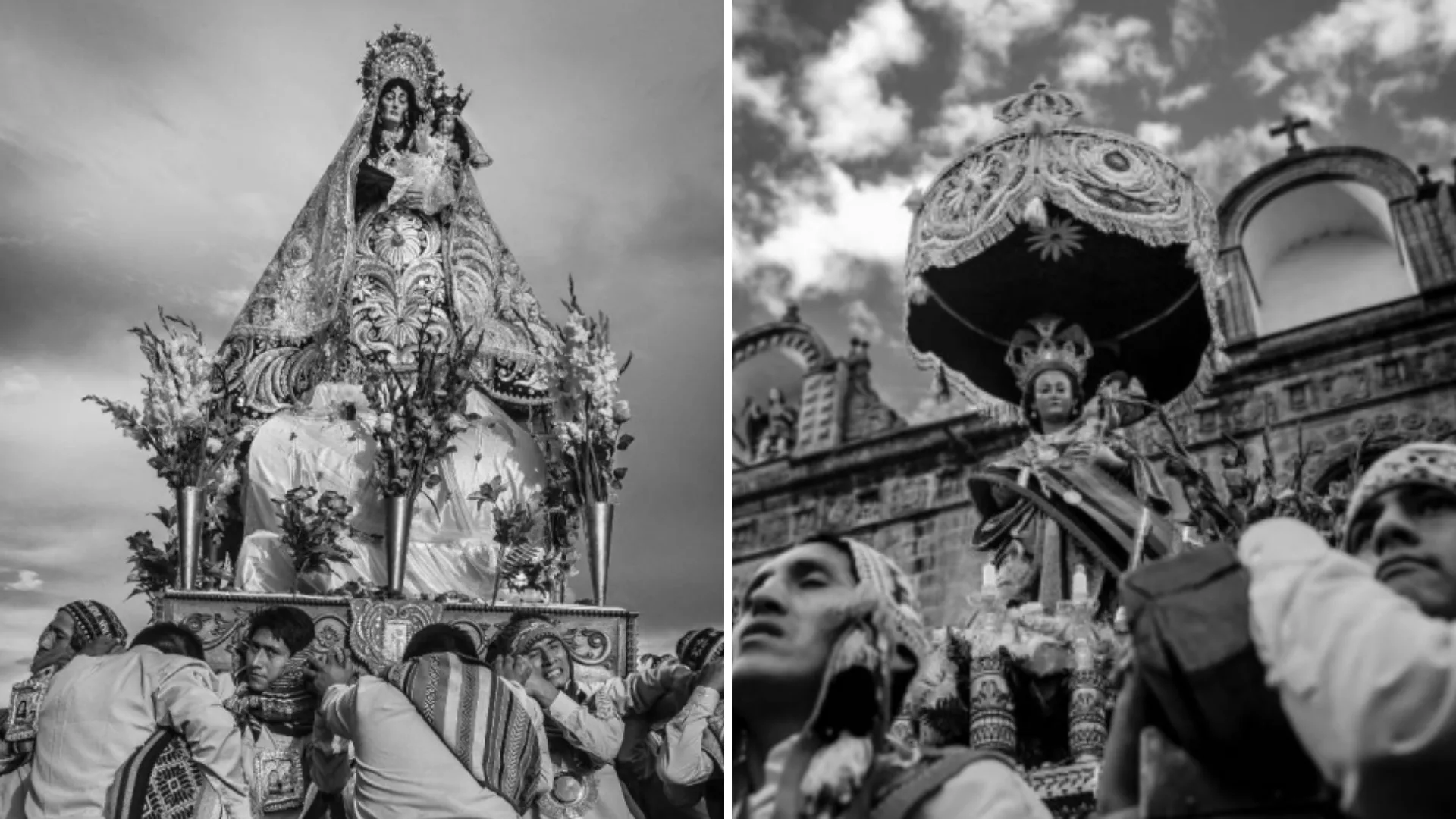
Corpus Cristi is a Catholic feast day that honors the real presence of Jesus Christ in the Eucharist the belief that the consecrated bread and wine are truly the body and blood of Christ. The name comes from Latin: Corpus Christi, meaning “Body of Christ.” Pope Urban IV established it as a universal feast in 1264, and for centuries it spread across Catholic Europe with grand processions and elaborate public displays of faith.
When Spanish missionaries arrived in Peru in the 16th century, they brought Corpus Cristi with them and in Cusco, the celebration evolved into something entirely its own. Corpus Cristi Cusco is not just a Catholic feast. It is a living fusion of two civilizations, a celebration that belongs simultaneously to the colonial church and to the ancient Andean world that existed long before it.
Since August 6, 2004, Corpus Cristi Cusco has been officially recognized as a National Cultural Heritage of Peru a designation that enshrines what every Cusqueño already knew: this is one of the most important expressions of Peruvian identity in existence.
History & Origin of Corpus Cristi in Cusco
Before the Spanish: The Inca Tradition
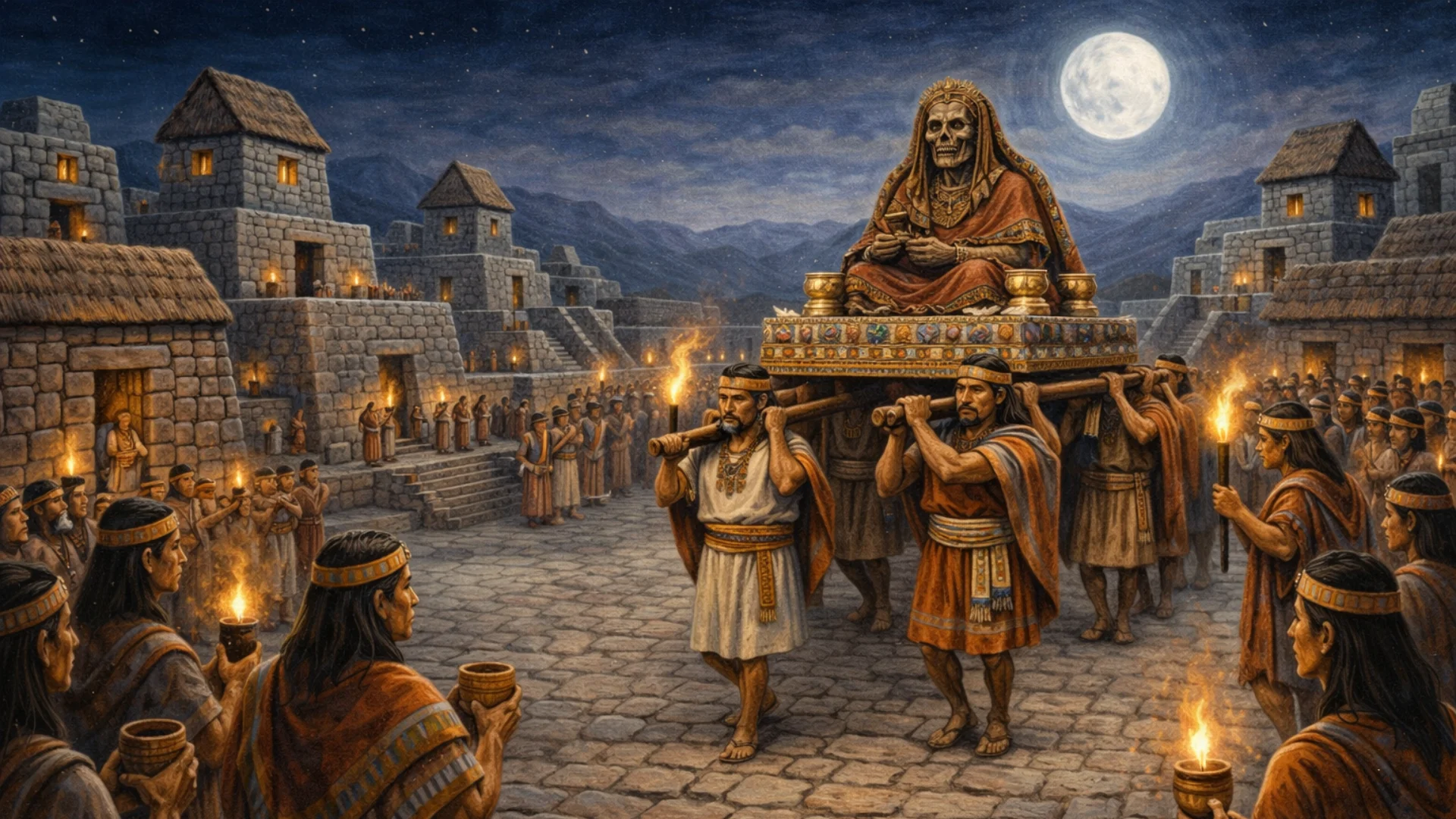
Long before the Spanish arrived, Cusco’s main square the Huacaypata was already the site of spectacular annual processions. Each year, the carefully preserved mummified bodies of deceased Inca emperors and nobles (called mallquis) were carried out on ornate litters. Families tended to these mummies year-round, dressing them in fine textiles and treating them as living presences. During major festivals, they were brought into the main square to be honored with music, aqha (chicha), and offerings.
The most important of these gatherings coincided with Inti Raymi, the Festival of the Sun, held around the June winter solstice. Communities from across the entire Inca Empire would send representatives to Cusco. The plaza would fill with music, dance, ritual feasting, and the collective presence of both the living and the ancestors. It was, by every account, one of the most spectacular religious gatherings in the ancient world.
The Spanish Arrival and the Colonial Substitution
Francisco Pizarro’s forces arrived in Cusco in 1533. Within years, the Catholic Church began the systematic transformation of the city’s religious life. The Inca temples were dismantled; the royal mummies were seized and destroyed. But the Spanish were practical: erasing five centuries of ritual tradition overnight was impossible.
The solution was substitution. The Catholic feast of Corpus Cristi, which in the colonial calendar fell near the same time as Inti Raymi, was introduced as the grand replacement ceremony. The mummified Inca ancestors were replaced by images of Catholic saints and the Virgin Mary. The community processions continued but now they honored San Sebastián, San Jerónimo, and the Virgen de Belén. The music, the communal gatherings, and the sacred spectacle all survived in transformed form.
The first Corpus Cristi celebration in Cusco is believed to have taken place in the late 1530s, just a few years after the Spanish refounded the city on March 23, 1534.
Five Centuries of Living Tradition
What began as a tool of Catholic evangelization became, generation by generation, something the people of Cusco made entirely their own. Each of the 15 parishes incorporated its own musical traditions, dance forms, and stories into the celebration. The mayordomos community members who take on the sacred responsibility of organizing their saint’s participation ensured the tradition was passed down with pride and devotion.
In 1982, the Archbishop of Cusco ordered the procession suspended following the death of a church dignitary. The mayordomos refused outright. The procession went ahead. That episode tells you everything about the depth of this celebration.
“What the Spanish intended as a tool of evangelization became, over five centuries, something that belongs entirely to the people of Cusco.”
When Is Corpus Cristi Day Celebrated?
Corpus Cristi day falls on a Thursday, 60 days after Easter Sunday. Since Easter is tied to the lunar calendar, the exact date shifts each year, typically landing between late May and mid-June. To find the exact date for any given year, count 60 days forward from Easter Sunday the result will always be a Thursday.
When Does Corpus Cristi Take Place?
- Main day: Always a Thursday, 60 days after Easter Sunday
- Typical window: Late May through mid-June, depending on the year
- La Entrada: Wednesday evening, the night before the main day
- La Octava: Exactly eight days after the main Thursday the following Thursday
- Total duration: Approximately 10 days from La Entrada through La Octava
Full Festival Timeline
Wednesday (eve) La Entrada de Corpus: Each of the 15 parishes begins its procession toward the Cathedral. The saints enter Cusco by candlelight, accompanied by brass bands and dancers. The historic center fills with music and devotion well into the night.
Thursday (main day — Corpus Cristi Day) — The Solemn Procession: Solemn mass at the Cathedral. All 15 saints and virgins are carried in the official procession around the Plaza de Armas in their traditional order. Food fairs, traditional dances, and communal celebrations fill the city.
Thursday through Thursday (8 days) — The Saints Reside in the Cathedral: All 15 images reside together in the Cathedral. Daily masses and visits by the faithful continue throughout the week. In Andean tradition, the saints are said to be visiting and conversing with each other.
Thursday (eighth day) — La Octava de Corpus: The farewell procession. Each saint is carried back out of the Cathedral and escorted home to its parish church. Cusco returns to ordinary time.
La Entrada de Corpus: The Eve of the Festival
Most travelers plan around the main Corpus Cristi day Thursday. But if you want the full experience, you need to be in Cusco on Wednesday night. La Entrada de Corpus is the arrival of the saints, and for many who have witnessed it, it is the most moving moment of the entire celebration.
What Happens During La Entrada
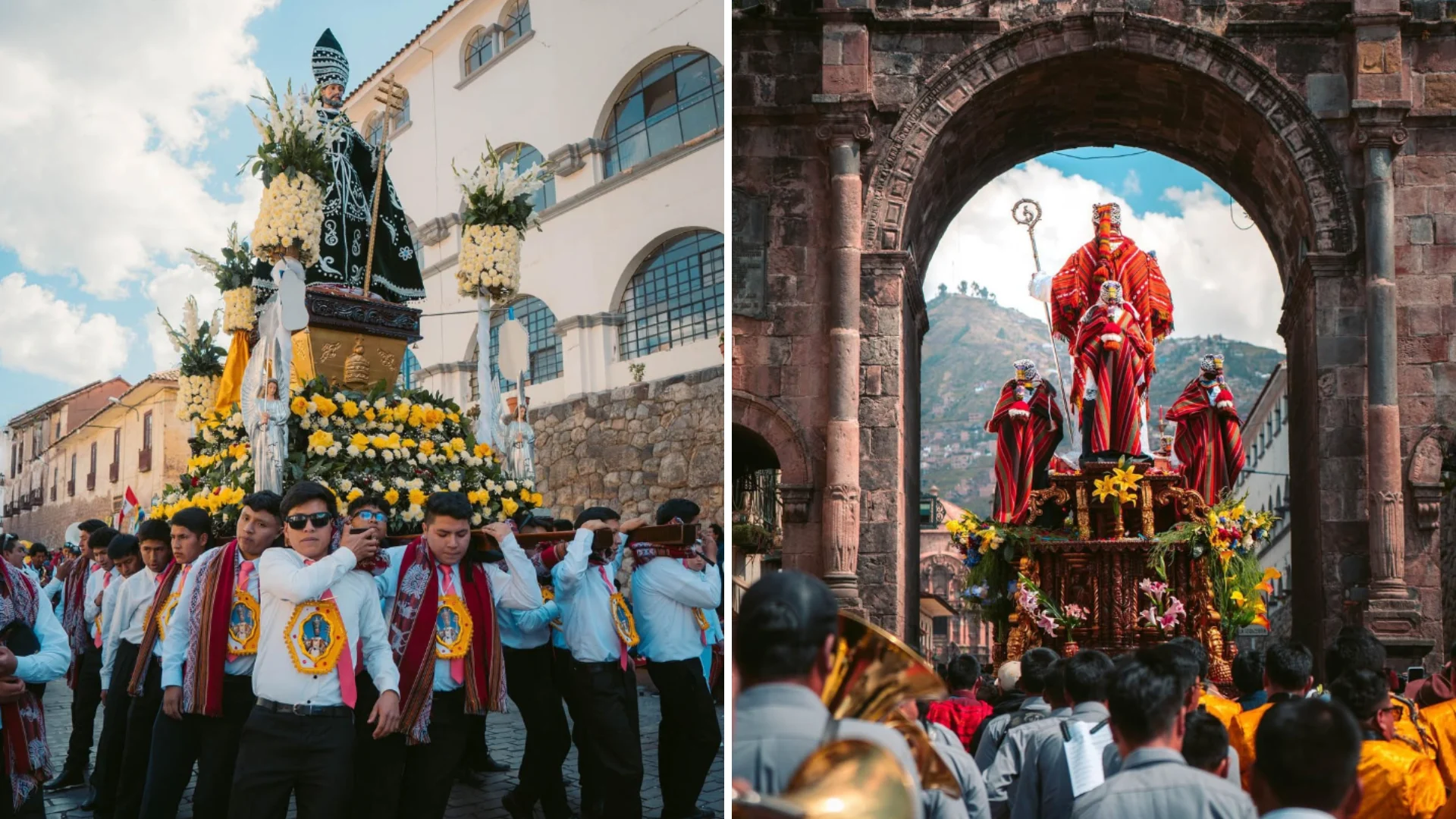
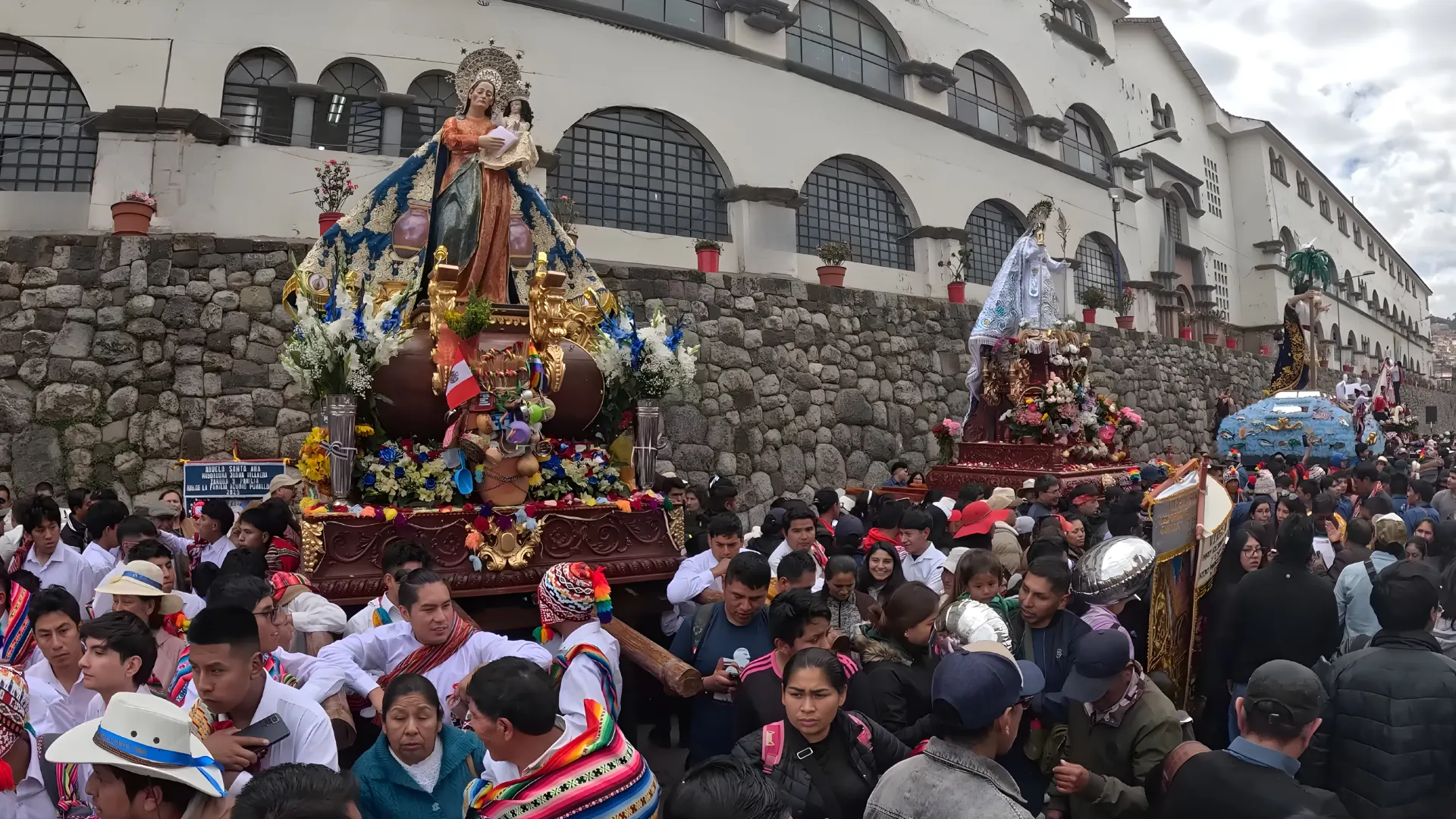
Beginning in the late afternoon, each of the 15 parishes begins its own separate procession toward the Cusco Cathedral. The saints and virgins are dressed in their finest embroidered gold and silver robes, jeweled crowns, fresh flower garlands and placed on their ornate wooden platforms called andas. The neighborhood’s brass band begins to play. The mayordomo and the community walk together through the cobblestone streets by candlelight.
What makes La Entrada so different from the main Thursday procession is its intimacy. There are no massive crowds yet. You might turn a corner in San Blas or near the San Pedro Market and suddenly find yourself walking alongside an entire neighborhood as they escort their patron through the fading light. The sound of a brass tuba reverberating off 400-year-old stone walls. Candles flickering against gold embroidery. The smell of incense and Andean night air.
By nightfall, all 15 images are installed inside the Cathedral together. On Thursday morning, before the procession begins, visitors can enter the Cathedral and see all 15 saints gathered in one extraordinary space one of the most visually stunning moments of the entire Corpus Cristi Cusco festival.
The Central Day: The Solemn Procession of Corpus Cristi
Corpus Cristi day the Thursday is the culmination of everything. By 8:00 AM, the Plaza de Armas is already filling with people. Locals in traditional dress, brass bands warming up, food vendors setting out their stalls.
The Morning Mass
The day begins with a solemn High Mass inside the Cathedral Basilica of Cusco, presided over by the Archbishop. The mass is celebrated partly in Spanish and partly in Quechua the language of the Inca Empire a reminder that Corpus Cristi Cusco exists at the intersection of two worlds.
The Grand Procession Around the Plaza de Armas
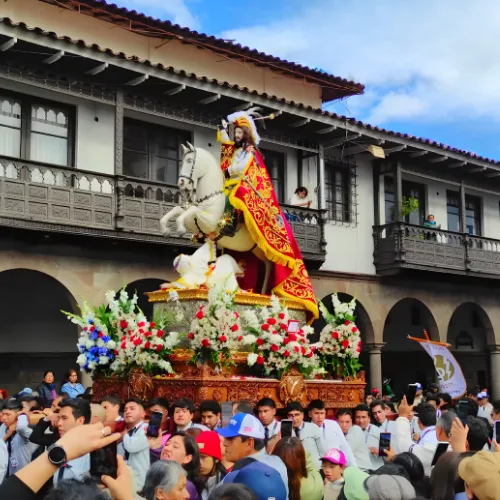
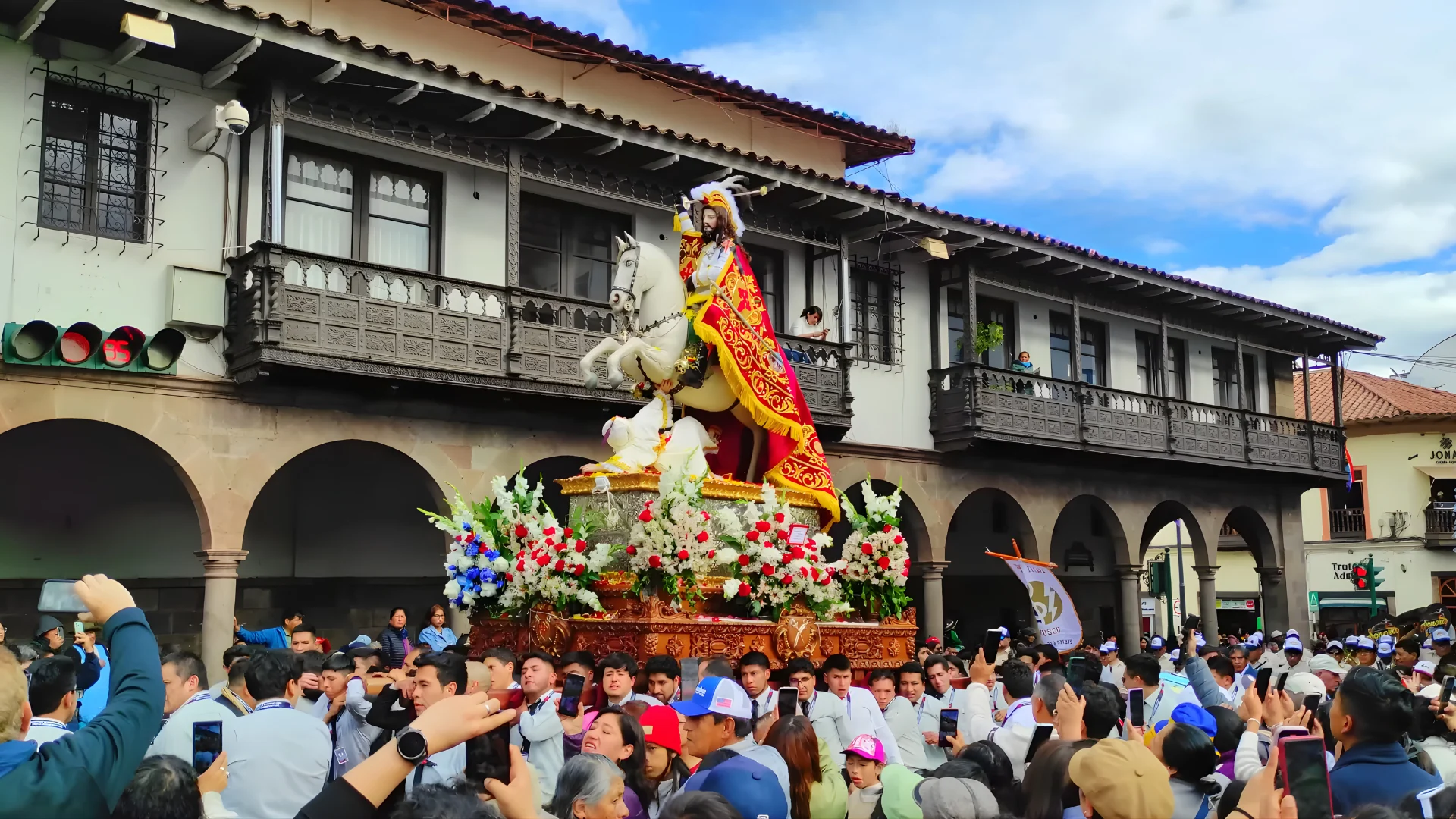
After the mass, the great procession begins. One by one, in their established traditional order, the 15 saints and virgins are carried out of the Cathedral on their andas and into the Plaza de Armas. Each image is accompanied by its parish’s brass band, its traditional dance group, its cargadores (the devotees who carry the platform), and its community.
The procession circles the Plaza de Armas the same square where Inca emperors once presided over their own great festivals. The andas are staggeringly heavy some require 20 or more carriers at a time. Carrying your saint’s platform is considered an act of deep spiritual merit. Families save for years to fund their saint’s participation.
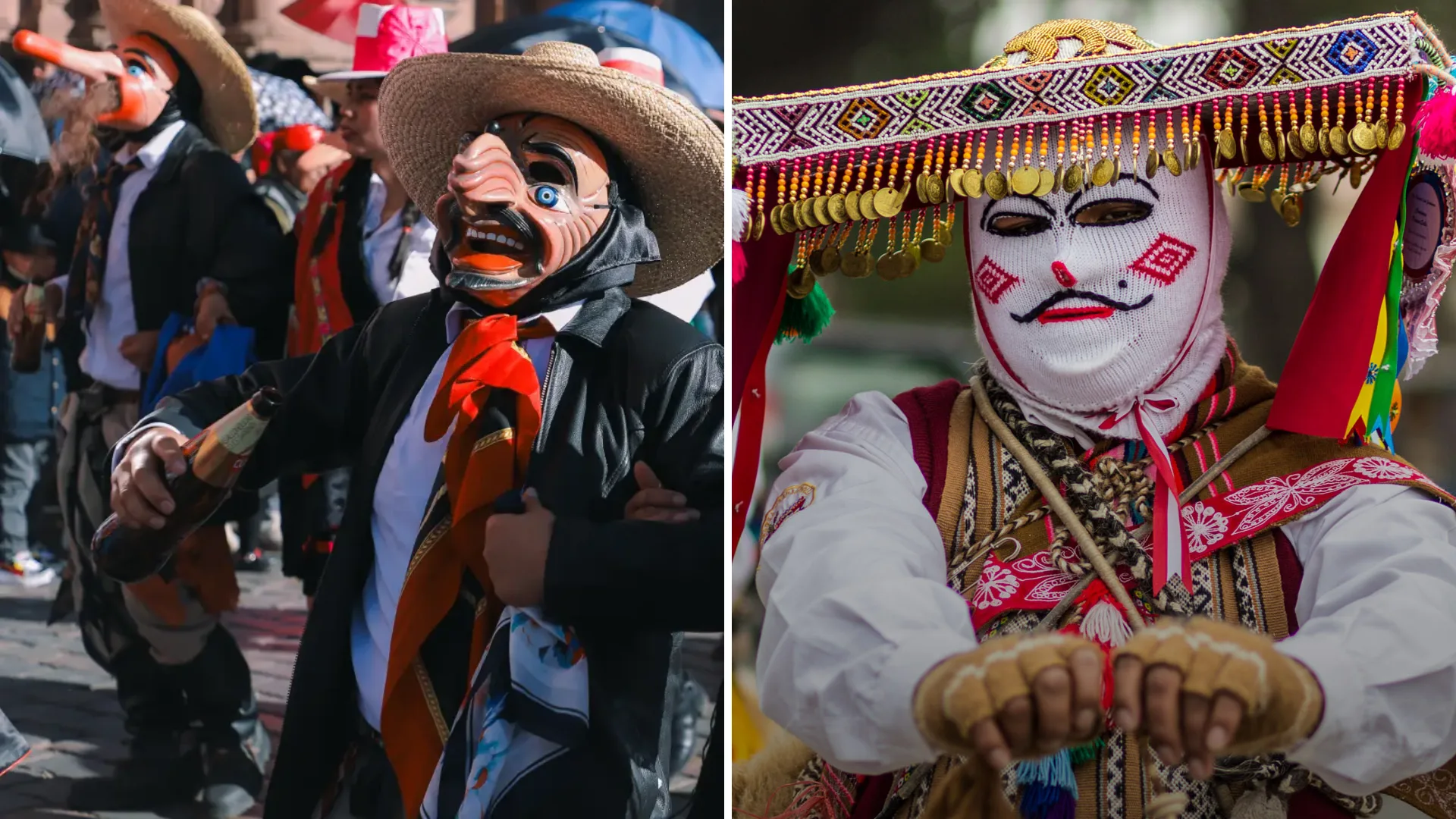
Traditional Dances of Corpus Cristi
- Majeños: Represent colonial-era mule drivers; costumes mix Spanish and Andean elements
- Qhapaq Qolla: Represent the great highland traders of the Altiplano, wearing distinctive tall hats
- Saqra (Devil Dancers): Add joyful, irreverent energy — the trickster alongside the sacred
- Qhapaq Negro: Represent African communities of the colonial period
- Ukuku: Costumed figures connected to the broader Andean ritual universe
The Official Order of the 15 Saints & Virgins
The order in which the saints and virgins process around the Plaza de Armas during Corpus Cristi Cusco is strictly traditional, maintained for generations. It reflects the historical hierarchy of parishes and the devotional traditions of each community. This order is sacred.
- Patron Saint Anthony Abbot — Temple of San Cristóbal
- Patron Doctor Saint Jerome — Temple of San Jerónimo
- Patron Saint Christopher — Temple of San Cristóbal
- Martyr Saint Sebastian — Temple of San Sebastián
- Maiden Saint Barbara — Parish of Sweet Name of Jesus
- Grandma Saint Anne — Temple of Santa Ana
- Patron Saint James the Apostle — Temple of Saint James the Apostle
- Patron Saint Blaise — Temple of San Blas
- Patron Saint Peter the Apostle — Temple of San Pedro the Apostle
- Patriarch Saint Joseph — Temple of Bethlehem
- Virgin Nativity — Real de la Almudena — Temple of La Almudena
- Virgin of Remedies — Temple of Santa Catalina
- Most Holy Purified Virgin (Virgin of Candelaria) — Temple of San Pedro the Apostle
- Most Holy Queen of Bethlehem — “Mamacha Belén” — Temple of Bethlehem
- Virgin Immaculate Conception — “La Linda” — Cathedral Basilica of Cusco
The Stories of Each Saint — Legends, History & Curious Tales
One of the most beautiful things about Corpus Cristi Cusco is that each of the 15 saints is not just an image each one is a character, with a personality, a history, and a set of stories that the community has been telling and retelling for generations. These tales blend Catholic hagiography with Andean humor and local legend in a way that makes each saint feel alive and fully human.
1. Saint Anthony the Abbot — Temple of San Cristóbal
Saint Anthony the Abbot is known as the protector of animals and the patron saint of farmers. In Cusco, he represents the spiritual connection between humans, nature, and the land an essential concept within the Andean worldview.
Legend: Saint Anthony is always depicted with a small pig, his most recognizable symbol. According to local tradition, before entering the Cathedral during Corpus Christi, Saint Anthony stops to visit Saint Peter. While the two saints talk, his piglet quietly wanders away into the nearby streets. Panic spreads quickly as Anthony searches everywhere for his lost companion, until the piglet is finally found happily wandering through the stalls of the San Pedro market.
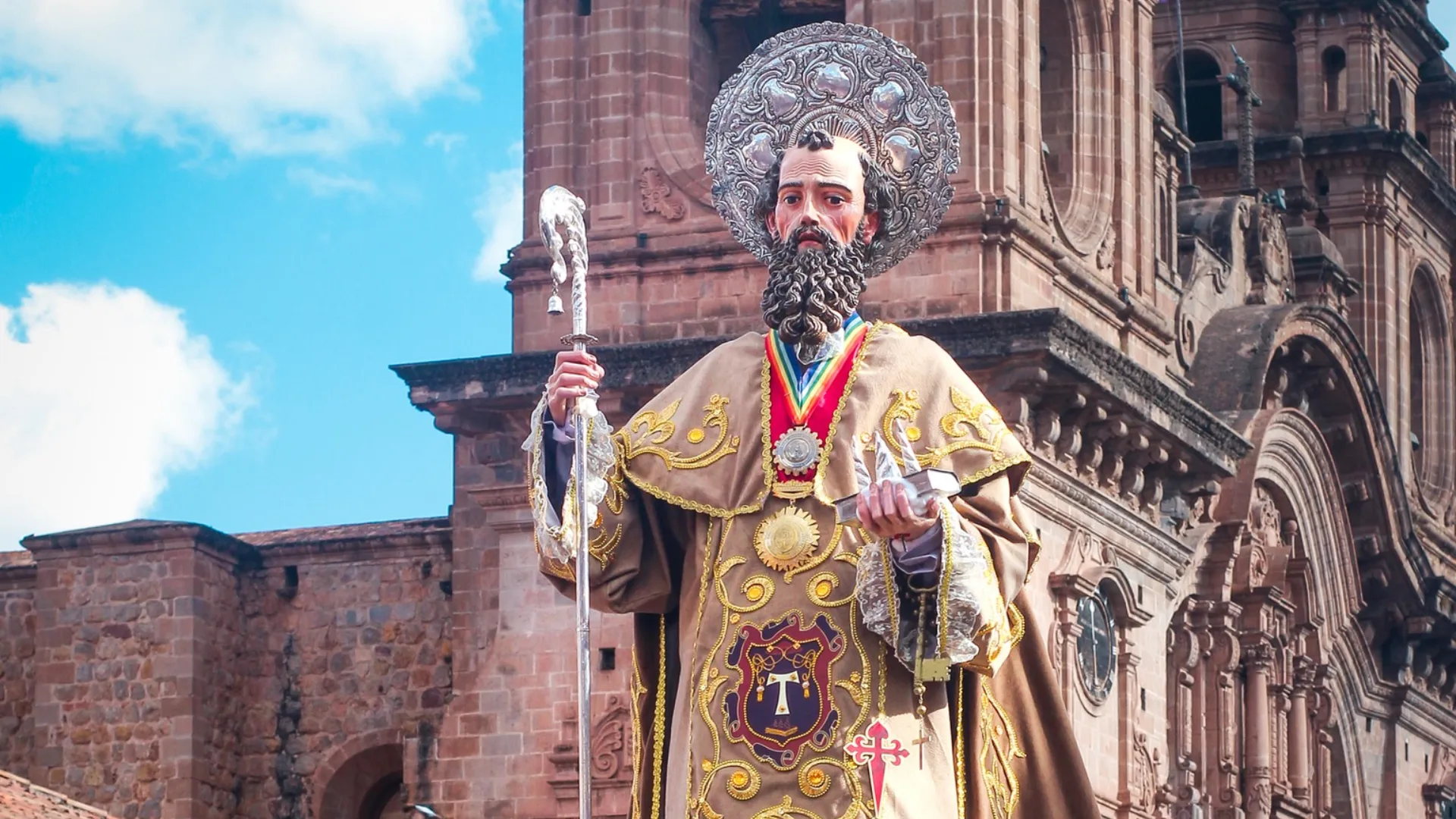
2. Saint Jerome — Temple of San Jerónimo
Saint Jerome represents wisdom and scholarship. He is the patron saint of translators and biblical scholars and is famous for translating the Bible from Hebrew and Greek into Latin, an achievement that shaped Christianity for centuries.
Legend: Saint Jerome is traditionally accompanied by a lion. According to the story, he once removed a thorn from the lion’s paw, and the grateful animal became his loyal companion. During the Corpus Christi procession in Cusco, people joke that the lion constantly tries to escape because it has spotted Saint Anthony’s piglet and wants to chase it. Jerome is also said to have a friendly rivalry with Saint Sebastian, as both saints compete to be the first to arrive at the Cathedral on Corpus Christi day.
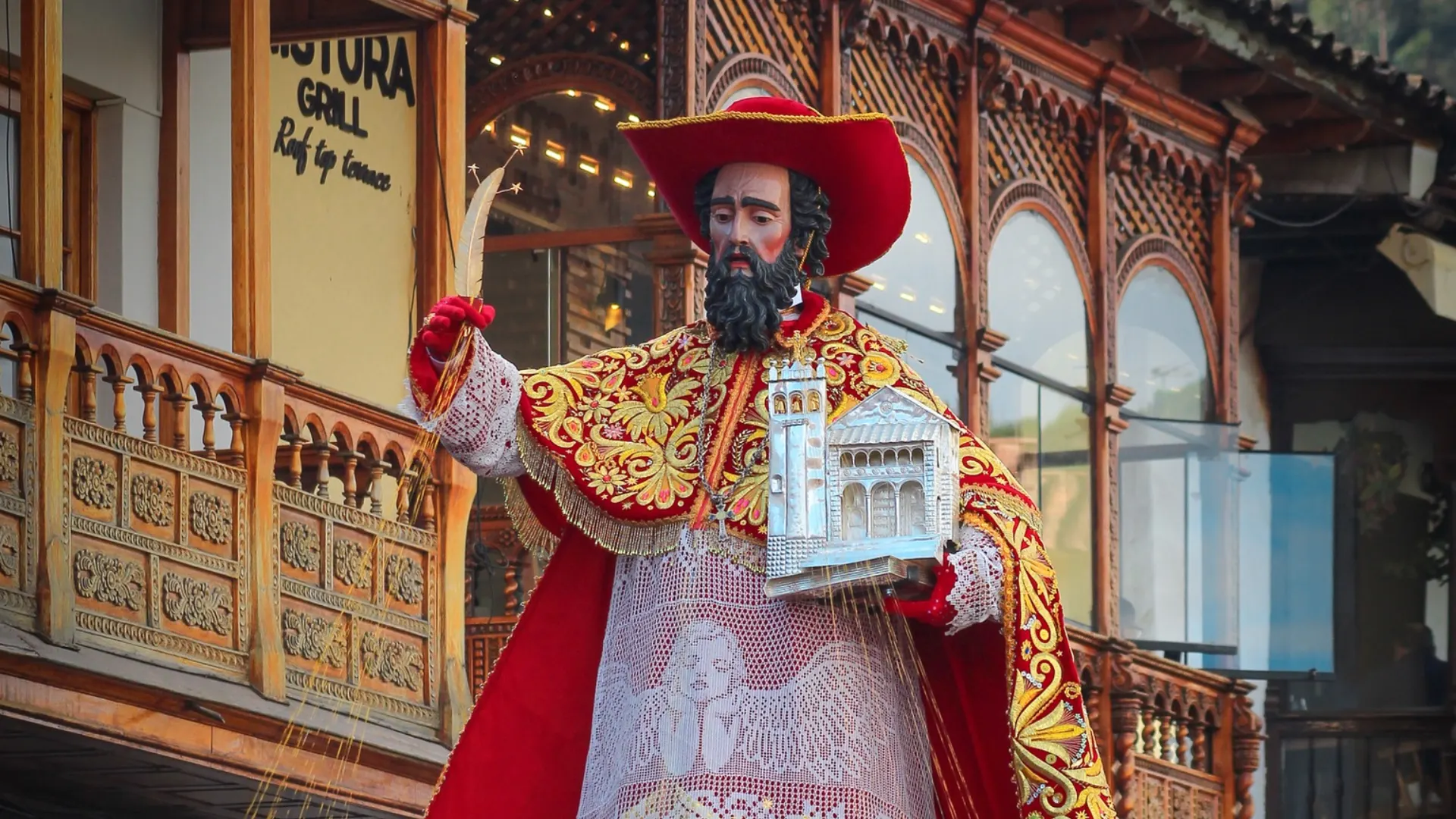
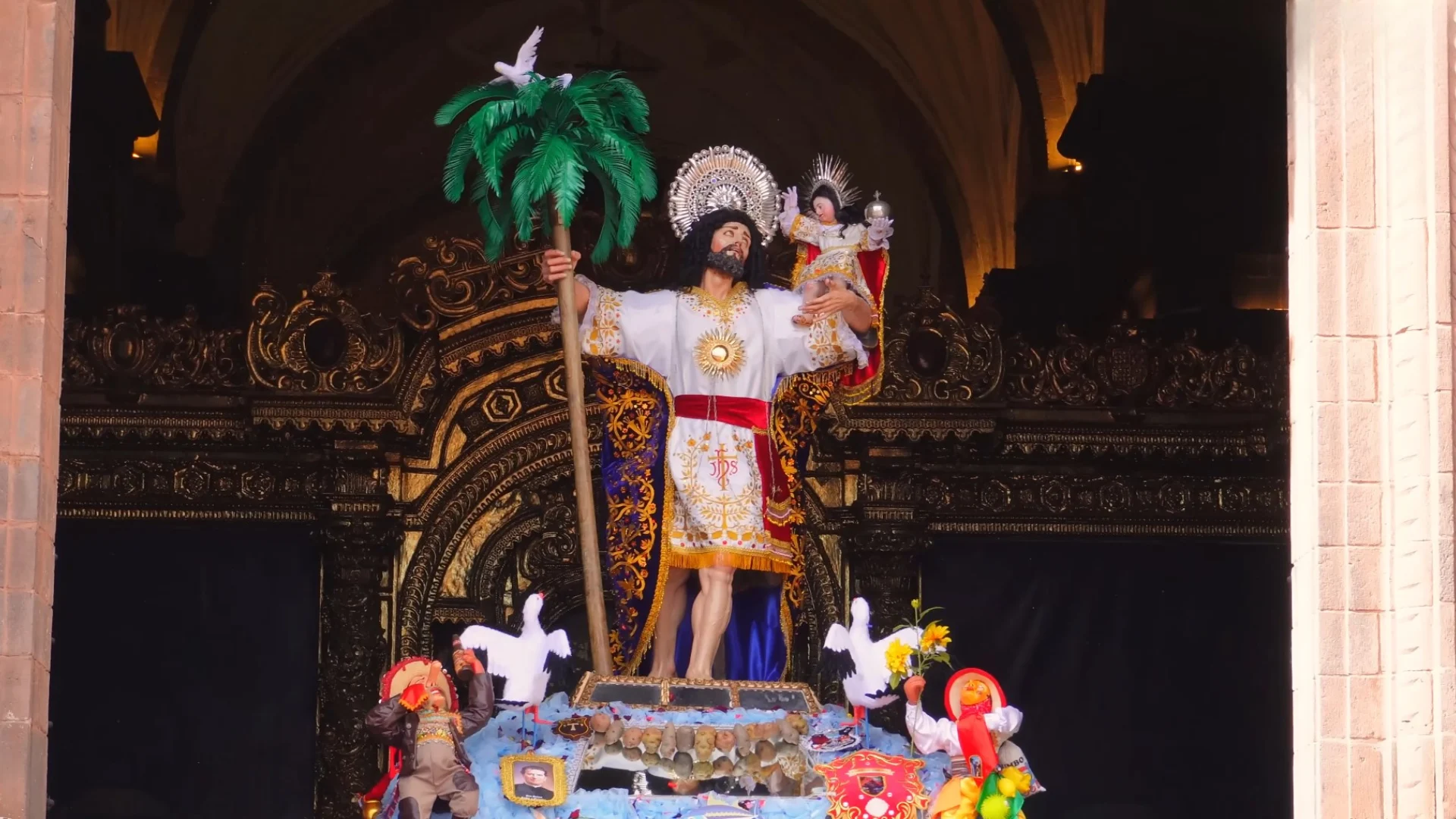
3. Saint Christopher — Temple of San Cristóbal
Saint Christopher is the protector of travelers and pilgrims. He is commonly depicted carrying the Child Jesus across a river, symbolizing divine protection during life’s journeys.
In the Andean world, where mountain roads are often dangerous, Saint Christopher is especially venerated.
Legend: Saint Christopher is said to be one of the tallest and most imposing saints in the entire procession. According to local stories, he also has a weakness for chicha de jora, the traditional fermented corn drink. One legend tells that after drinking too much chicha, he crossed the Saphy River carrying a child, only to realize halfway through that it was not the baby Jesus at all—he had accidentally picked up the wrong child.
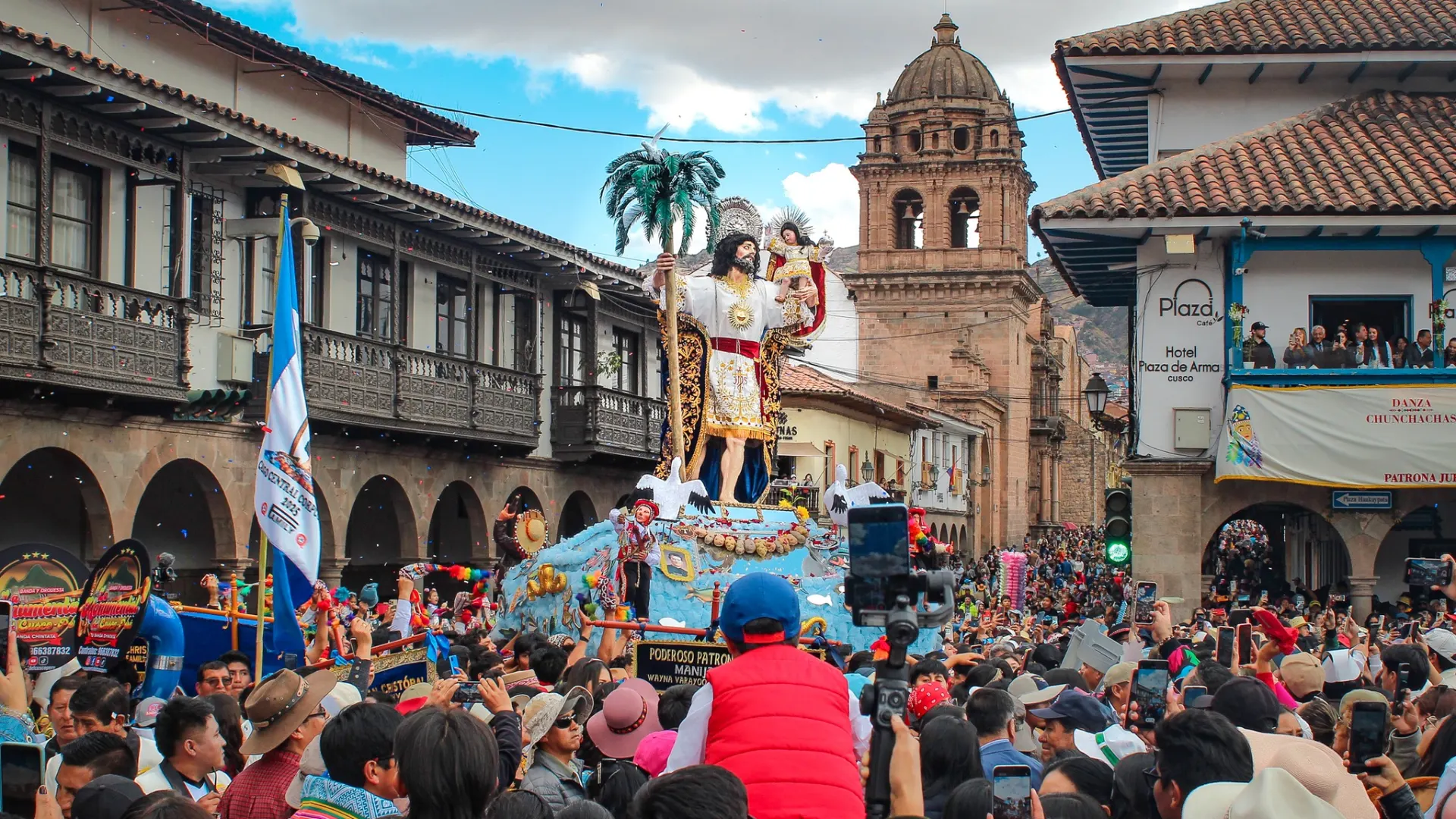
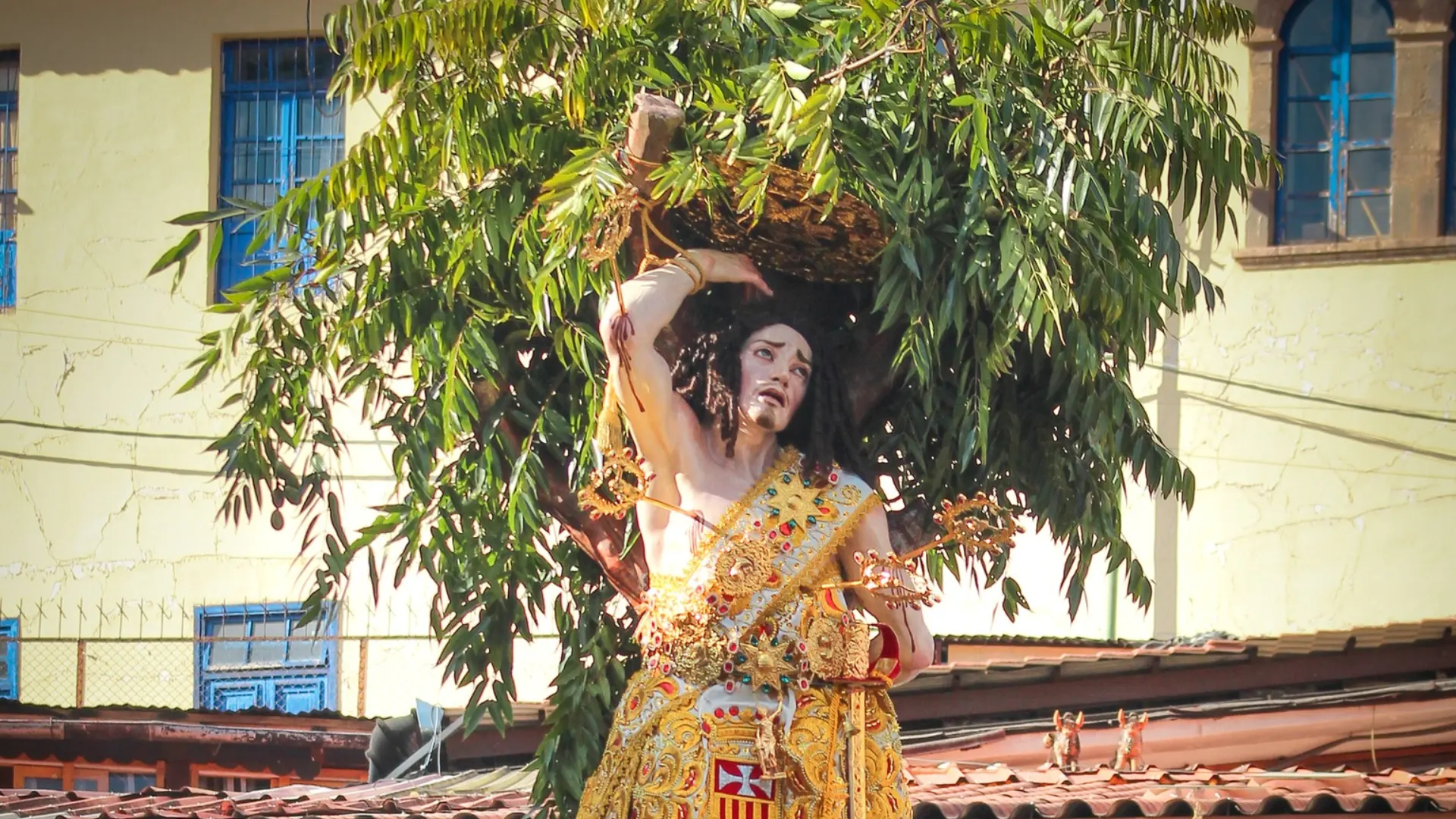
4. Saint Sebastian — Temple of San Sebastián
Saint Sebastian was a Roman soldier who secretly converted to Christianity and was executed for his faith in the 3rd century. He is depicted with arrows and is often invoked as a protector against disease and suffering.
Legend: In Cusco, Saint Sebastian is affectionately known as “Calapatita,” meaning “the barefoot one.” His devotees carry his platform barefoot all the way from his parish to the Cathedral as a sign of devotion and sacrifice. His community is also famous for its discipline and organization, often arriving among the first at the celebration.
5. Saint Barbara — Parish of the Sweet Name of Jesus
Saint Barbara is invoked for protection against storms, lightning, and natural disasters. In the Andean highlands, where sudden storms are common, she holds special importance.
Legend: According to tradition, Barbara was a beautiful princess whose father locked her in a tower to prevent her from meeting any men. Overcome with sadness, she wept endlessly. Her tears gathered into a powerful storm that struck the tower with lightning and fire. From that moment, she became associated with the power of storms and protection against natural disasters.
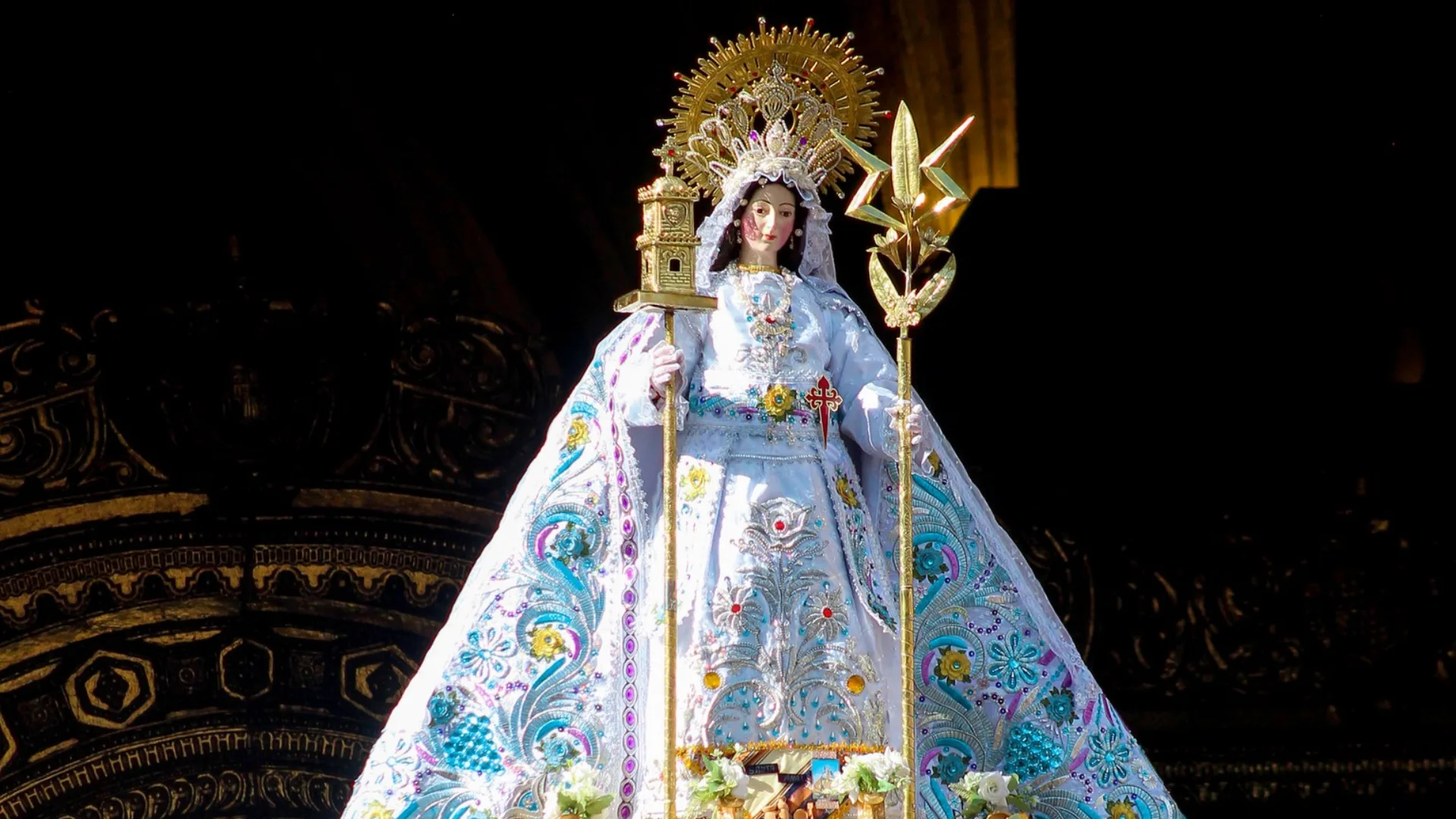
6. Saint Anne — Temple of Santa Ana
Saint Anne is the mother of the Virgin Mary and the grandmother of Jesus. She symbolizes family values and the transmission of faith between generations.
In Cusco, she is also affectionately known as the patroness of the city’s traditional food stalls and picanterías.
Legend: Saint Anne is famous for making the best chicha de jora in the city. However, Saint Christopher is known for secretly drinking it whenever he visits. In the days before Corpus Christi, Saint Anne is said to complain loudly: “Who drank my chicha and didn’t even leave a drop?” Everyone already knows the answer.
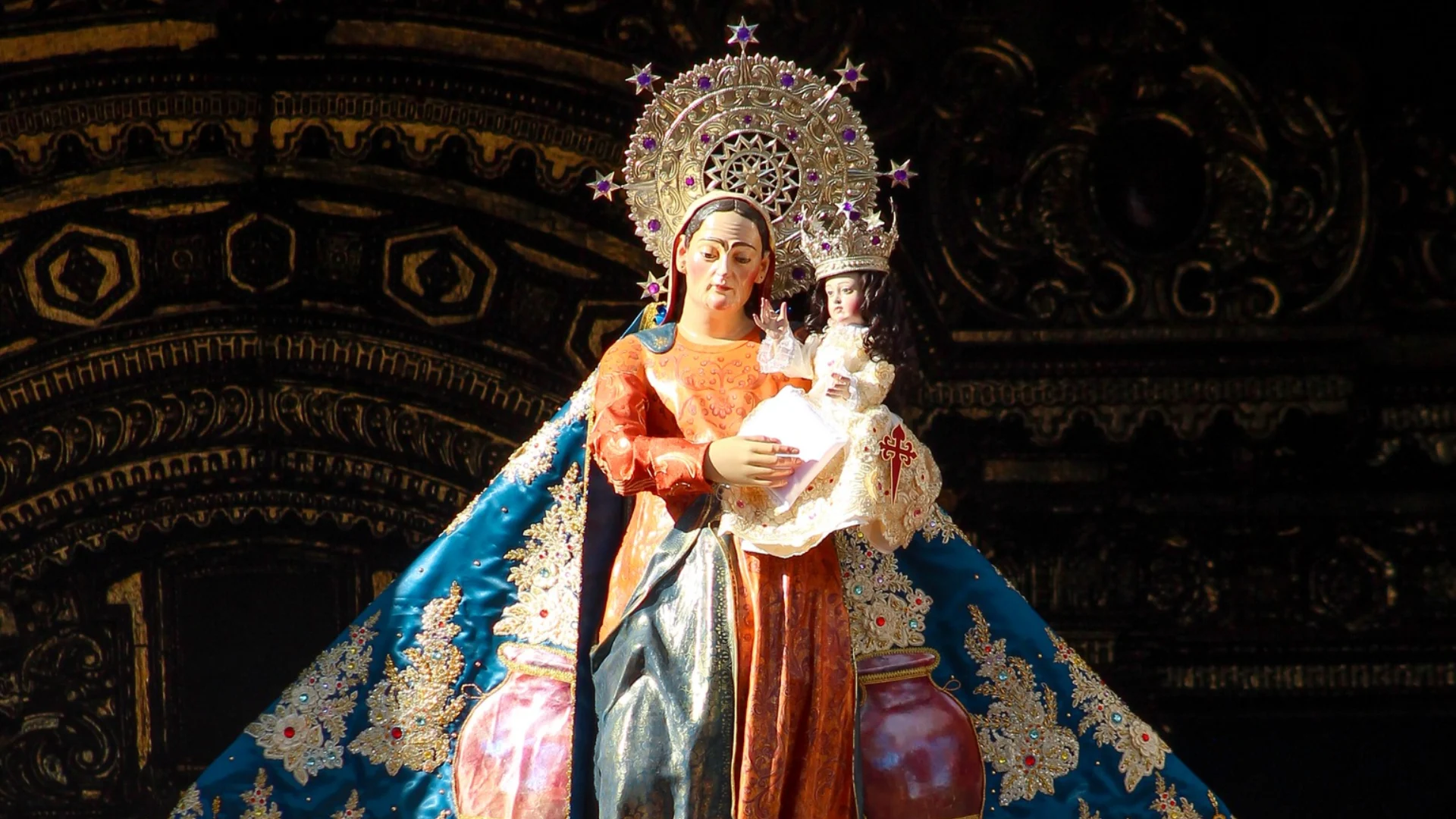
7. Saint James the Apostle — Temple of Santiago
Saint James, also known as Santiago, is portrayed as a powerful warrior on horseback and symbolizes the defense of the Christian faith.
In the Andes, he became associated with Illapa, the Inca god of thunder and lightning one of the clearest examples of religious syncretism between Catholic and Andean beliefs.
Legend: According to local stories, Saint James once borrowed Saint Sebastian’s horse and promised to return it. Unfortunately, Sebastian died in battle before Santiago could return it. Since then, the debt remains unpaid. Another legend says that some saints prefer Santiago not to enter the Cathedral because his energetic personality causes too much commotion.
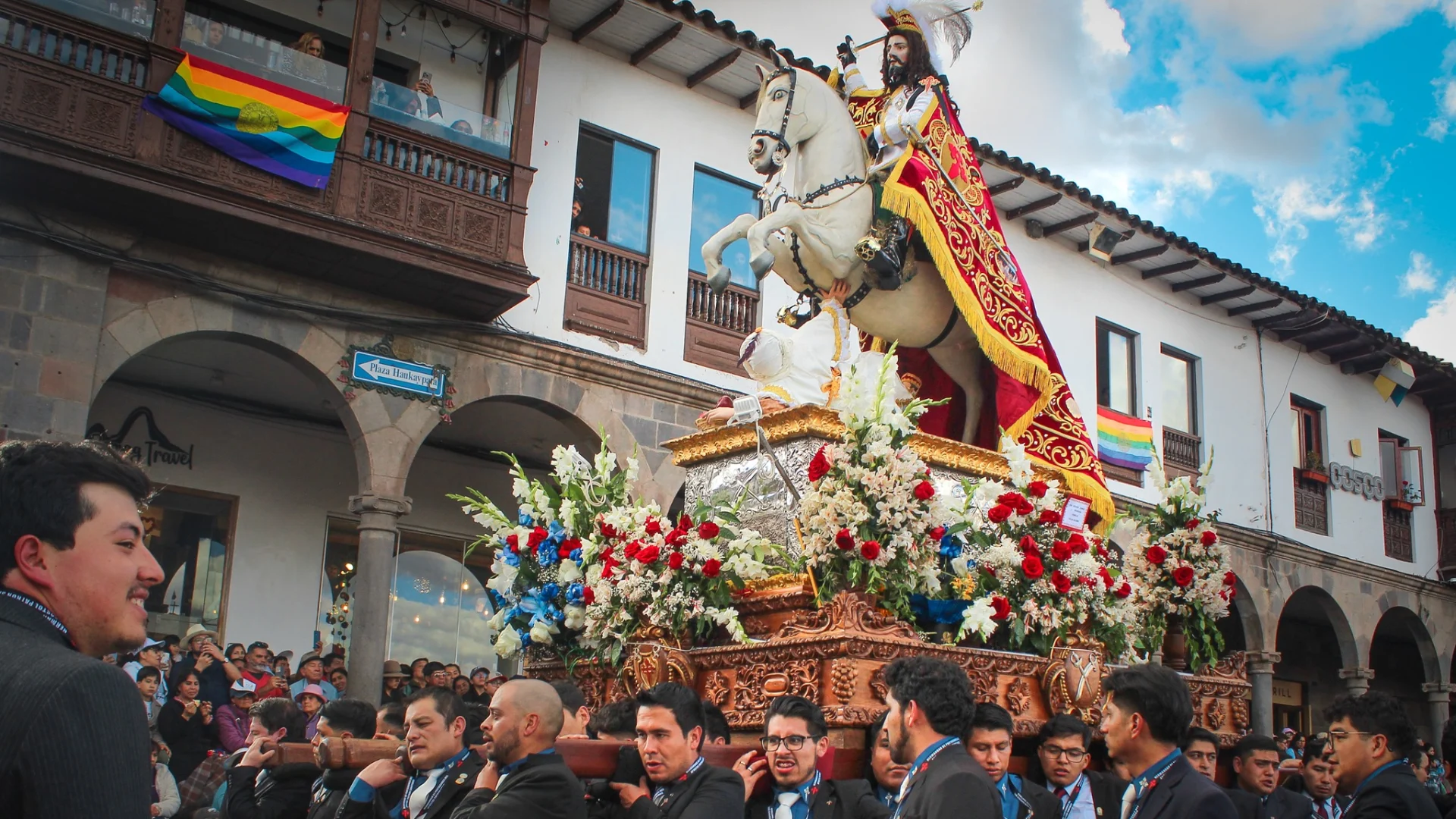
8. Saint Blaise — Temple of San Blas
Saint Blaise is the protector of the throat and is associated with healing and medicine. He is also the patron saint of the historic artisan neighborhood of San Blas.
Legend: Saint Blaise is known in Cusco as one of the most sociable saints. Local jokes say that the gesture of his raised fingers during the procession actually means, “Two more chichas before we leave.” Because of this, he is often described as the most cheerful and approachable of all the saints.
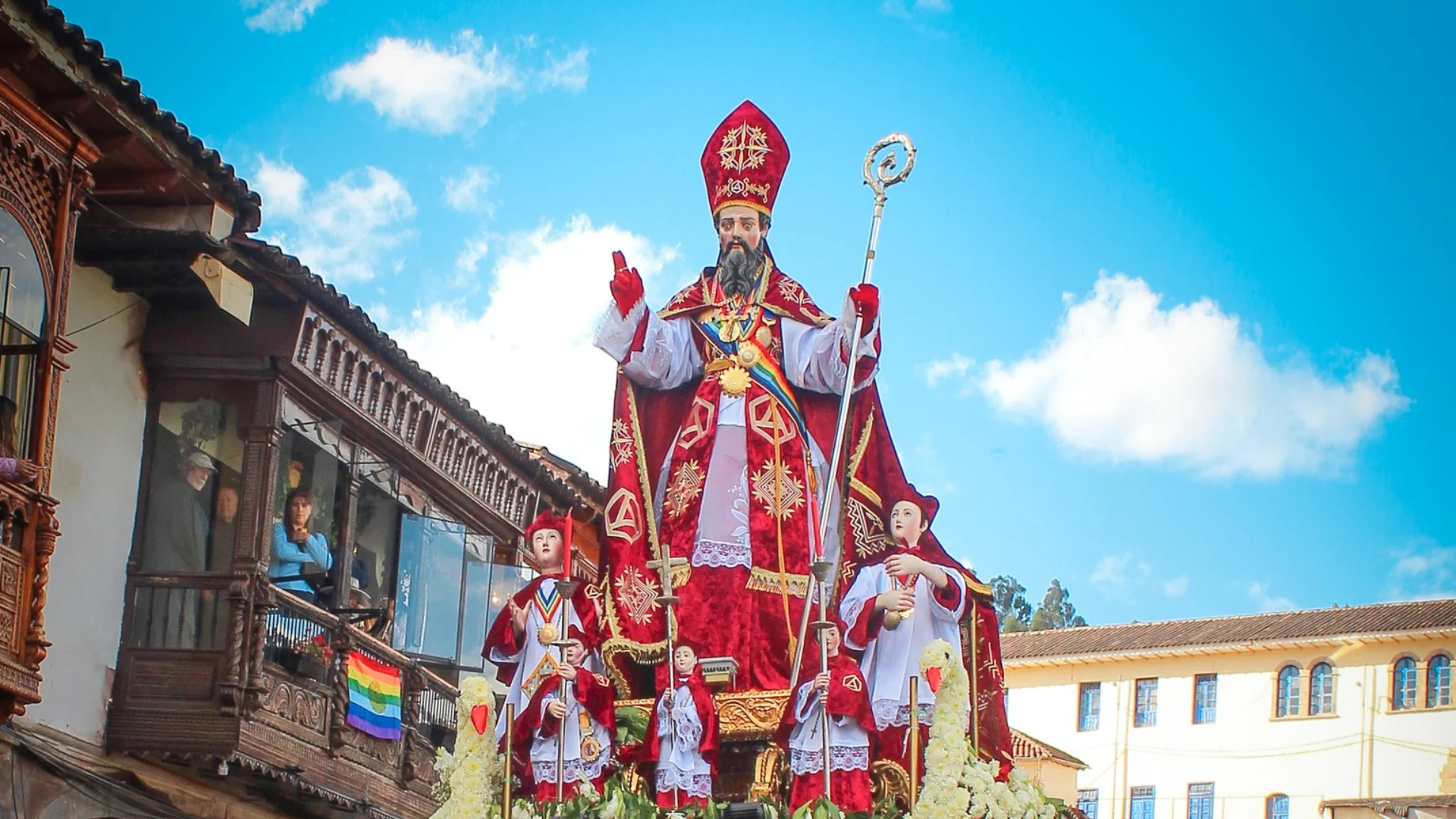
9. Saint Peter the Apostle — Temple of San Pedro
Saint Peter is considered the founder of the Catholic Church and the first Pope. He is represented with the keys of heaven, symbolizing his authority within the Church.
Legend: During the eight days that the saints remain inside the Cathedral after Corpus Christi, Saint Peter is said to act as the messenger among them. According to tradition, he shares news about the city and its people with the other saints, often in a lively and entertaining way.
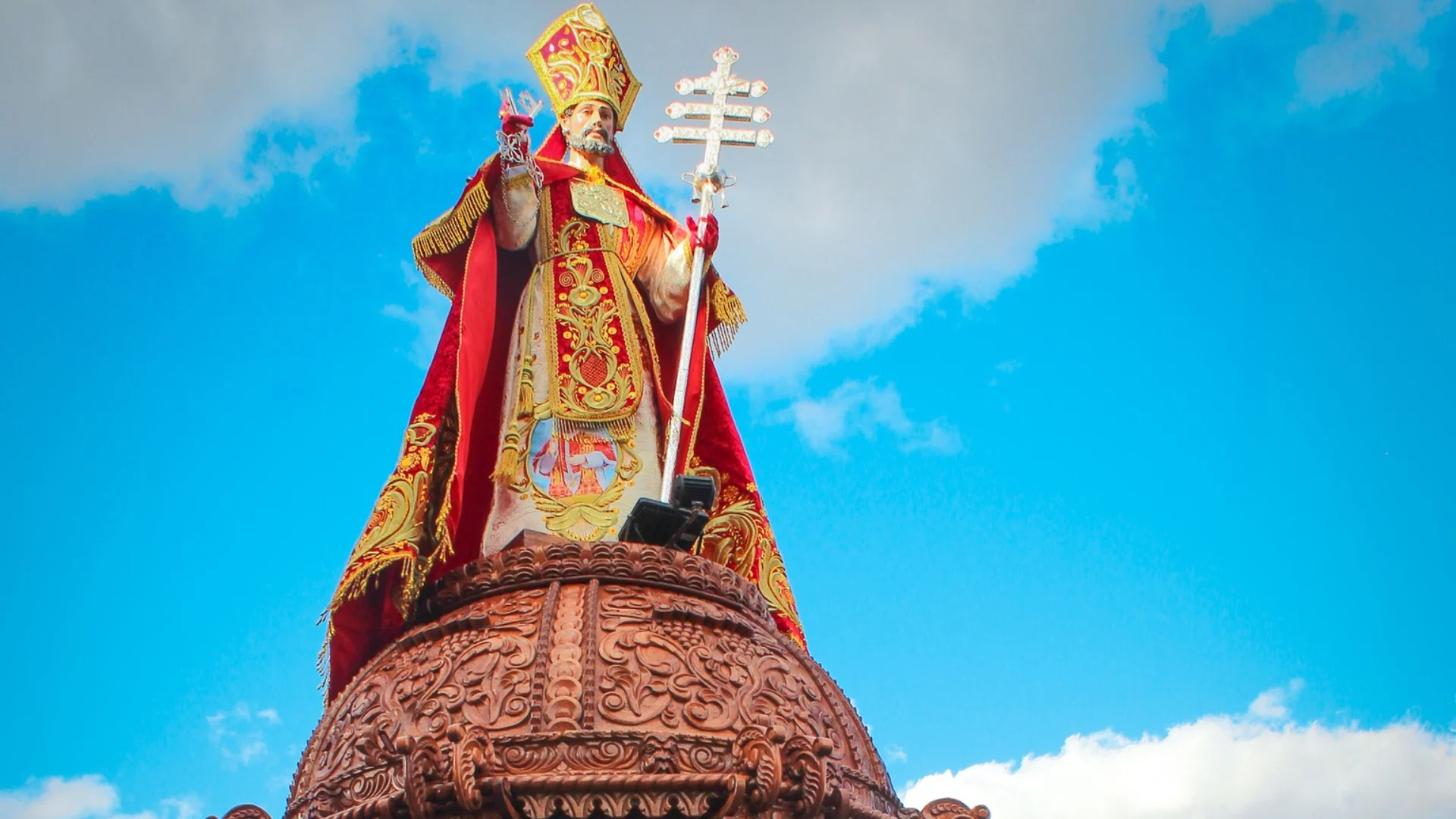
10. Saint Joseph — Temple of Belén
Saint Joseph, the husband of the Virgin Mary, is the patron saint of workers and families. In Cusco he represents humility, protection, and devotion to family life.
Legend: In local stories, Saint Joseph is portrayed as extremely jealous of the attention given to Mamacha Belén, the Virgin of Bethlehem. Because she is admired by many saints during the festival, Joseph is said to keep a watchful eye on anyone who gets too close to her.
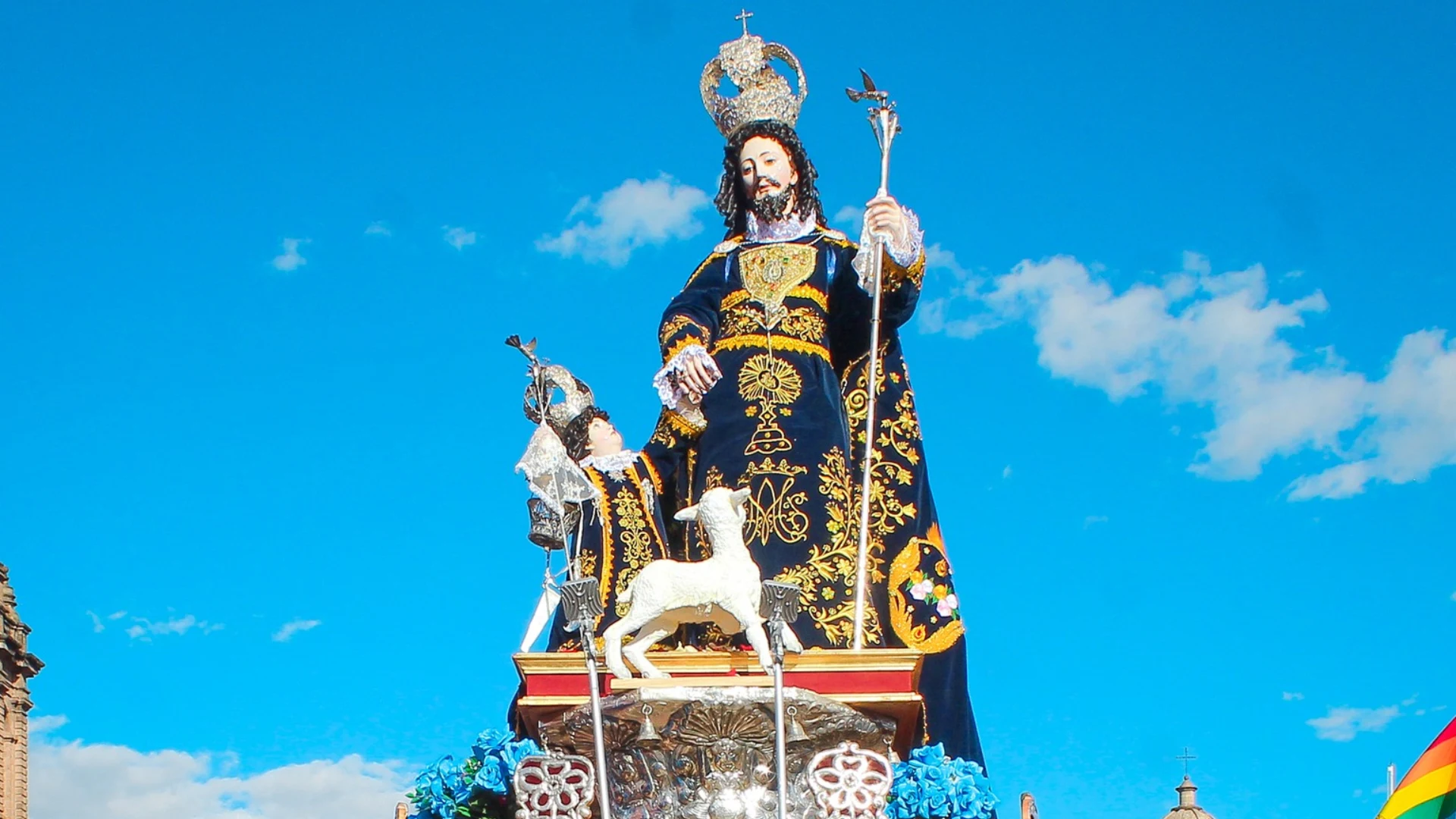
11. Virgin of the Nativity (Nati) — Temple of La Almudena
The Virgin of the Nativity represents the birth of the Virgin Mary and symbolizes hope and renewal. Locals affectionately call her “Nati.”
Legend: Nati is known as the humblest of all the Virgins. Her clothing and decorations are simpler compared to the others. According to popular stories, Mamacha Belén sometimes mocks her modest appearance, but Nati calmly replies that humility is more valuable than wealth.
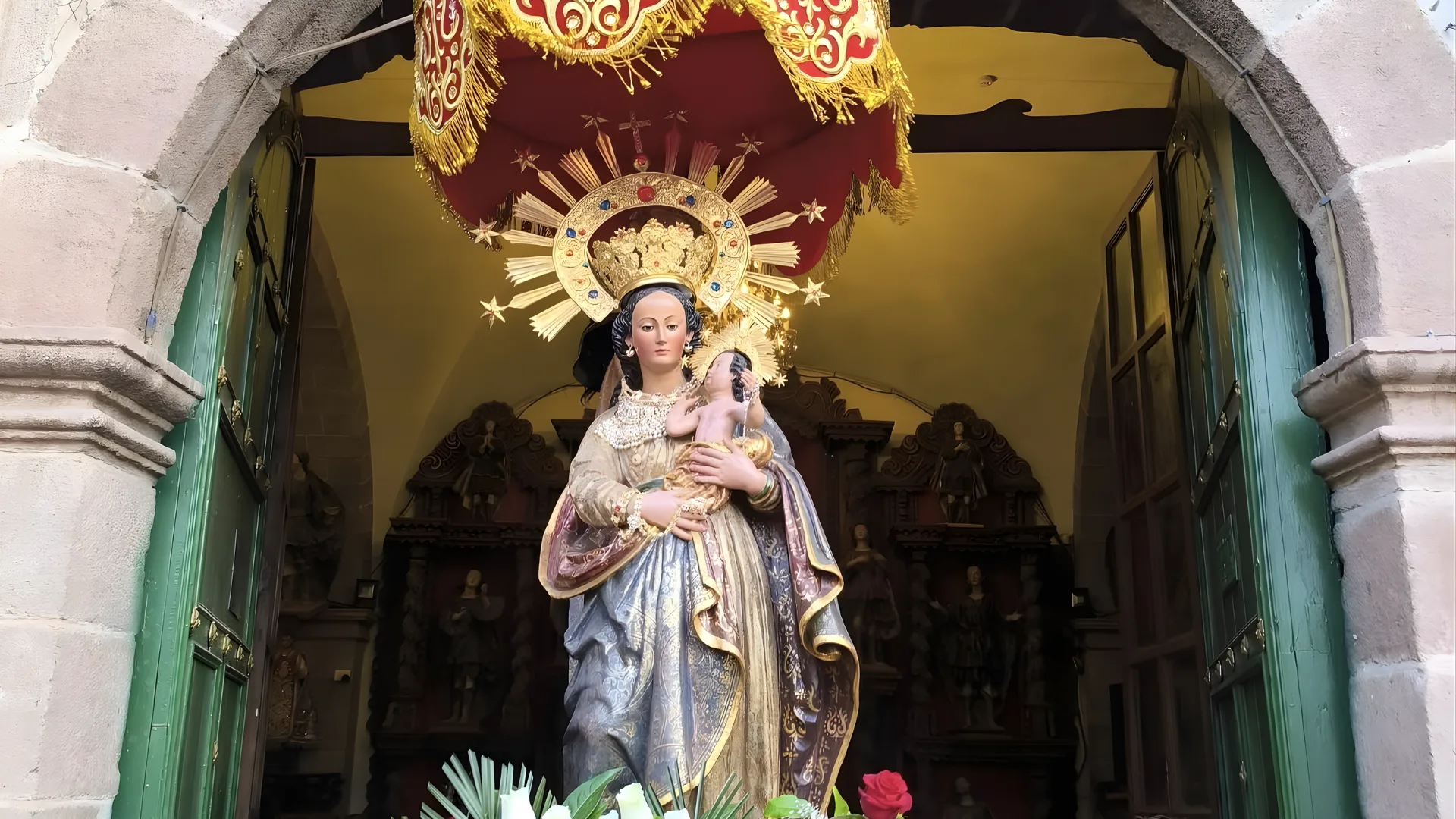
12. Virgin of the Remedies — Temple of Santa Catalina
The Virgin of the Remedies is known for her healing power and is considered one of the oldest images participating in the Corpus Christi celebration.
Legend: This Virgin is often depicted with children. According to tradition, couples who wish to have children pray to her for a miracle. Many families who believe their prayers were answered return every year to thank her during the festival.
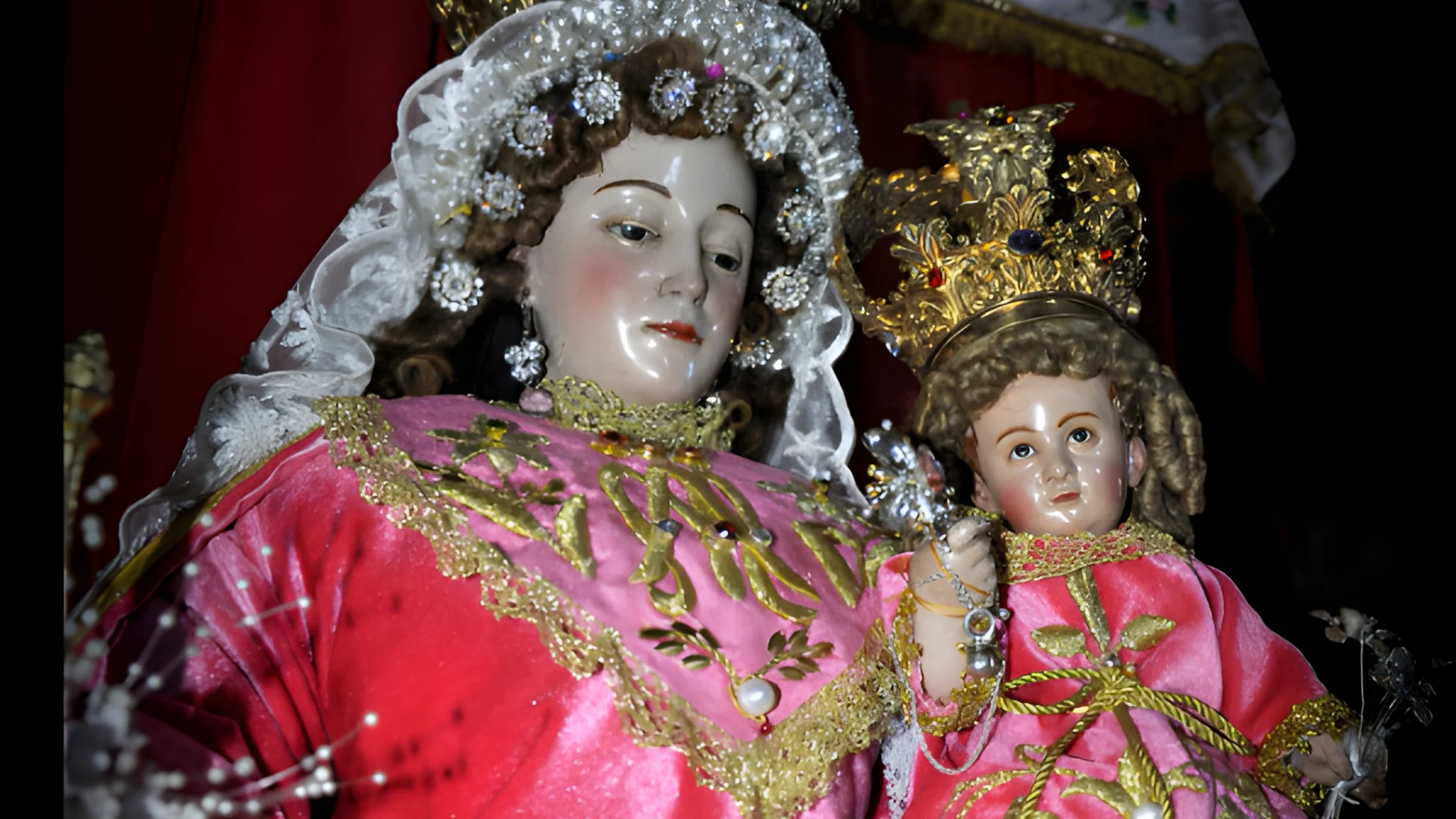
13. Virgin of the Purification – “The Millionaire” — Temple of San Pedro
Also known as the Virgin of Candelaria, she symbolizes spiritual purification and faith. Her statue is covered with jewels and precious ornaments.
Legend: Because of the large amount of jewelry she wears, people jokingly call her “the millionaire.” Despite her luxurious appearance, local stories describe her as friendly and cheerful, someone who enjoys celebrating with the community.
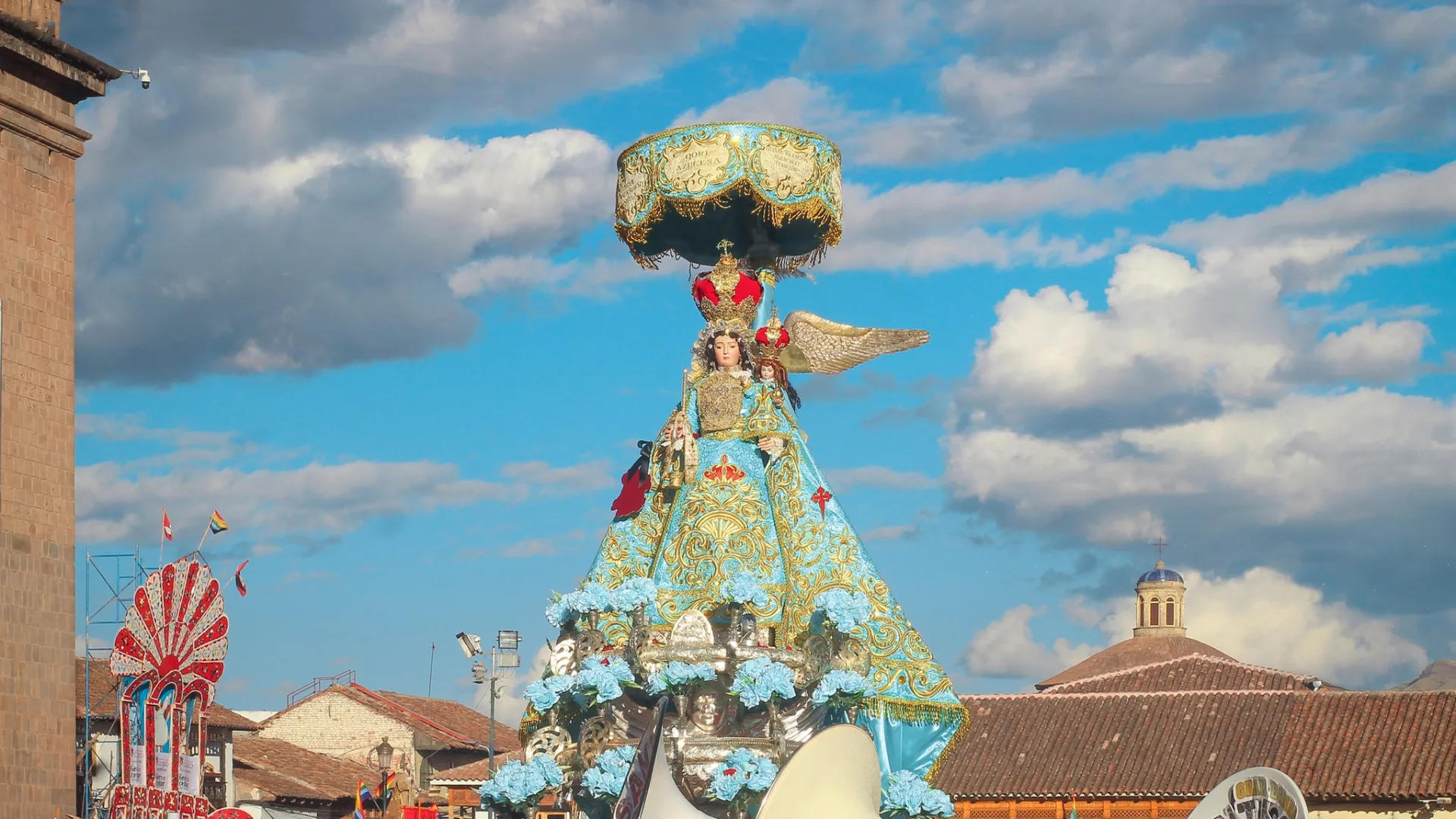
14. Mamacha Belén — Temple of Belén
Mamacha Belén is one of the most beloved Marian images in Cusco and is considered the Patroness of the city.
She is richly decorated with jewels and is famous for her elegant appearance.
Legend: In popular stories, Mamacha Belén is described as proud of her beauty and aware that she receives the most admiration during the festival. However, this playful vanity only increases the affection that people feel for her.
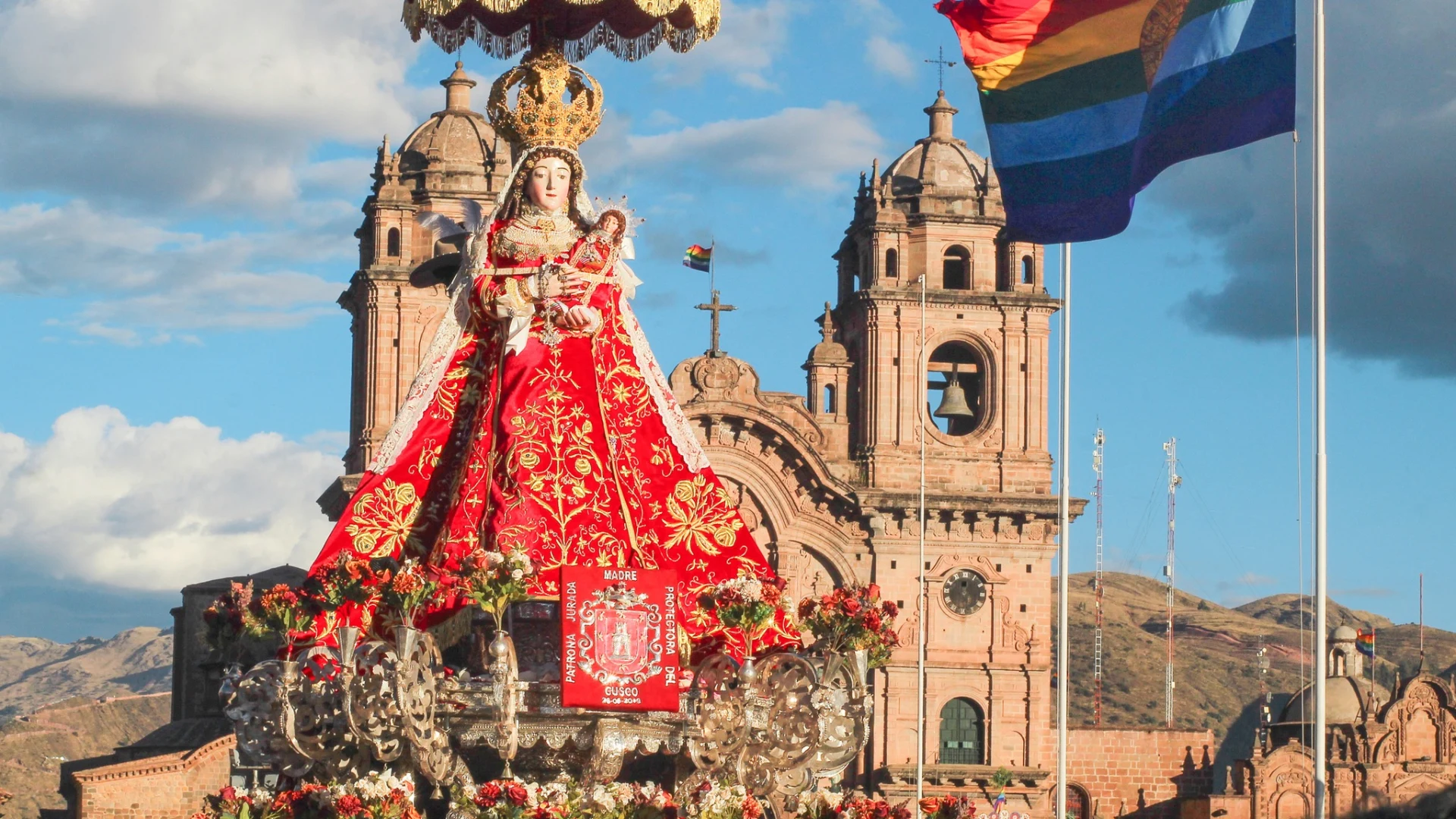
15. The Immaculate Conception – “La Linda” — Cusco Cathedral
Known as “La Linda” (The Beautiful One), the Virgin of the Immaculate Conception is the hostess of the Cathedral and the final image in the procession.
Legend: La Linda is seen as the elegant host who welcomes all the visiting saints during the eight days they remain in the Cathedral. Some stories say that during the nights she quietly leaves the Cathedral to visit her friends among the other Virgins before returning before anyone notices.
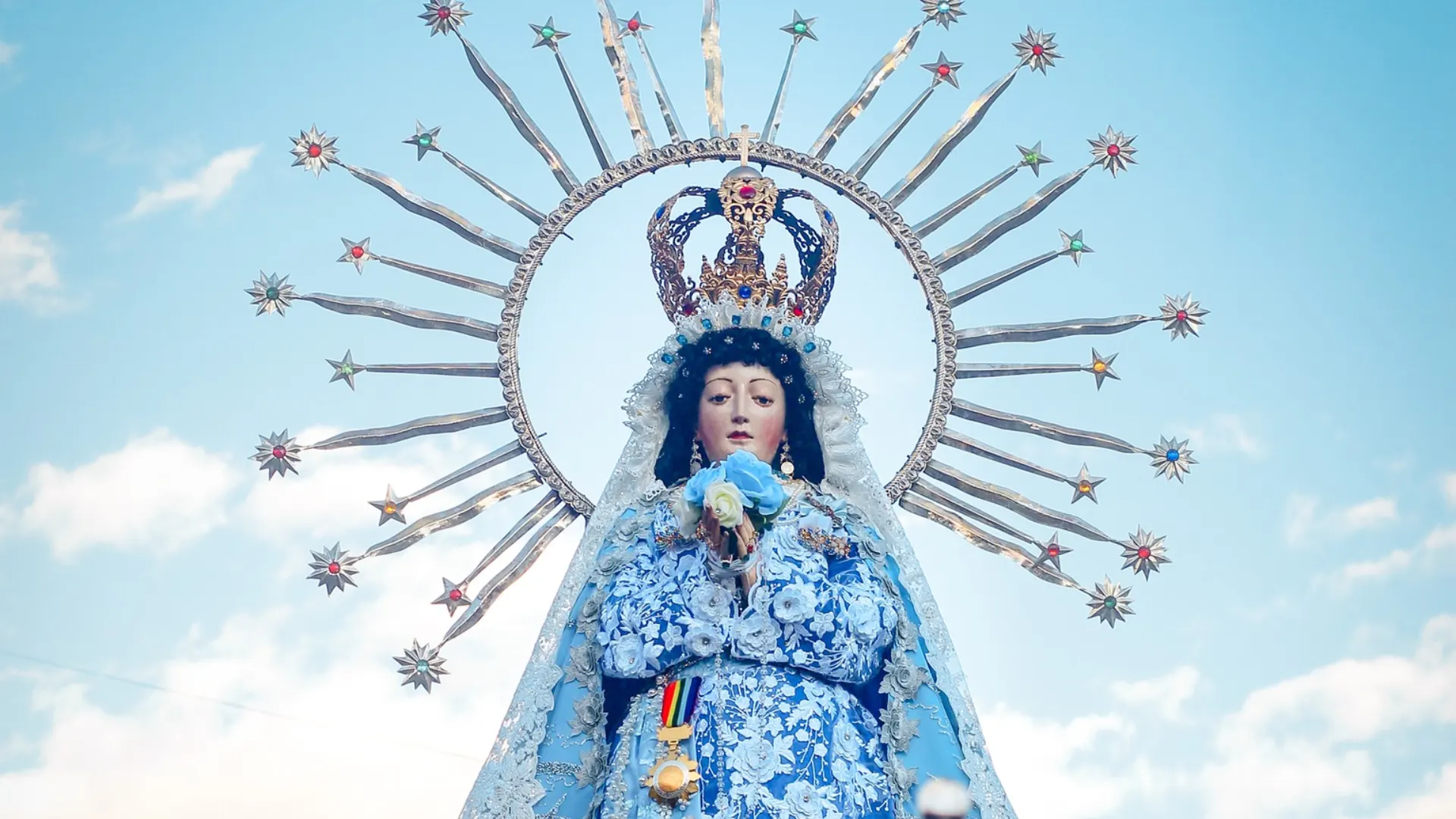
La Octava de Corpus Christi
If the Thursday procession is the opening act of Corpus Cristi Cusco, then La Octava is the emotional finale. Eight days after the central celebration, the 15 saints and virgins that have been residing together inside the Cathedral make their journey home.
What Is La Octava?
The word octava comes from Latin, meaning “eighth.” In Catholic liturgical tradition, the eight days following a major feast are treated as a continuation of the celebration. In Cusco, La Octava de Corpus is not a formality it is treated by locals with nearly the same weight as the main Corpus Cristi day.
The Eight Days Between
During the eight days the saints spend inside the Cathedral, the faithful come daily to visit. Masses are celebrated, prayers offered, and the communal atmosphere of Corpus Cristi Cusco continues through the week.
In Andean popular tradition, these eight days are described as a time when the saints are “visiting each other” sharing news about their communities, comparing their year’s experiences, and enjoying each other’s company before the long separation begins again. Given the characters described above Jerome’s lion, Anthony’s wandering piglet, Santiago’s disruptive energy, Joseph’s jealousy, and the running drama between Mamacha Belén and Nati the Cathedral during these eight days must be a lively place indeed.
The Return Procession
On the eighth day a Thursday, mirroring the main Corpus Cristi day each saint is carried out of the Cathedral one final time. The format mirrors the original procession: brass bands, traditional dancers, the community walking in devotion. But the atmosphere is entirely different.
There is a bittersweetness to La Octava that you cannot prepare for. The saints are leaving. The neighborhoods are reclaiming their patrons. You can see it in the faces of the faithful the mixture of pride, devotion, and a quiet grief. By nightfall, the Plaza de Armas is quiet. Cusco has returned to ordinary time.
Why La Octava Is Worth Attending
Most visitors to Corpus Cristi Cusco miss La Octava entirely. This is one of the great missed opportunities in Andean travel. The farewell procession is less crowded, more intimate, and in many ways more emotionally resonant than the main event. Consider arranging to stay for La Octava follow a single saint from the Cathedral all the way back to its parish church and you will understand Corpus Cristi Cusco in a way that no main-day tourist ever does.
La Octava de Corpus
- How to find the date: Add eight days to the main Corpus Cristi day of any given year
- What happens: All 15 saints carried from the Cathedral and returned to their home parishes
- Atmosphere: Intimate, less crowded, deeply emotional arguably the most authentic day
- Best experience: Follow one saint from the Cathedral all the way back to its parish
Chiriuchu: The Sacred Dish of Corpus Cristi Cusco
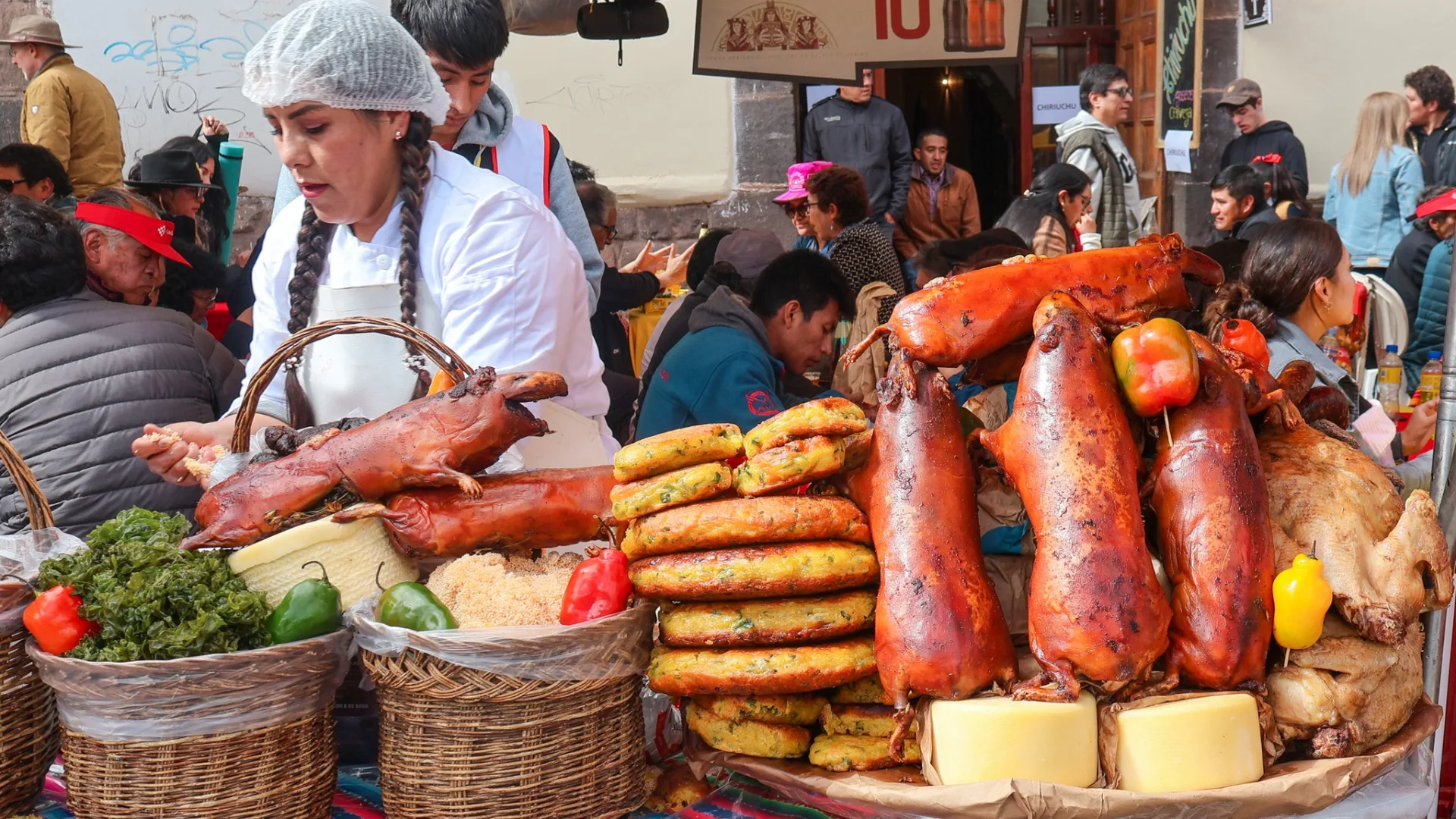
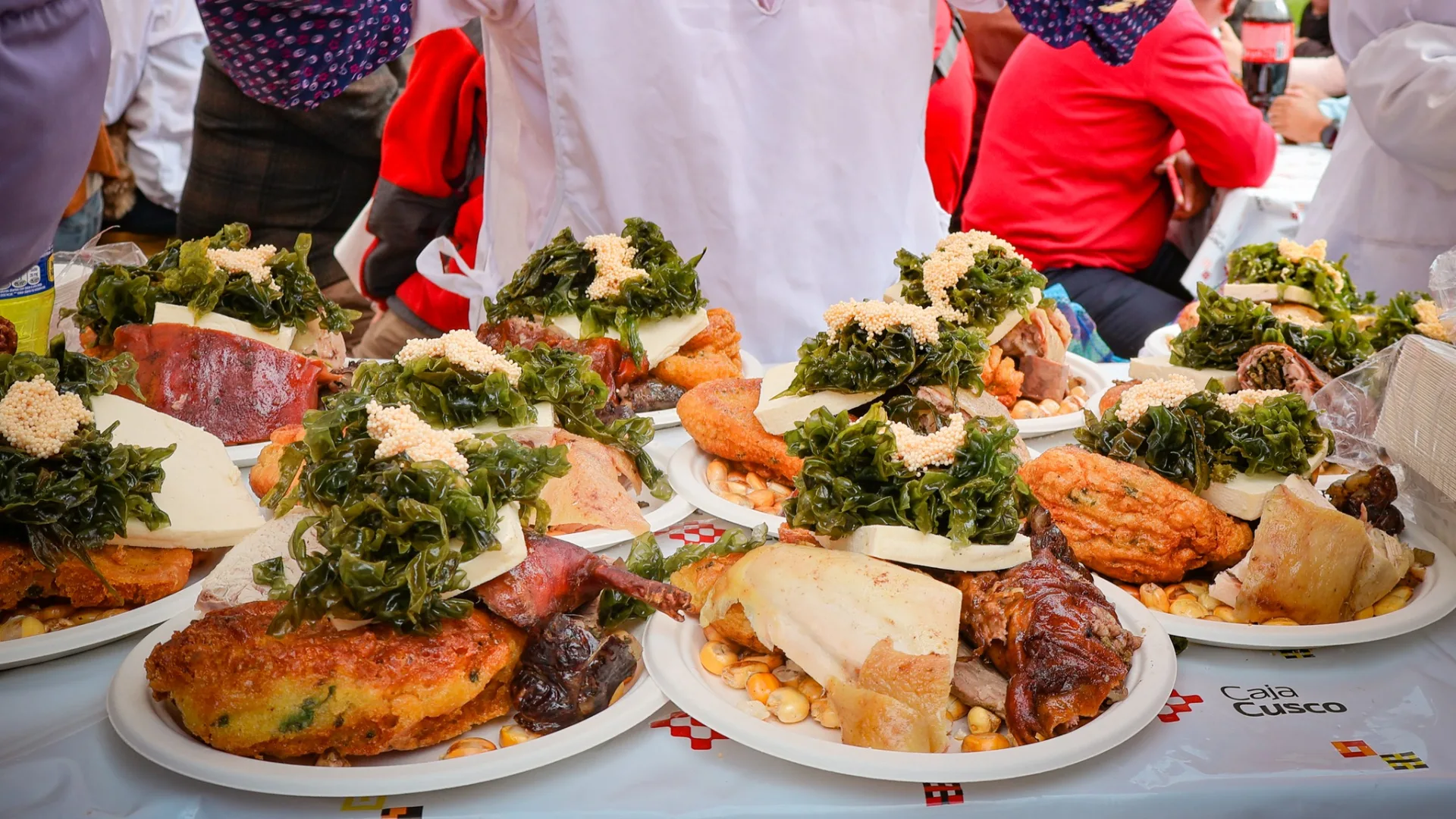
You cannot experience Corpus Cristi Cusco without eating Chiriuchu. This cold platter the word comes from Quechua and means “cold spicy” is the emblematic dish of the festival. It tells the story of the entire Inca Empire in a single serving: ingredients drawn from every ecological region of Peru, united on one plate.
Ingredients of Traditional Chiriuchu
- Cuy: Roasted guinea pig from the Andean highlands
- Chalona / charki: Dried alpaca or llama meat
- Chicken: Boiled or roasted
- Cochayuyo: Dried seaweed from the Pacific coast
- Fish roe: Representing the rivers and lakes
- Cusco chorizo: Local sausage
- Corn tortilla: From the Sacred Valley
- Cancha: Toasted Andean corn
- Fresh cheese
- Rocoto pepper: For heat
Everything is served cold unusual in Andean cuisine and the combination of flavors is complex, earthy, briny, smoky, and subtly spicy. Family-run stalls at San Francisco Square have preserved the same recipe for over 50 years. Get there before noon it sells out fast.
Andean Roots & Catholic Traditions: A Festival of Two Worlds
Corpus Cristi Cusco unapologetically inhabits two spiritual worlds at once. Officially it is a Catholic feast. But look beneath the surface and you find the unmistakable structure of something far older: the great Inca plaza gatherings, the processional format of the mallqui rituals, the communal feasting that echoes the sacred banquets of the Huacaypata.
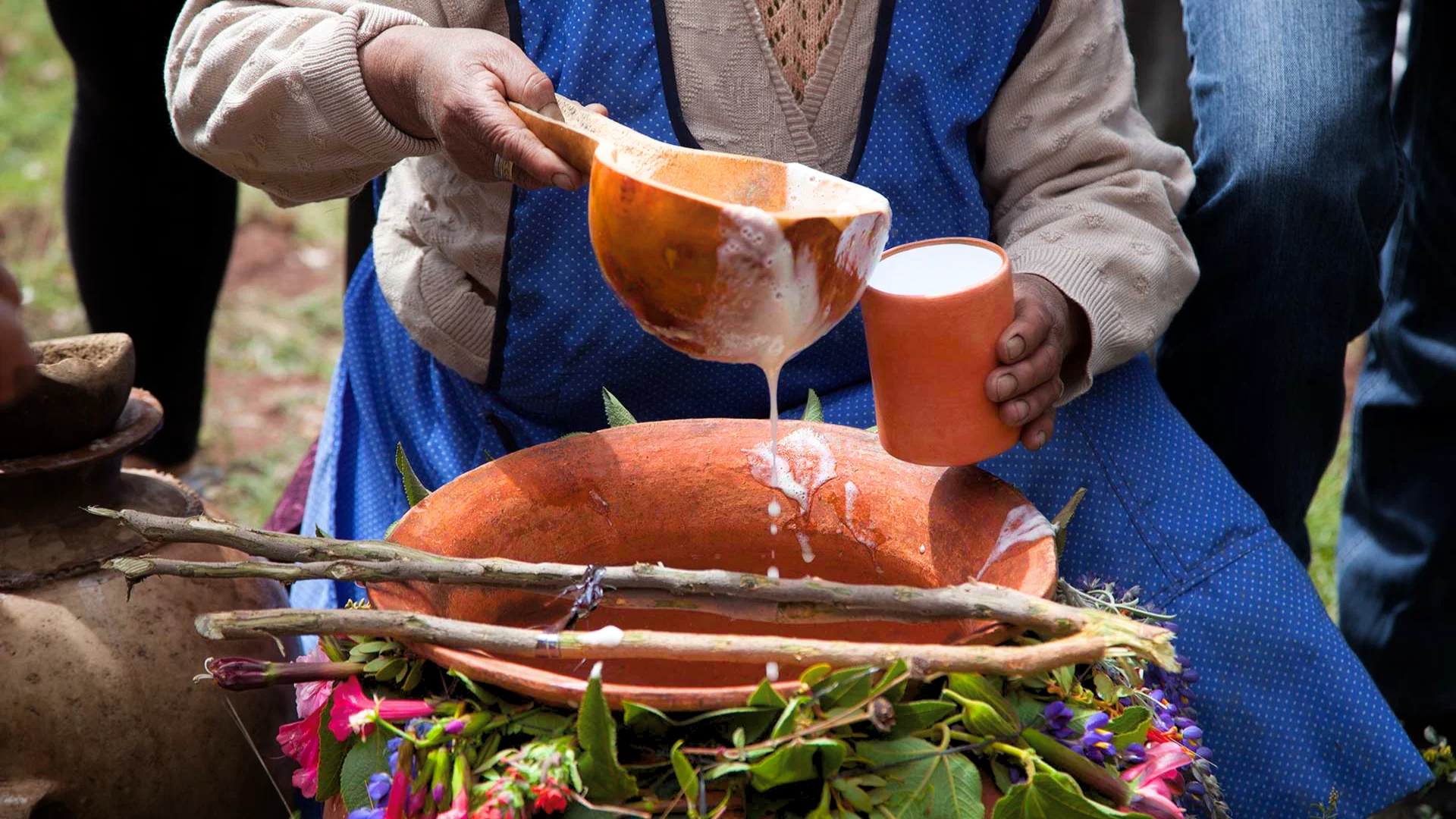
The mass on Corpus Cristi day is sung partly in Quechua the language of the Empire the Spanish thought they had replaced. The saints are dressed in Andean textiles as much as European robes. The chicha de jora consumed during the festival is the same sacred drink that was offered to the Inca ancestors. The stories told about the saints their jealousies, their chicha habits, their midnight escapes sound much more like Andean community life than European hagiography.
Corpus Cristi Cusco also shares its spiritual season with Qoyllurit’i the great Andean pilgrimage to the glacier sanctuary of Ausangate which ends in Cusco just days before the main festival. The energy of one flows directly into the other, creating the most spiritually charged period in the entire Andean calendar.
Why Corpus Cristi Cusco Is One of Peru’s Most Important Festivals
Every city has its festivals. But Corpus Cristi Cusco occupies a different category. This is not a tourism event invented to fill hotel rooms. It is a living tradition that has survived the fall of the Inca Empire, five centuries of colonial history, and everything the modern world has thrown at it. It is still here. It is still entirely itself.
For locals, Corpus Cristi is not a spectacle to witness it is something to be participated in, funded, organized, and carried on literal shoulders. For visitors, witnessing Corpus Cristi day in Cusco is one of the genuinely irreplaceable experiences of travel in South America. You are not watching a performance. You are watching a city be fully, unreservedly itself.
“For the people of Cusco, the festival is a reunion of saints, of communities, of the living and the memory of those who came before.”
Recommendations for Visitors Attending Corpus Cristi Cusco
Before You Arrive
- Book accommodations 6–8 weeks in advance: Cusco fills quickly for Corpus Cristi day, especially Plaza de Armas balcony hotels
- Arrive 2–3 days early to acclimatize to the altitude (3,400m / 11,150ft) before the festivities
- Reserve balcony restaurant tables weeks ahead — the best views of the procession are from second-floor terraces overlooking the Plaza
- Plan your visit to include both Corpus Cristi day and Inti Raymi (June 24 each year) for the most culturally immersive week in the Andean calendar
During the Festival
- Don’t skip Wednesday night: La Entrada is intimate, photogenic, and far less crowded than the main Thursday procession
- Enter the Cathedral on Thursday morning to see all 15 images assembled together in one extraordinary space
- Wear layers: June means cold mornings (5–8°C), warm middays (16–18°C), and cold evenings
- Bring cash: festival vendors are mostly cash-only
Food & Drink
- Chiriuchu at San Francisco Square before noon — the best family-run stalls sell out fast
- Try chicha de jora (fermented corn beer) from street vendors — the same drink Saint Christopher can’t resist
- Book a balcony restaurant table on the Plaza de Armas well in advance to eat well while watching the procession
Frequently asked questions about Corpus Christi in Cusco History, Procession of the Saints and Traditions
Corpus Cristi is a Catholic feast day that honors the presence of Christ in the Eucharist. In Cusco, it holds deep cultural significance far beyond Catholic doctrine blending 500 years of colonial faith with the ancient Andean traditions it replaced. Today, Corpus Cristi Cusco is one of the most iconic religious and cultural events in Peru, recognized as a National Cultural Heritage since 2004.
The celebration arrived with Spanish colonization in the 1530s. Spanish missionaries deliberately scheduled it near the Inca festival of Inti Raymi and replaced the Inca practice of parading mummified ancestors with processions of Catholic saints. Over five centuries, Andean customs were woven into the celebration, creating a tradition of profound cultural syncretism that continues to evolve today.
The 15 images are: Saint Anthony the Abbot, Saint Jerome, Saint Christopher, Saint Sebastian, Saint Barbara, Saint Anne, Saint James the Apostle, Saint Blaise, Saint Peter, Saint Joseph, the Virgin of the Nativity (Nati), the Virgin of Remedies, the Purified Virgin (the Millionaire), the Virgin of Bethlehem (Mamacha Belén), and the Virgin Immaculate Conception (La Linda). Each comes from a different parish and has its own beloved stories in Corpus Cristi Cusco’s popular tradition.
The signature dish of Corpus Cristi Cusco is Chiriuchu a cold platter combining guinea pig (cuy), chicken, sausage, dried meat (chalona), corn tortilla, fresh cheese, seaweed (cochayuyo), roasted corn, and rocoto pepper. It represents the geographic diversity of the Inca Empire.