Santurantikuy in Cusco: Tradition, History, and Andean Christmas
In the month of December every year, the city of Cusco recreates one of the most important and genuine manifestations of its identity. The Plaza de Armas in the city of Cusco will become the scene for the Santurantikuy festival, a typical fair that mixes religious beliefs, folk art, historical memory, and the community in the same place during the days of December 22nd, 23rd, and 24th, with the celebration commonly known by the name feria Santurantikuy.
The streets are filled with colors, smells, and festive sounds. Whole families are walking along the booths, artists are carefully designing their handmade goods, and the whole city is living in a different rhythm, dictated by the sense of waiting and the spirit of Christmas. An experience in Santurantikuy is much more than an event; it is a shared experience in which one should be living in a state of serenity, respect, and deep sense of belonging to the most characteristic tradition in Santurantikuy Cusco.
Contrary to many Christmas markets in the world today, Santurantikuy is not an activity born out of commercial or tourist motivations. It is a living tradition that is deeply imbedded in Cusco’s reality, in which Christmas celebrations are experienced from an Andean perspective, filled with symbols, spiritual connotations, recognizing in Santurantikuy Peru a faithful expression of Christmas in an Andean context.
What Is Santurantikuy and Why Is It So Important in Cusco?
Santurantikuy is an artisanal and religious fair primarily dedicated to the sale of sacred images and elements for assembling Christmas nativity scenes, a central tradition in Cusqueño households. Its significance goes far beyond buying figurines; it represents a moment of spiritual and family preparation leading up to Christmas Eve, which is why many visitors describe it as a unique Santurantikuy market focused on tradition rather than modern commercial displays.
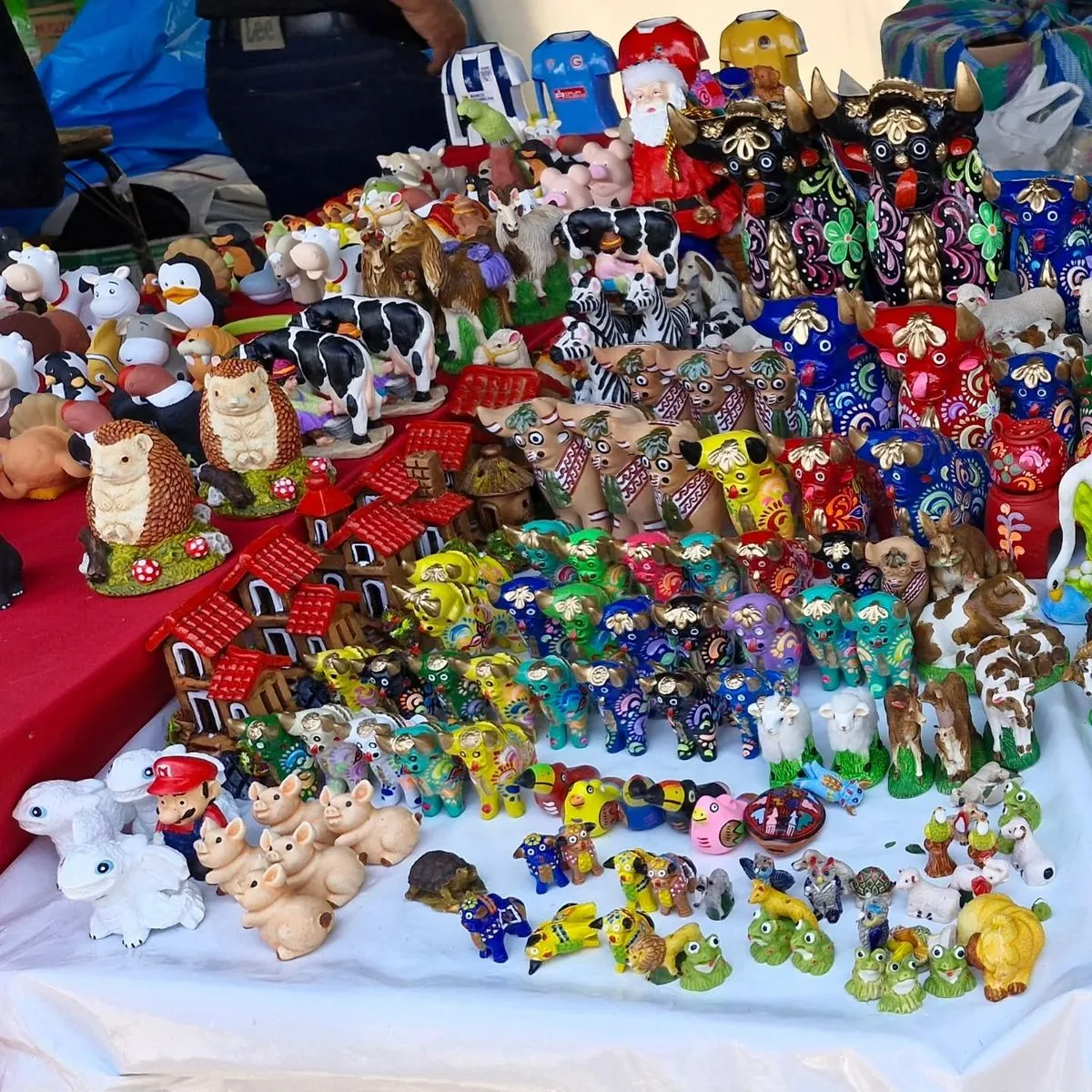
The fair specializes in everything needed to build a complete nativity scene. You’ll find main figures, small decorative pieces, animals, natural materials, and accessories that allow families to recreate the scene in detail. For this reason, many families return year after year, always finding something to complete, renew, or improve especially those who visit the feria de Santurantikuy as part of their annual Christmas ritual.
Although December 24 remains the most symbolic and emotionally charged day, Santurantikuy now takes place over three days. This gives visitors more time to explore the fair at a relaxed pace and engage directly with artisans, particularly for those who want to experience Santurantikuy en Cusco with more time and less rush.
For Cusco, Santurantikuy is not merely an annual fair. It is a cultural practice that connects generations, reinforces local identity, and keeps alive a tradition that has endured centuries of historical and social change, which is why the feria Santurantikuy is considered one of the city’s most meaningful December experiences.
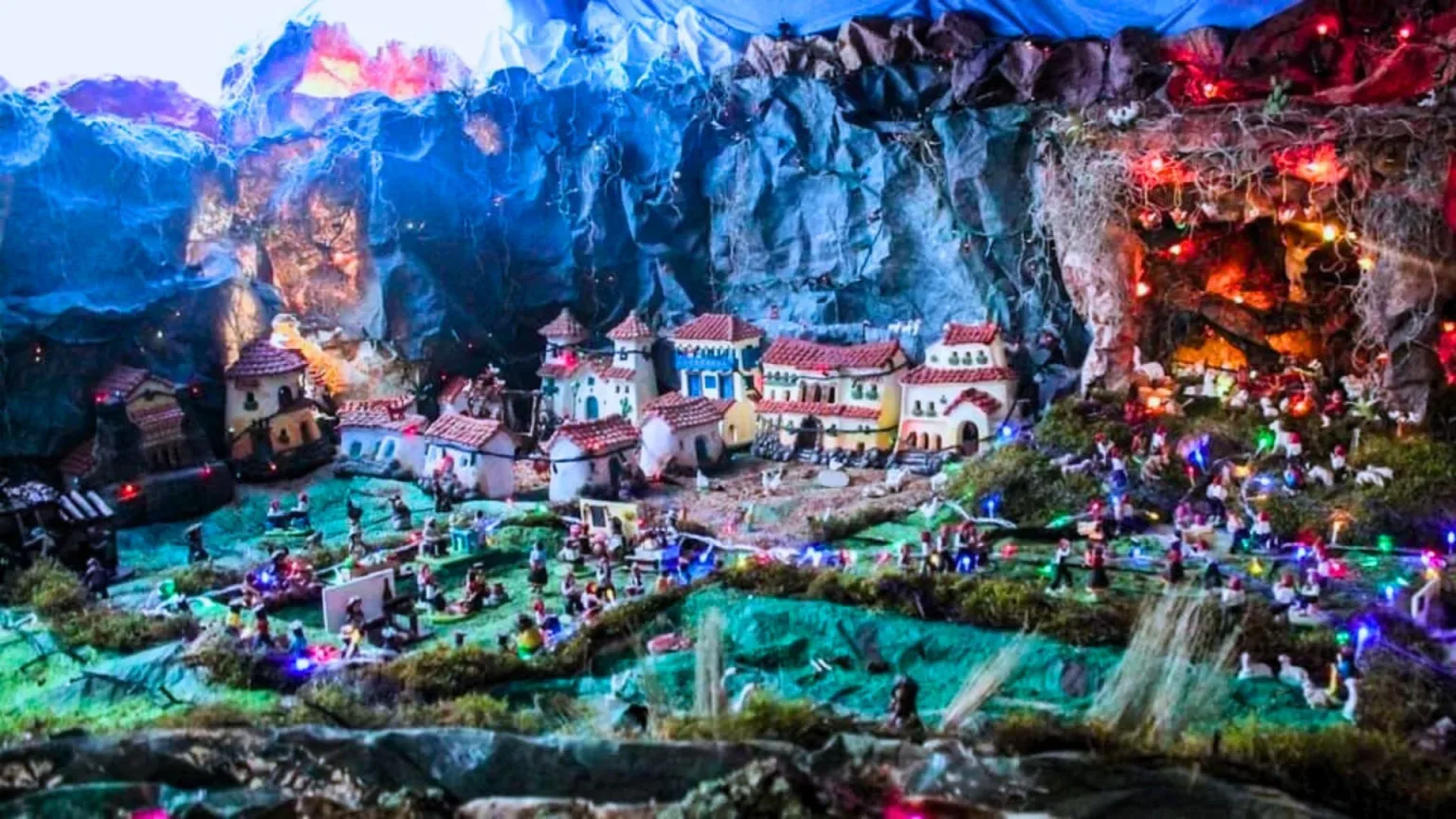
Nativity scenes with pieces from SanturantikuyNativity scenes with pieces from Santurantikuy
The Origins of Santurantikuy: Meaning, History, and Colonial Roots
Santurantikuy was practiced as early as the early colonial period in which Cusco was experiencing a major transformation in culture, religion, and society making it an origin that explains why Santurantikuy in Cusco has so much meaning.
What Does “Santurantikuy” Mean in Quechua?
Santurantikuy originates from Quechua, a combination of “santu,” meaning “saint,” and “rantikuy,” which is a phrase that means “buy/sell.” Its interpretation is “the buying and selling of saints.”
The translation helps people who come to learn not only its meaning but also aids in proper santuranticuy pronunciation, considering that it originated from Quechua and appears unfamiliar to some people.
Within the Andean culture, however, rantikuy is a transaction that is symbolically and culturally richer than a simple mercantile transaction. It is for this reason, then, that Santurantikuy is a space that is much more than a market, and this is why the Santurantikuy market is so different from a typical holiday market.
Importance of Santurantikuy within the festivals of Peru
Among all the traditional feasts in Peru, Santurantikuy holds a singular place because of its historic depth and symbolic richness. Unlike other religious feasts, it is not confined to merely liturgical acts but rather brings together art, faith, community, and living tradition, which makes Santurantikuy Peru one of the most relevant references when talking about Andean Christmas culture.
Its importance lies in this capacity for the conservation of ancestral usages in its natural adjustment to contemporary Cusco. In time, Santurantikuy Cusco has turned into one of the most genuine expressions of Andean Christmas and a symbol of regional and national identity.
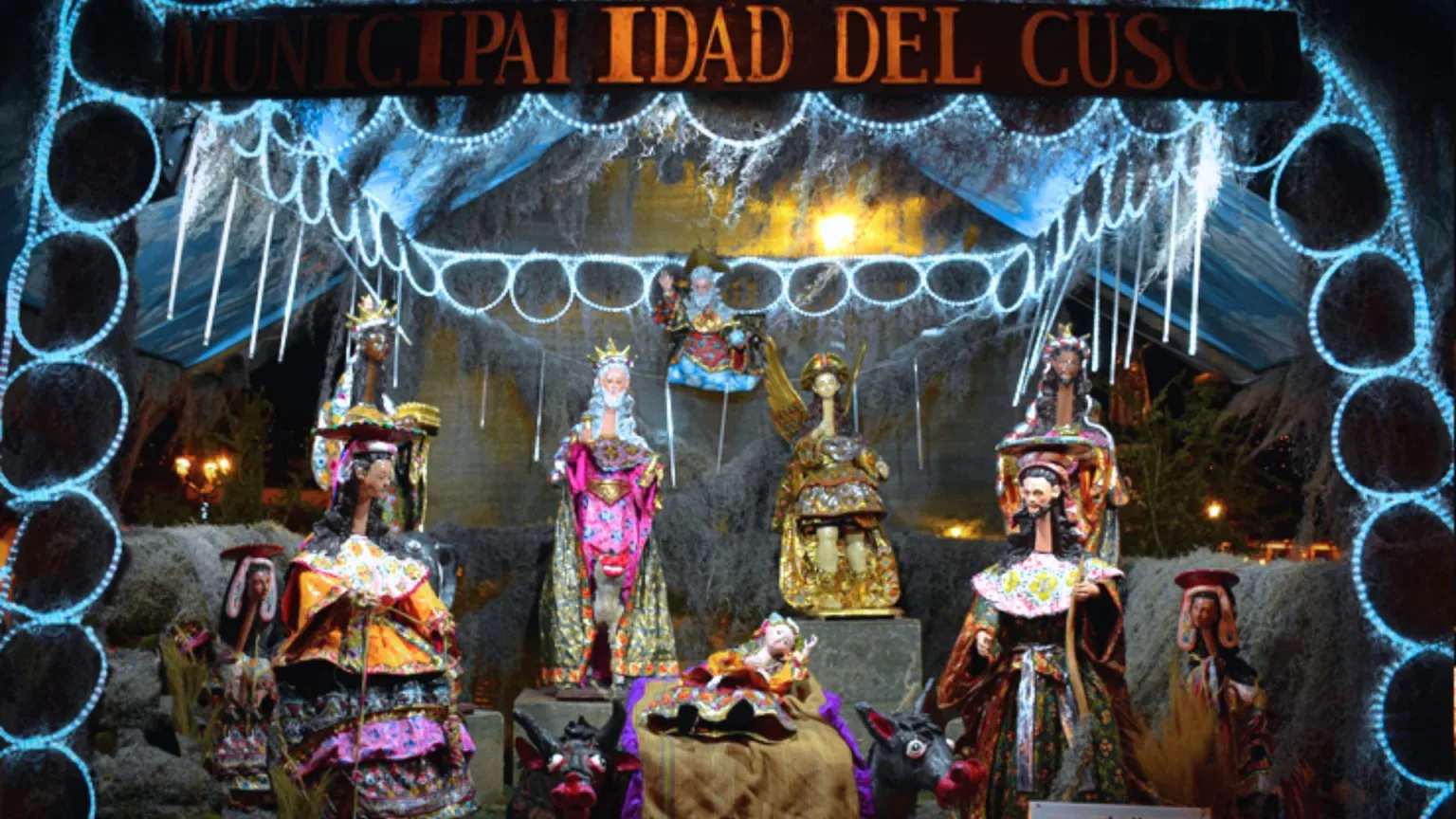
Reconstruction of the nativity scene in the Plaza de Armas in Cusco during the celebration of Santurantikuy Reconstruction of the nativity scene in the Plaza de Armas in Cusco during the celebration of Santurantikuy
Santurantikuy During the Colonial Period
During the 16th and 17th centuries, the Catholic Church promoted religious art as a tool for evangelization. This led to the rise of Cusco’s imagineros, artisans specialized in religious sculpture who adapted European techniques to local materials and Andean aesthetics an artistic legacy that still defines the feria de Santurantikuy today.
These works were created not only for churches and convents, but also for private homes, where the nativity scene became the spiritual center of family life. Santurantikuy emerged as the space where these images could be acquired before Christmas, shaping what we now recognize as the Santurantikuy festival in the city’s main square.
The Cusco School and Popular Art
Santurantikuy is closely connected to the Cusco School of Art, one of the most important artistic movements of colonial Peru. This style reinterpreted European models through a local perspective, incorporating vibrant colors, Andean facial features, and highland landscapes elements still visible throughout Santurantikuy en Cusco each December.
Through the fair, this artistic tradition moved beyond elite spaces and became part of everyday life, transforming popular art into an accessible and deeply meaningful expression.
Cultural Syncretism: Andean Tradition and Christianity
Over time, Santurantikuy absorbed elements of the Andean worldview. Christian figures began to appear set within mountain landscapes, accompanied by llamas, alpacas, moss, ichu grass, and stone. The birth of Jesus is symbolically relocated to the Andes, in harmony with Pachamama and the apus, the sacred mountains one of the clearest examples of why Santurantikuy Cusco feels deeply local and spiritually layered.
This cultural dialogue explains why Santurantikuy remains relevant today. Rather than imposing belief, it adapts faith to place, identity, and local ways of understanding the sacred.
Christmas in Cusco: The Andean Celebration That Transforms the Imperial City
Santurantikuy in the oral and literary tradition
Beyond its religious and artistic significance, Santurantikuy also appears in oral traditions and local literature. Stories and narratives recount the fair from the perspective of children and communities, often used in educational and cultural contexts, reinforcing Santurantikuy as more than a Santurantikuy market it is part of Cusco’s living memory.
Where Is Santurantikuy Celebrated and On What Dates?
The time and place of the Santurantikuy are part of the urban and religious history of Cusco, and this is very noticeable if you have the experience of the Santurantikuy en Cusco in its most emblematic form.
Santurantikuy in the Plaza de Armas of Cusco
The Plaza de Armas in Cusco was not selected randomly either. Before the arrival of the Spanish, this spot was the religious center of the Inca civilization, and later on, it became the administrative and religious center of the city during the colony period. The feria Santurantikuy in Santurantikuy is therefore closely linked with Plaza de Armas in Cusco itself.
The plaza is also transformed into a large outdoor gallery of folk art, bounded by Cusco Cathedral and Church of the Society of Jesus during that time.
Santurantikuy Dates: December 22, 23, and 24
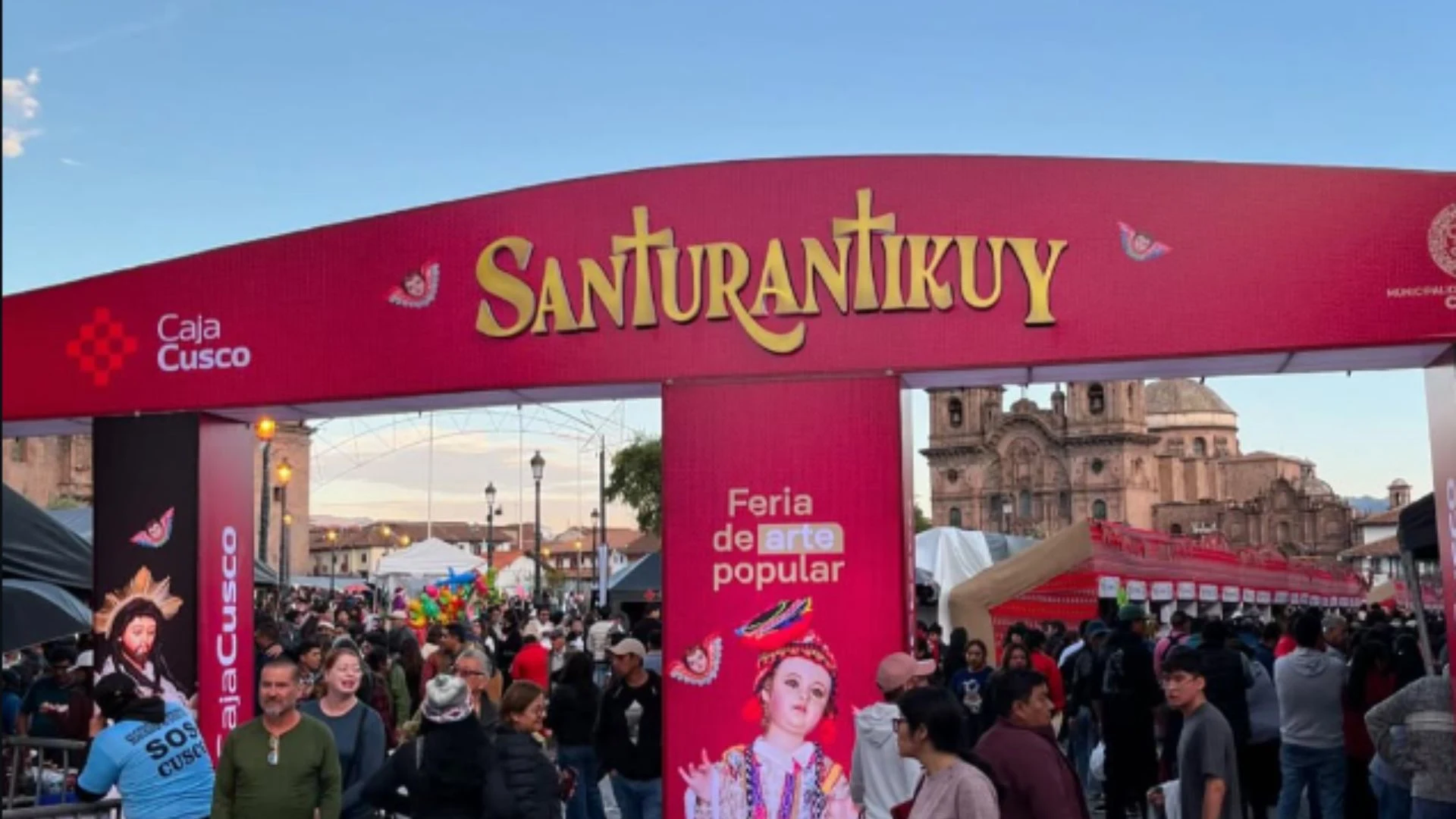
Santurantikuy happens on the 22nd, 23rd, and 24th of December (Christmas Eve), with the most charged atmosphere on the 24th. In addition, this time frame provides a more relaxed atmosphere where you can take your time to appreciate the handmade artistry of the artisans, talk to them about how they made the things they created, and select your items mindfully if you want to visit the Santurantikuy market without the crowds.
December 24 has a more ritualistic atmosphere. For many families, visiting Santurantikuy on this day is part of their final preparation for Christmas Eve a collective act that closes the pre-Christmas cycle and opens the family celebration.
Santurantikuy and the Plaza de Armas in Cusco: location and urban significance
The connection between Santurantikuy and the Plaza de Armas, the city centre or heart, of Cusco is very strong, and this shows again through the fact that the Santurantikuy is located here in the cultural epicentre of Cusco, and thus demonstrates how Santurantikuy originated and is still experienced, and it also shows how the plaza is used to demonstrate the importance of the connection between history and the world today, and also shows how deeply rooted Santurantikuy is in the cultural identity of Cusco.
Santurantikuy as a Traditional Craft Fair
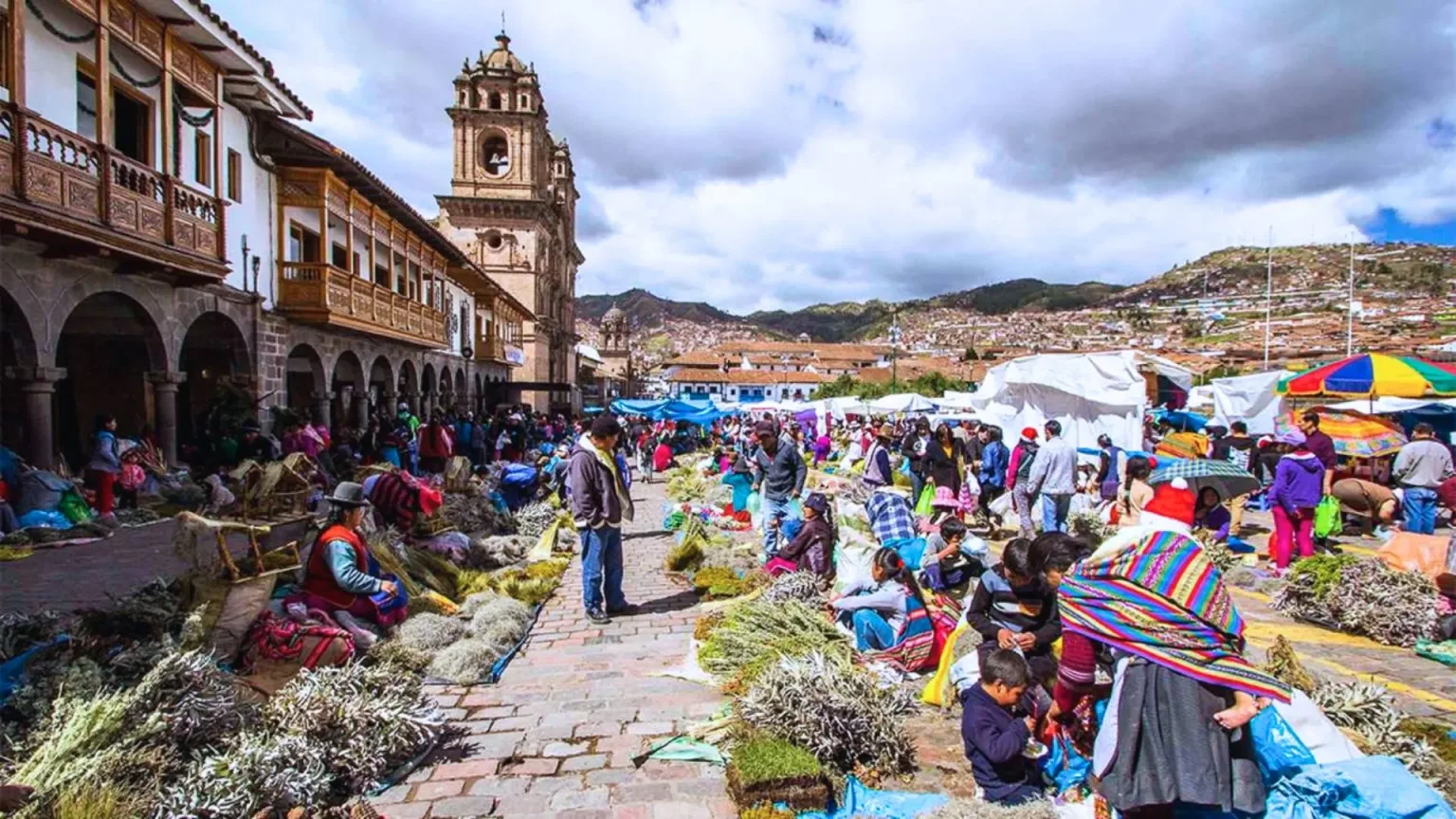
Santurantikuy is indeed a specialized fair where each vendor is part of a larger story implied by the nativity scene, and this EssaysAlso genuine reason is exactly why so many people who visit it consider it a meaningful Santurantikuy Market rather than your average holiday fair.
Santurantikuy Handicrafts are Folk Art, Faith and Andean Tradition.
Every item that is sold in Santurantikuy was carefully handcrafted by skilled artisans who have preserved techniques handed down from generation to generation.
All these pieces represent an element of cultural memory, cultural identity, as well as an affiliation with the Weihnachten of the Andean culture.
The Child Manuelito: the heart of Santurantikuy
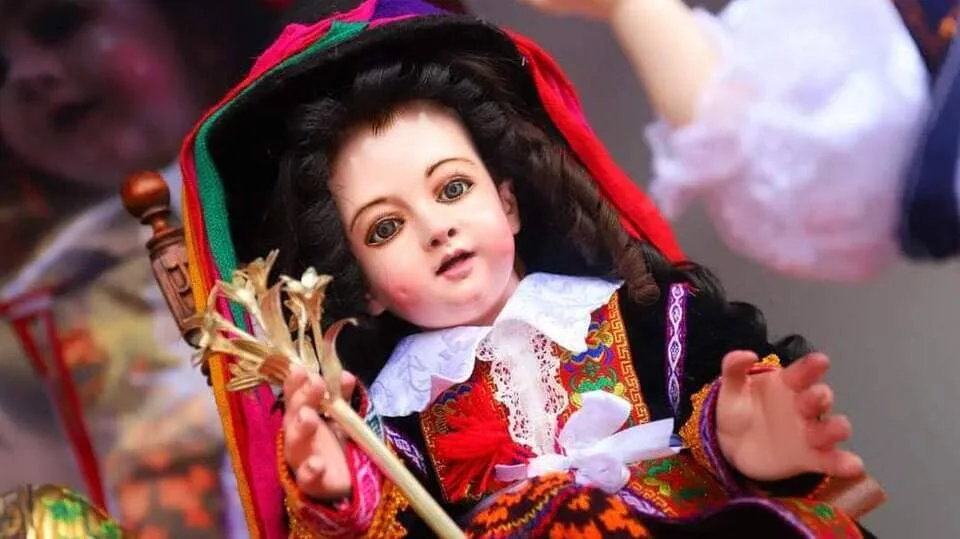
The center of this celebration is the Niño Manuelito, also known as the ‘Inca Child’ He is named as a combination of Emmanuel, which means ‘God with us,’ and symbolically represents Jesus Christ but with an Andean twist.
Finding the Niño Manuelito is the most important thing that can happen at the event to many families. They are usually handed down from generation to generation, reinforcing the link that exists among faith, memory, and tradition.
El Niño Manuelito is portrayed many times as a small shepherd from the Andean tribes or with a thorn in his foot symbolizing the hardships he would face in the future as Christ. Perhaps the most important element in the statue is the child’s locks made from the first cut of a child in the community in which the statue was created.
Niño Manuelito’s clothes are equally important, which are also inspired by traditional dances and regional clothing from Cusco, providing a festive, intimate, and thoroughly folkloric feel to the image.
On Christmas Eve and during the celebration of Epiphany, or Bajada de Reyes, on January 6, families often take Niño Manuelito to the church to receive a blessing, a reminder of his importance as the spiritual focus of the Nativity scene.
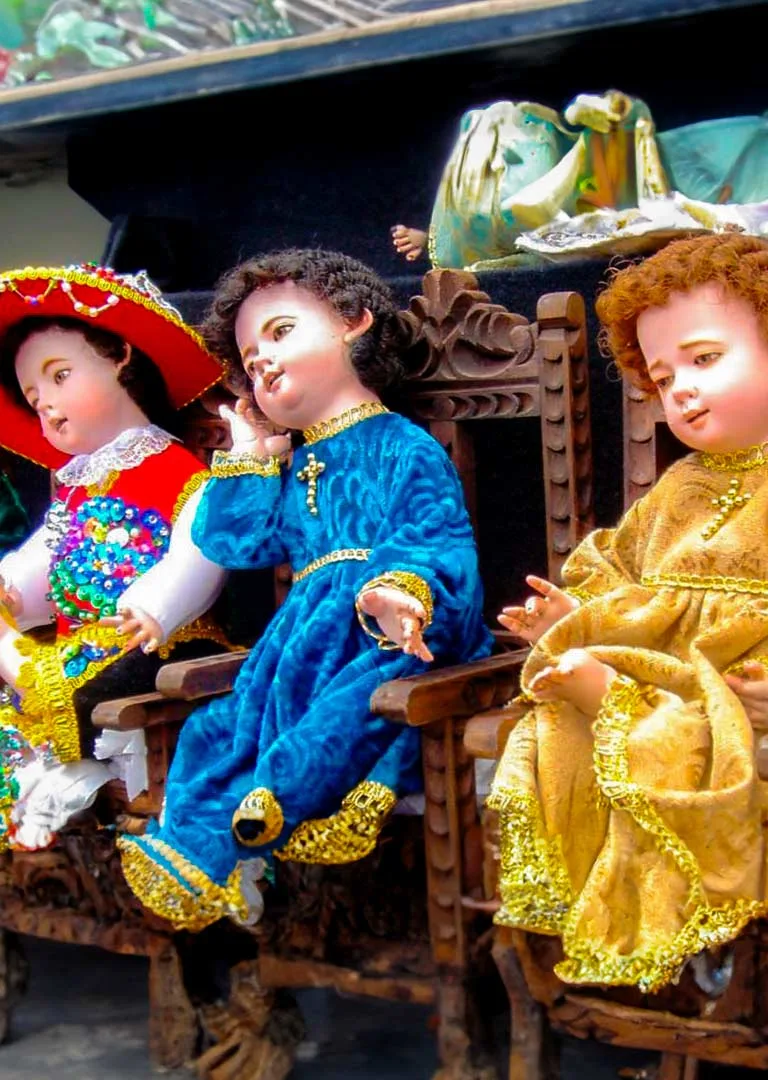
During Santurantikuy, it is also common to purchase the garments worn by the Niño Manuelito ( Little Manuel), which are notable for their symbolic and aesthetic richness. Many of these outfits are inspired by typical regional costumes and traditional dances from Cusco, such as the Contradanza, Ccapac Chuncho, Doctorcitos, Qorilazo, Saqras, Danzaq, or Terala, giving the image a relatable, festive, and deeply folkloric character.
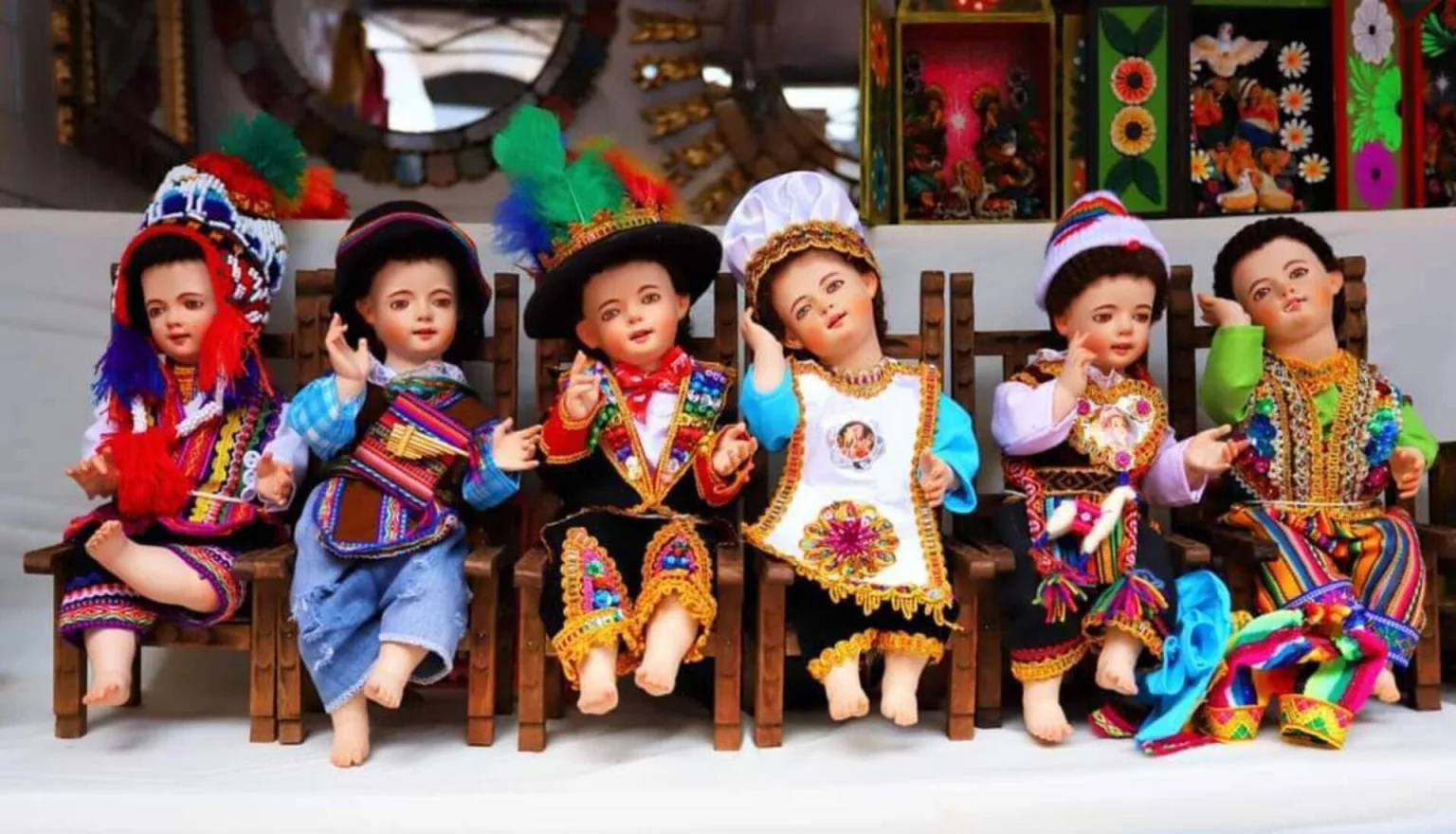
On Christmas Eve and during Epiphany, on January 6th, many families carry the image of the Christ Child to Masses celebrated in various churches throughout the city to receive a blessing. This gesture reaffirms its role as the spiritual center of the Nativity scene in Cusco and as one of the most representative symbols of the Santurantikuy festival.
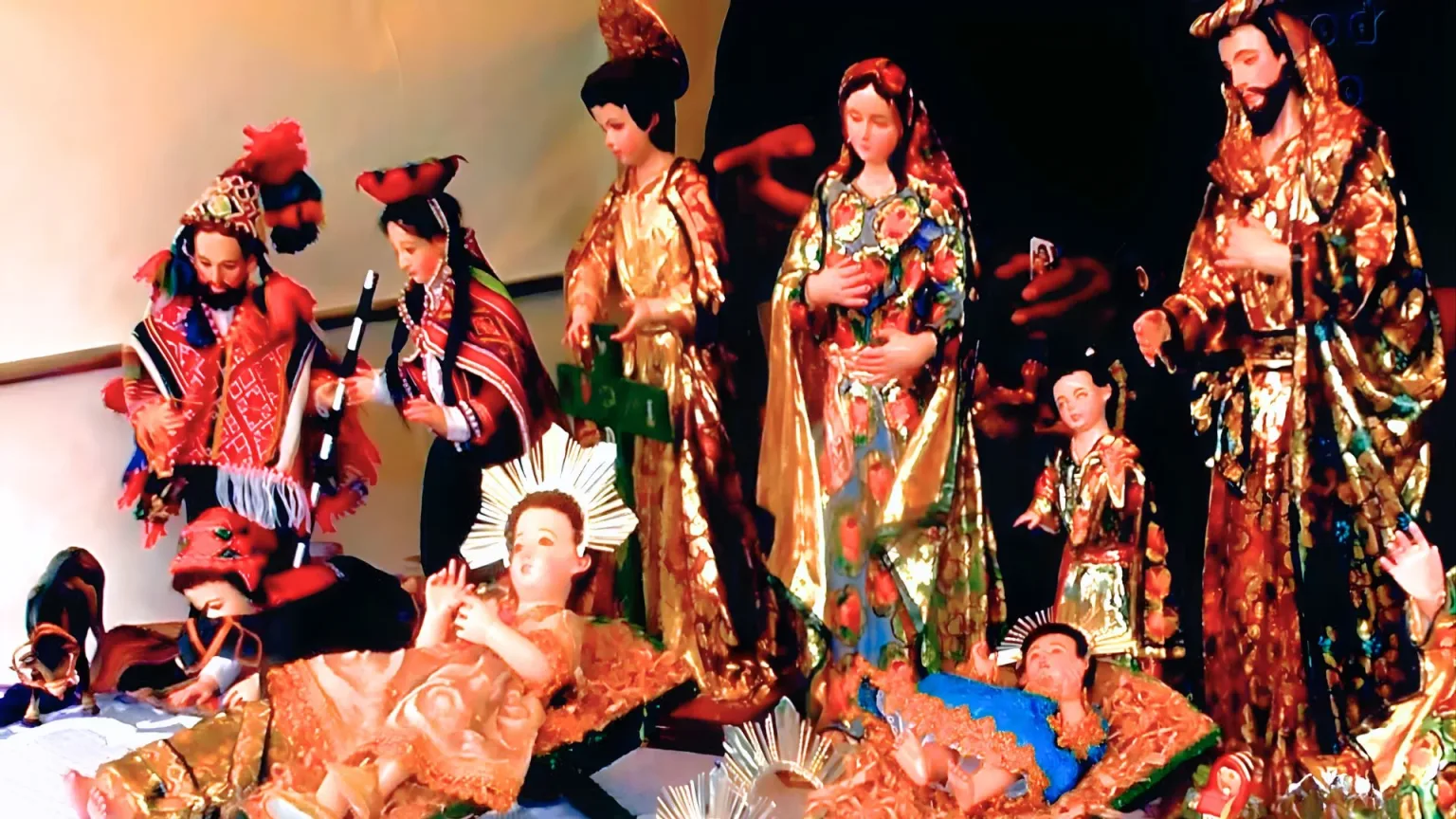
Religious figures and Andean characters
In addition to the Niño Manuelito, the fair offers:
- Saints and virgins venerated in Cusco
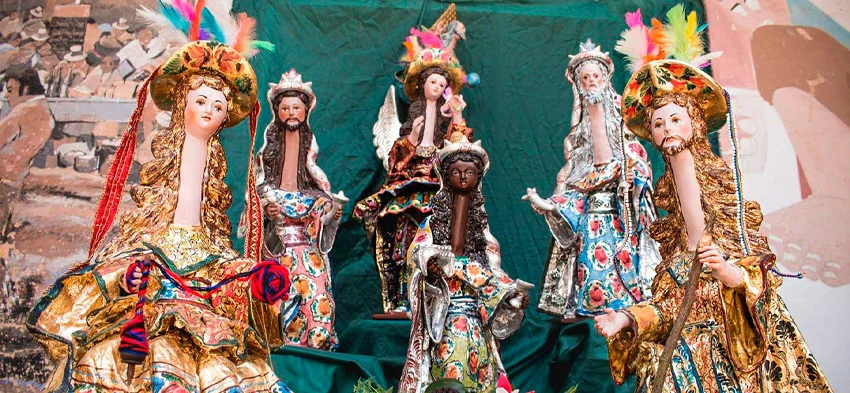
- Three Wise Men and shepherds in Andean attire
- Hand-carved angels and archangels
These figures show how Christianity was reinterpreted and adapted to the cultural context of the Andes, giving rise to unique expressions of religious art.
Andean animals and natural elements of the nativity scene
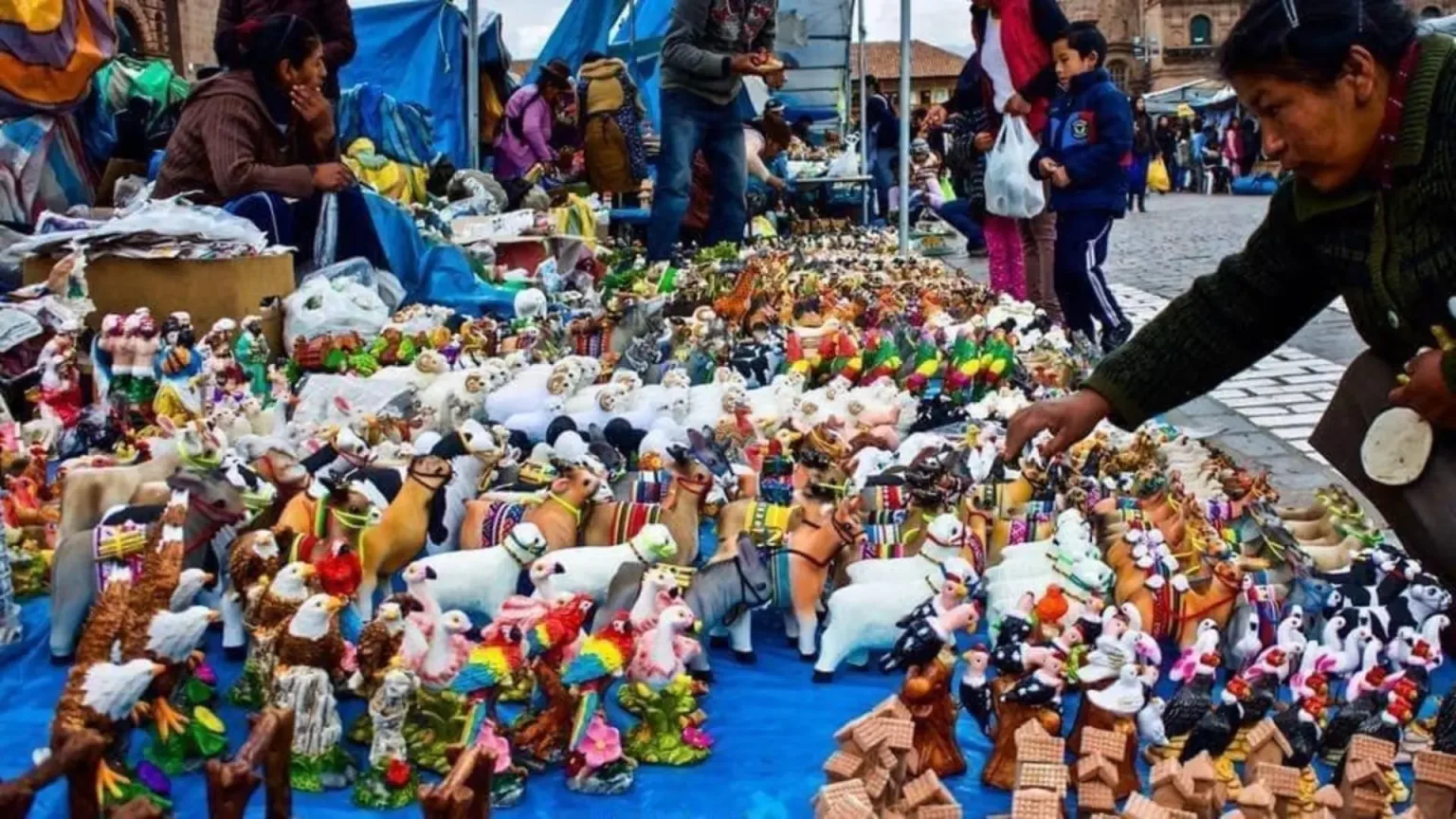
The Cusco nativity scene is distinguished by incorporating the Andean environment:
- Llamas and alpacas replace European animals
- Condors symbolize the connection with the apus.
- Moss, ichu grass, broom, and stones recreate the mountain geography
In this way, the birth is symbolically transferred to the Andes, reinforcing the link between faith and territory.
The role of artisans in Santurantikuy
The artisans of Santurantikuy are not occasional vendors. Many belong to families that have participated in the fair for generations, passing down carving, modeling, and polychromy techniques through generations.
Each piece is unique and can take weeks or even months to create. Buying from Santurantikuy means acquiring a work of folk art imbued with history, knowledge, and cultural memory.
What does Santurantikuy represent for Cusco and its cultural identity?
Santurantikuy expresses one of the fundamental bases that caracterize the cultural identity of Cusco and an example of living heritage.
Santurantikuy as cultural and artistic heritage
The Santurantikuy represents living cultural patrimony, which guarantees the continuation of the folk art of Cusco. It reflects techniques, knowledge, and styles that each piece has passed on from generation to generation.
The fair as a family gathering and living tradition
Santurantikuy is a family ritual. Children take an active part in it, as well as young people and adults, which strengthens collective memory and provides for tradition continuity.
Declaration of Santurantikuy as Cultural Heritage of the Nation
On September 22, 2009, the traditional Santurantikuy festival was declared a Cultural Heritage of the Nation of Peru for its great historical, religious, and cultural value. In fact, it has become one of the most representative manifestations of the cultural patrimony that Catholicism left in the region Andina of Peru, reinterpreted by the vision of the world and popular art of Cusco.
Santurantikuy is officially considered more than just a craft fair; it is a living cultural manifestation in which faith, tradition, identity, and the collective memory all come together, having been preserved across generations by artisans and families originating from Cusco.
How to visit Santurantikuy
For many families in Cusco, visiting Santurantikuy is part of their spiritual preparation for Christmas . Choosing a religious figure, renewing the nativity scene, or simply strolling through the fair becomes an act of reflection and contemplation.
The fair invites contemplation and dialogue, maintaining a different rhythm than modern commercial celebrations, where symbolic value surpasses material value.
December 22nd and 23rd are ideal for strolling through the fair at a leisurely pace and appreciating the details of the crafts. December 24th offers a more intense and emotional experience, although it will be more crowded.
Recommendations for visiting Santurantikuy
| Aspect | Recommendation |
|---|---|
| Footwear | Wear comfortable shoes or sneakers. Visiting Santurantikuy involves a lot of walking, stopping at many stalls, and moving through the crowds for several hours. |
| Weather and rain | December is the rainy season in Cusco. Bring a waterproof jacket or light poncho. Umbrellas are not recommended due to the crowds and limited space. |
| How to buy | Browse the fair before you buy. Comparing pieces and prices will allow you to choose calmly and better appreciate the craftsmanship. |
| Money | Bring cash in soles. Most artisans don’t accept cards or dollars, and leaving the plaza to find an ATM could cause you to miss out on a unique piece. |
| Group visit | If you’re going with someone, agree on a meeting point and time. It’s very easy to get separated in a crowd without realizing it. |
| Personal safety | Keep your belongings in sight, wear your backpack in front of you, and keep an eye on your phone and wallet. The atmosphere is festive, but it’s always best to be vigilant. |
Santurantikuy and Christmas in Cusco
The official start to Christmas in Cusco is symbolized by Santurantikuy. Many families visit the Market Fair and return home to prepare for Christmas Eve by displaying their Nativity Scenes.
Santurantikuy: a tradition that keeps the Andean soul alive
Santurantikuy takes place every December 22, 23, and 24 in the Plaza de Armas of Cusco City. Although Santurantikuy Day is celebrated at a Christmas Fair, the true meaning of Santurantikuy is much deeper. The deep sense of self, faith, community, and memory are the key components that allow the cultural heritage of Cusco to continue through art and tradition.
Before Christmas Eve, the Plaza de Armas starts filling up from early morning hours as families come to Santurantikuy, arriving full of passion, determined to buy that piece that is missing to put up their Christmas nativity. Some need an animal, others a shepherd, and most, however, come searching for that one most special piece that is known as “Niño Manuelito.”
This depiction of the Christ Child is one that is imbued with a deep meaning that is taken from the culture that is embedded up in the highlands, and it represents a figure that is deeply revered, as it is representative of a period that is deeply imbued in their culture, a time when their culture had reached a point where it had a direct influence on the world around it as a whole.
The depiction of most of these figures is that of a child who is a shepherd, even to the point that they come with a thorn inserted into their foot, while their hair is woven out of the first shaving of a boy or a girl that was accomplished back where they came from.
As the night of the 24th of December settles in, the celebration proceeds into the very traditional “Midnight Mass” held in the Cusco Cathedral. This is a very emotional experience, as Christmas songs are sung in the native language of the region, the Quechua language, and a number of the devotees hold statues of the Christ Child (Niño Manuelito) bought from the Christmas fair, to receive the blessings of the priest. Outside the cathedral, it is not surprising to find people gathered together to enjoy cups of hot punch, a drink made from milk and cinnamon, the perfect beverage for a cold December night.
Frequently asked questions about Santurantikuy in Cusco: Tradition, History, and Andean Christmas
Santurantikuy means “sale of saints” in Quechua, the original language of the Inca empire, and that is precisely the main activity that takes place in this traditional market.
Although December 24th remains the central and most symbolic day, today Santurantikuy is celebrated over three days: December 22nd, 23rd and 24th.
The oldest written account of Santurantikuy dates from 1834, by Father José M. Blanco, who describes how families from Cusco would gather near the atrium of the Cusco Cathedral to buy figures made by artisans so they could set up their own nativity scenes at home.
Santurantikuy is a traditional Christmas fair held in Cusco, Peru, on December 24th, where local artisans sell religious figures and elements to decorate nativity scenes, merging Andean culture with Catholicism, and was declared a Cultural Heritage of the Nation in 2009.
Santurantikuy is open from 6:00 a.m. to 8:00 p.m. If you’re looking for peace and quiet during your visit, we suggest going in the morning, as there are fewer visitors.
Absolutely, because of its festive, safe, and colorful atmosphere. If you plan to attend with children, we recommend arriving early to avoid peak hours and explore all the stalls at your leisure.