


Yurac Rumi: The Last Inca Sacred Site
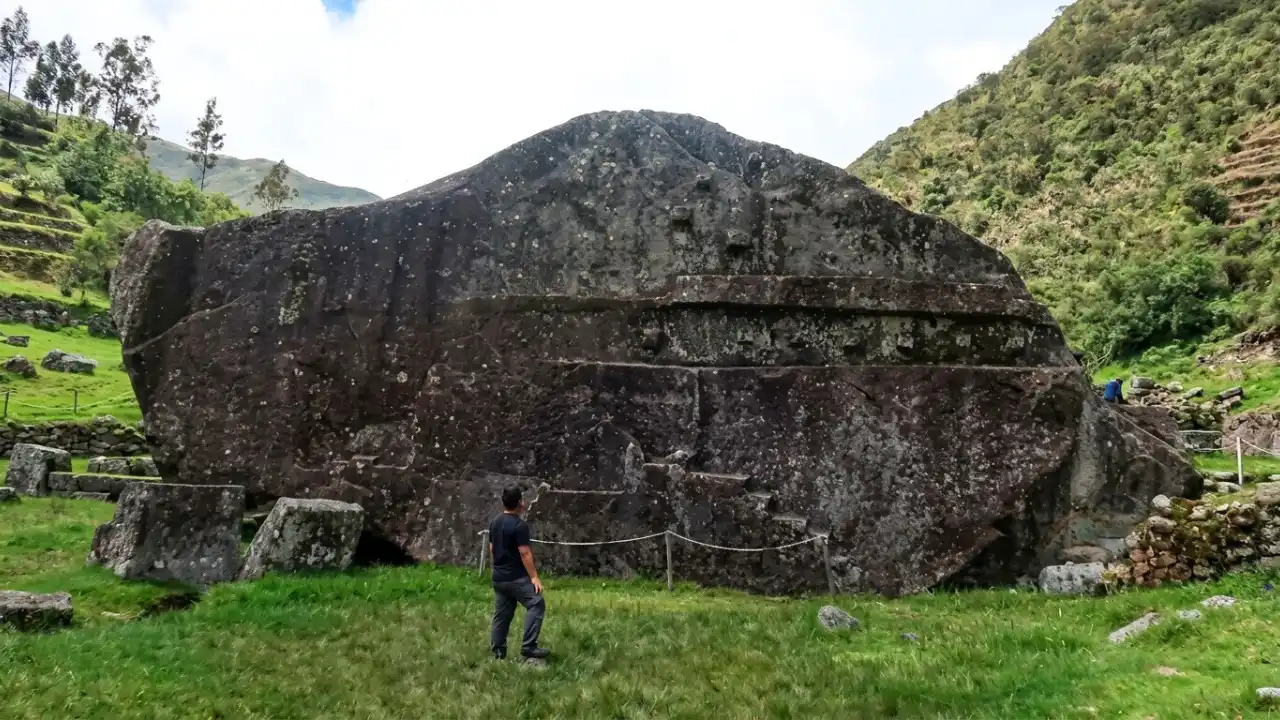
Yuraq Rumi is an archaeological site located in Vilcambamba, Cusco. This huaca, or sacred sanctuary, was primarily a ceremonial site, finely crafted from a large block of white granite. This rock was used to perform rituals related to the worship of the sun, Pachamama, and other deities.
It is part of a larger archaeological complex called Ñusta Hispana (formerly Chuquipalta), which is typically linked to the Vitcos-Rosaspata fortress, one of the key strongholds of the Inca resistance prior to the final conquest of the Tahuantinsuyo in 1572.
This sacred site was part of a center of resistance for the Inca Empire during its final phase. Yurac Rumi (Ñusta Hispana) and Vitcos represent the last bastion of the Inca nobility.
What was Yurac Rumi?
Yurac Rumi was the main sanctuary, or huaca, of the last Inca state in Vilcabamba (1536–1572). This huaca is carved from a massive block of granite: 8.3 m long, 6.6 m wide, and 7 m high.
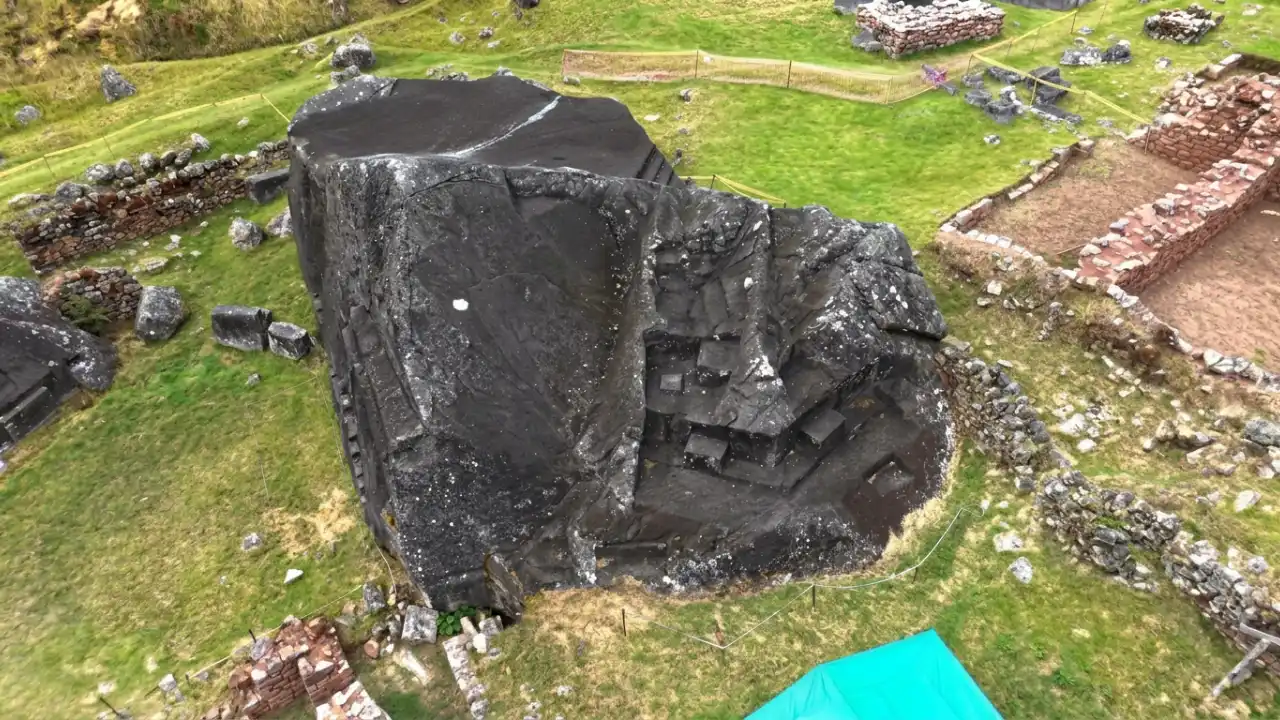
It features high and low relief carvings depicting Inca religious symbols. This large rock has flat surfaces at the top, such as steps oriented toward the cardinal directions.
A spring flows from beneath the rock and is channeled into a fountain, a typical feature of huacas associated with water.
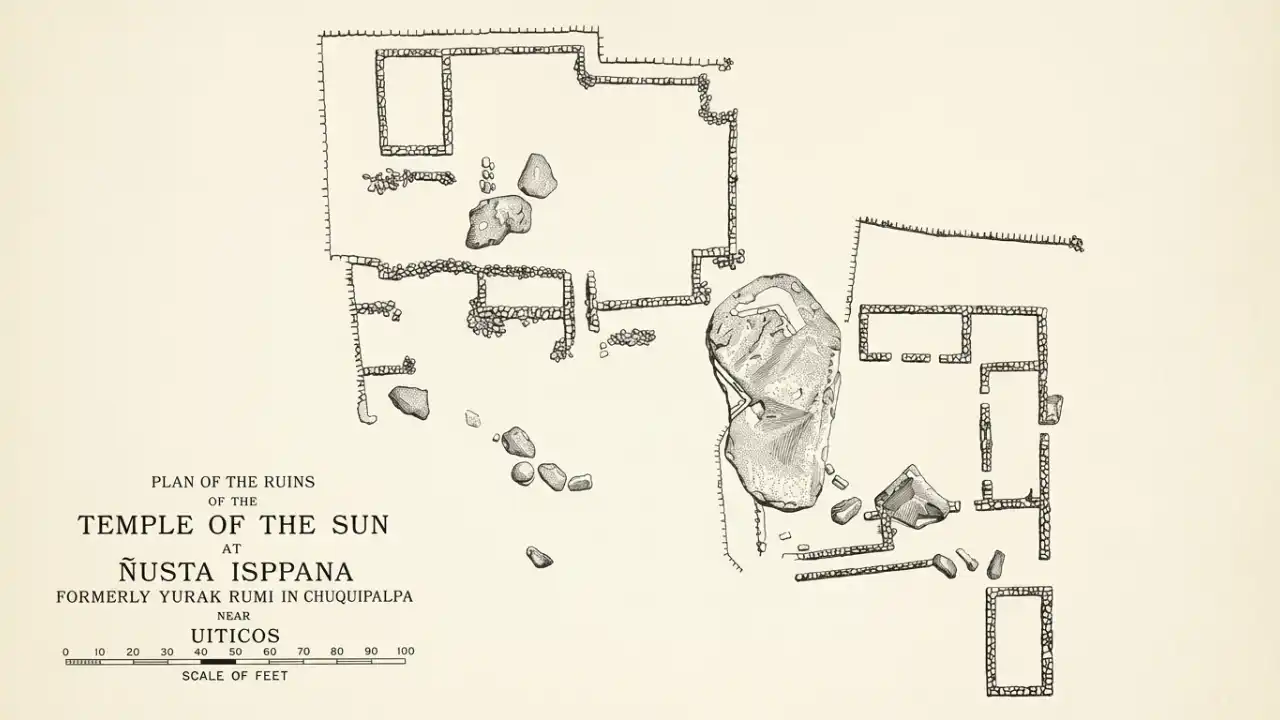
Surrounding this sanctuary are walls of fine masonry with double-jambed openings (characteristic of elite architecture), platforms, enclosures, and terraces that organize the ceremonial space. In addition, there is an archaeological complex covering approximately 12 hectares, which includes streets, groups of terraces, qolqas (storage buildings), and other structures. All these structures, together with the sacred rock, are collectively known as “Ñusta Hispana.”
At this sanctuary, the Incas performed rituals to the Sun God and Pachamama, as well as ceremonies to ask for protection, success in war, and to assert Inca power in the region.
Around 1570, Augustinian friars attempted to burn down the Temple of the Sun and the Yurac Rumi rock itself in an act of religious coercion during the evangelization campaign.
The Vitcos fortress, also called Rosaspata, located a few kilometers away, was the residence of the last Incas (Manco Inca, Sayri Túpac, Titu Cusi Yupanqui, Túpac Amaru I) before the final fall of the Inca Empire.
Yurac Rumi Meaning
Yurac Rumi (or Yuraq Rumi) means “white stone” in the Quechua language (yuraq = white, rumi = stone).
The entire archaeological site is also known as:
Ñusta Hispana, which could be interpreted as “Spanish princess” or “princess’s bath,” although the original pre-Hispanic name is Chuquipalta (or Chuqepalta), which means something like “platform/plain of precious metal.”

Location and Access
Yurac Rumi (or Ñusta Hispana) is located in the district of Vilcabamba, province of La Convención, Cusco region, within the Vilcabamba-Choquequirao National Archaeological Park.
Exact Location
District: Vilcabamba, province of La Convención, Cusco.
Nearby: east of the town of Huancacalle.
Elevation: approximately 3,150 m above sea level.
Typical route from Cusco: From Cusco to Challhuay (179 km), then to Huancacalle (another 50 km); followed by a 3.5 km walk to the ceremonial site.
History of Yurac Rumi
Yurac Rumi was a huaca, or place of worship, that was part of the archaeological site known as Ñusta Hispana. During the period of Inca resistance (1536–1572), many of the Incas’ most important rituals were held at this very sanctuary, which is identified in the chronicles as Chuquipalta or Chuquepalta.
This sacred site served as a high-level ceremonial and religious center, linked to the worship of the sun and water, and was connected to the Vitcos or Rosaspata complex, one of the key settlements of the late Incas.
Origins of Yurac Rumi
Yurac Rumi is identified as a huaca (wak’a) or carved-rock sanctuary, with an adjacent ceremonial complex (walls, terraces, water sources).
The architecture (fine masonry, double-jambed openings, platforms oriented toward the cardinal points, hydraulic system) is typical of the elite sanctuaries of the Tahuantinsuyo.
Some theories suggest that Yurac Rumi was reorganized and expanded by Manco Inca through the construction of the Temple of the Sun, terraces, and elite walls to serve as the religious center of the new state in Vilcabamba.
Others argue that the sanctuary may have been built at the height of the Inca Empire (15th century) as part of the state’s expansion toward Vilcabamba, and that Manco Inca and his successors would have repurposed and enhanced it as a state sanctuary.
The Yurac Rumi Ruins
Yurac Rumi, also known as Ñusta Hispana, was considered the main place of worship in Vilcabamba. This site includes the “Temple of the Sun” (of which only the foundations remain today) and the large carved rock known as Yurac Rumi, described as the main “mochadero” (place of worship and offering) for the indigenous people of Vilcabamba.
The relationship between Yurac Rumi and Victos is of paramount importance for this phase of Inca resistance.
Yurac Rumi represents symbolic and religious power; it was here that ceremonies legitimizing Inca rule were held, offerings were made to the Sun and the huacas, and the cycles of the ritual calendar were marked.
Vitcos represents political and residential power; it was the residence of the Inca and his court, as well as a center of administration and defense.
The Burning of Yurac Rumi
According to historical accounts, two Augustinian friars, Marcos García and Diego de Ortiz, who were stationed at the Puquiura chapel, organized an attack on the sanctuary under the pretext of “driving out the devil.”
Together with some indigenous people who had converted to Catholicism, they arrived at the site and set fire to the shrine, severely damaging the temple’s structure and leaving marks of fire and destruction on the rock and its surroundings.
This desecration caused a major scandal among the Inca elite and the people of Vilcabamba; the captains and leaders demanded that the Inca governor, Titu Cusi Yupanqui, expel Friar Marcos García, who was considered the instigator.
This marked a turning point that would culminate in the Spanish campaign of 1572 and the capture and execution of Túpac Amaru I, bringing an end to the final period of the Inca Empire.
Rediscovery and the Name “Ñusta Hispana”
The turning point in the modern rediscovery occurred in 1911, during Hiram Bingham’s expeditions to Vilcabamba—the same year he brought Machu Picchu to the world’s attention.
The site was documented by 20th-century travelers and scholars. Over time, it also became known as Ñusta Hispana (“Spanish princess”).
Hiram Bingham’s studies made it possible to place Yurac Rumi on the map of key sites of Inca resistance, alongside Vitcos, Espíritu Pampa, and Choquequirao.
From the 2000s to the 2010s, modern archaeological research led by archaeologists Brian S. Bauer and Miriam Aráoz Silva confirmed that the site was an elite ceremonial center during the Inca resistance.
As a result, artifacts (pottery, stone tools, and metals) were recovered, allowing researchers to refine the site’s chronology and status.

Enhancement of the Sanctuary
The site was officially incorporated into the Vilcabamba-Choquequirao National Archaeological Park, under the administration of the Ministry of Culture.
Starting in 2023, archaeological research and restoration projects were launched at the Yuraq Rumi Ñusta Hispana Archaeological Zone, resulting in the discovery of dozens of pre-Hispanic metal artifacts on the terraces.
This has brought greater visibility to the site, which is now included in trekking tours and cultural itineraries.
The Ñusta Hispana Sanctuary
The Ñusta Hispana Sanctuary (also known as Chuquipalta) is a ceremonial architectural complex centered around a large carved rock called Yurac Rumi.
The archaeological site covers an area of approximately 12 hectares and features stone structures, including streets, terraces, and qolqas (storage rooms).
Central Feature: The Yurac Rumi Rock
It is a white granite monolith approximately 8.3 m long, 6.6 m wide, and 7 m high. It features high- and low-relief carvings depicting Inca religious iconography (possibly related to the Sun, water, and the elite).
Structures Near Yurac Rumi
Surrounding Yurac Rumi are stone structures that form part of the archaeological complex.
The site features stone walls with fine masonry; platforms and structures whose layout creates a ceremonial “atrium”; and stone elements (carved blocks, possibly bases or altars) that likely served ritual and astronomical purposes complementary to the sun cult.
Hydraulic System
The spring beneath the rock is channeled through canals and directed toward fountains, creating a watercourse that reinforces the sacred nature of the site.
Terraces and the Productive-Ceremonial Sector
Dozens of terraces have been discovered near Yurac Rumi; 21 Inca terraces are currently being restored as part of the archaeological site.
The terraces serve productive functions, help stabilize slopes, and contribute to the ritual organization of the territory.
Ceremonial Function of Yurac Rumi
The platforms or steps at the summit of the Yurac Rumi rock are oriented toward the cardinal directions and form part of a ritual design typical of high-ranking Inca huacas.
Orientation, elevation, and contact with sacred elements were central aspects of ritual ceremonies in the Inca Empire.
Ritual Function of the Platforms
The rock features small platforms at its summit that served as altars or bases where offerings such as chicha, corn, coca leaves, animals, etc., were placed.
The platforms’ orientation toward the four cardinal directions served to perform rituals that invoked the deities associated with each direction.
Likewise, their elevated position and orientation suggest that they were also used to observe sunrises and sunsets, as well as events such as solstices and equinoxes.
Why at the Top of the Rock?
Ritual ceremonies were held at the top of the rock, as this reinforced the idea of being in contact with the divine. Beneath the rock flows a spring that channels water into a fountain, conveying the idea of a place of purification and fertility.
Ritual Ceremonies
Yurac Rumi is described in the chronicles as the main “mochadero” (place of worship and offering) of the Vilcabamba Indians.
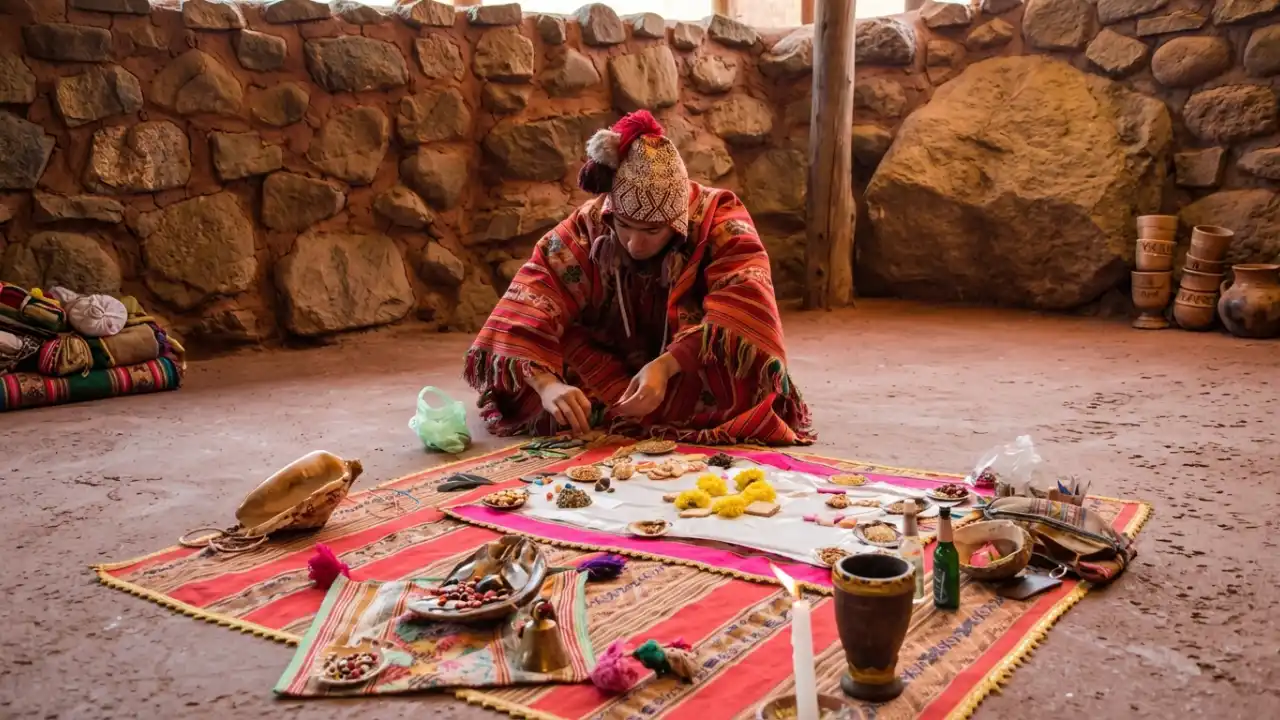
On top of and around the rock, material offerings were made, such as chicha, corn, coca leaves, llama fat, and possibly small animals (guinea pigs, birds).
On special occasions, the offerings were more elaborate and included metal objects (cups, ornaments).
Rituals of Petition and Thanksgiving
At Yurac Rumi, rituals were performed to petition for the fertility of the land, bountiful harvests, and sufficient water; for success in war and protection against the Spanish; and for the health and legitimacy of the Inca and his lineage.
Sun Ceremonies and the Ritual Calendar
At Yurac Rumi, solar rituals were performed, especially on key dates such as solstices and equinoxes, marking the beginning of agricultural and political cycles.
These ceremonies reinforced the idea that the Inca was the son of the Sun and maintained cosmic order. During the ceremonies, the Sun was “greeted and thanked” from different directions, integrating the sacred space with the cosmos.
Ceremonies Related to Water and Fertility
Rituals related to water were performed to pray for rain, ample river flow, and the fertility of the terraces. Purification rituals were also performed; these could be used symbolically to “wash away” sins or prepare participants before the main offerings.
Ceremonies for the Apus
The Yurac Rumi site is surrounded by Apus, or guardian mountains, such as Wiracochan, Pumasillo, Yanantin, and Izmaccoya, which form part of the local worldview.
Rituals were performed to honor the Apus, asking for protection, a bountiful hunt, lush pastures, and balance in the territory.
Today, the residents of the Vilcabamba community continue to make offerings to Pachamama, demonstrating the continuity of these ritual practices at this ancient sacred site.
Current state of Yurac Rumi
The Yurac Rumi (Ñusta Hispana) sanctuary is currently undergoing restoration and enhancement as part of the Vilcabamba-Choquequirao National Archaeological Park.
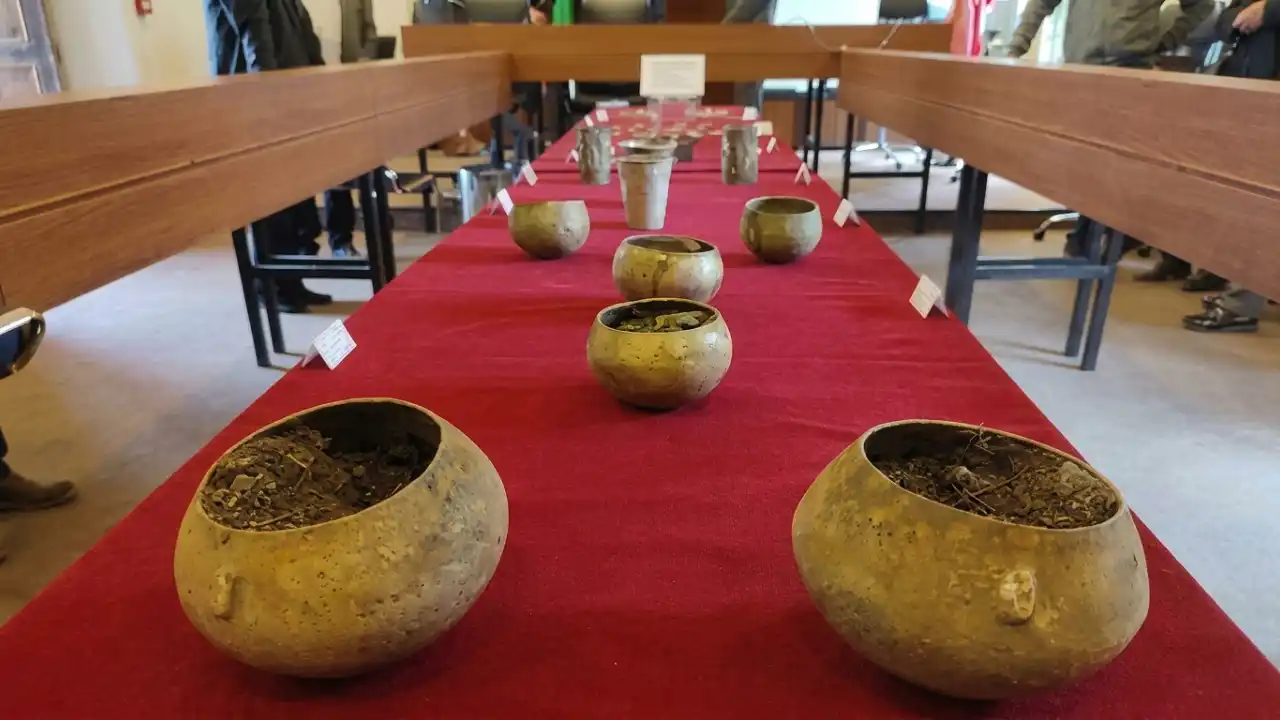
In 2023, during excavation and restoration work on the terraces at Yurac Rumi, 38 pre-Hispanic metal artifacts were discovered that belonged to a high-ranking individual (possibly a local leader or a member of the Inca elite).
The collection includes:
4 ceremonial vessels (possibly keros), some containing objects inside.
1 metal bracelet and 4 anklets.
2 knives (probably tumis or ritual cutting instruments).
18 pectoral beads and 1 folded pectoral.
1 headband and 1 headdress.
6 associated ceramic vessels.
Later, upon opening one of the ceremonial vessels, 3 additional metal bracelets were found inside, bringing the total inventory to 41 pre-Hispanic artifacts.
Yurac Rumi and the Apus
The apus located around Yurac Rumi—Wiracochan, Pumasillo, Yanantin, and Izmaccoya—served as protective mountains for this sanctuary.
According to historians, Yurac Rumi was not a huaca used on its own, but rather the ritual center of a broader sacred landscape that included small surrounding structures and the mountains encircling the site.
Rituals at Yurac Rumi included invocations to these four mountains as protectors of the valley and guarantors of water and harvests.
Specific Relationship with the Apus
Wiracochan: the Creator Apu
Wiracochan, whose name is linked to Wiracocha, was associated with the origin and order of the world.
Ceremonies honoring the Sun and the creative forces of the cosmos were also understood as acts of attunement with Wiracochan, as if the sanctuary “aligned” the power of the Inca with the higher order of the universe.
Pumasillo: the Warrior and Protector Apu
Pumasillo, with his “rock claws” and “ice claws,” is described as an Apu with a warrior’s character.
During a period of war against the Spanish, it is very likely that specific rituals were performed at Yurac Rumi to invoke Pumasillo.
Yanantin and Izmaccoya: The Complementary Apus
Yanantin and Izmaccoya represent Andean duality: two distinct forces that complement each other (masculine–feminine, active–receptive, high–low).
Ritual Ceremonies Today
The community of Vilcabamba continues to make offerings to Pachamama and the Apus, demonstrating a continuity between Inca ritual traditions and current practices.
Today, Yurac Rumi (Ñusta Hispana) remains a site of Andean ritual practice, albeit on a much smaller scale than in Inca times. Contemporary ceremonies combine elements of the pre-Hispanic Andean worldview with colonial influences and are performed primarily by the local community of Vilcabamba and by visitors interested in Andean spirituality.
The most common practice is the offering to Pachamama (Mother Earth), known in Quechua as Haywarikuy, and in a better-known version (held on August 1) as Hatun Willka Haywarikuy.
In these contemporary ceremonies, participants explicitly mention Wiracochan, Pumasillo, Yanantin, and Izmaccoya as the protectors of the valley.
Frequently asked questions about Yurac Rumi: The Last Inca Sacred Site
Yurac Rumi is the main huaca (sacred sanctuary) of the last Inca state in Vilcabamba (1536–1572), carved from a massive block of white granite. It was the ceremonial center where Inca power was legitimized and where the Sun and Pachamama were worshipped.
In Quechua, it means “white stone” (yuraq: white, rumi: stone). The entire site is also known as Ñusta Hispana (“Spanish princess”), although its original pre-Hispanic name was Chuquipalta.
The typical route is from Cusco to Challhuay (179 km), then on to Huancacalle (an additional 50 km), followed by a 3.5-km hike to the ceremonial site, located at an elevation of about 3,150 m above sea level in the district of Vilcabamba.
Both sites formed the last stronghold of the Inca nobility: Vitcos was the political and residential center of the last Incas, while Yurac Rumi was the religious and ceremonial center where their rule was legitimized.
Vitcos-Rosaspata is a fortress located a few kilometers from Yurac Rumi, in the district of Vilcabamba, province of La Convención, Cusco region, within the Vilcabamba-Choquequirao National Archaeological Park. It was the residence of the last Inca emperors and served as the political and defensive center of the Inca Empire.


